WHIPS - Child seat. WHIPS - Seating position. When the system has been triggered. General information about the safety mode
The WHIPS section for the Volvo S80 (2nd generation, 2013–2016) emphasizes correct seating posture and what to do after activation. It provides practical guidance on how the system can provide its protective effect and when an inspection is required.
WHIPS - Child seat
The WHIPS system has no negative effect on the protective properties of the child seat or the seat cushion.
A child seat/booster cushion may be installed on the front seat if the vehicle is not equipped with an active front passenger airbag.
Related information
- General information about child safety
WHIPS - Seating position
For the best possible protection from WHIPS, the driver and passengers must adopt the correct seating position and ensure that the function of the system is not obstructed.
Seating position
Adjust the front seat to the correct position before driving.
The driver and front passenger should sit in the middle of the seat, with the smallest possible distance between the head restraint and the head.
Function
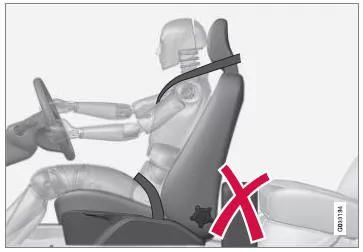
Do not place objects on the floor behind the driver or front passenger seat that could obstruct the function of the WHIPS system.
Do not arrange box-shaped cargo so that it is trapped between the rear seat cushion and the front seatback. Remember not to obstruct the function of WHIPS.
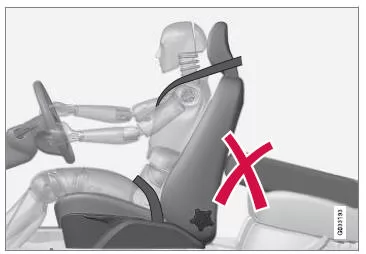
Do not place objects in the rear compartment that could obstruct the function of the WHIPS system.
WARNINGIf a rear seatback is folded down, the corresponding front seat must be moved forward so that it does not contact the folded seatback.
WARNINGIf the seat has been subjected to a significant load, for example in a rear impact, WHIPS must be inspected. We recommend having the system checked by a Volvo dealer.
Even if the seat appears undamaged, it may have partially lost the protective properties of WHIPS.
We recommend that you have the system inspected by a Volvo dealer, even after minor rear-end collisions.
When the system has been triggered
In a collision, the various Volvo occupant protection systems work together to reduce injuries.
| System | Activation |
| Front seat belt pretensioner | In a frontal and/or side and/or rear impact and/or rollover |
| Rear seat belt pretensioner | In a frontal and/or side impact and/or rollover |
| Airbags (driver and front passenger airbags) | In a frontal impact.A |
| SIPS side airbags | In a side impactA |
| System activation head/shoulder airbag IC | In a side impact and/or in certain cases in a frontal impactA |
| Whiplash protection WHIPS | In a rear impact |
A The vehicle may be severely deformed in a collision without the airbags deploying. Various factors, such as the stiffness and weight of the impacting object, vehicle speed, impact angle, etc., affect the extent to which the vehicle's various safety systems are activated.
If the airbags have been deployed, Volvo recommends the following:
- Recover the vehicle. Volvo recommends having the vehicle transported to a Volvo dealer.
Do not drive with deployed airbags.
- Volvo recommends having any replacement of components in the vehicle's safety system carried out by an authorized Volvo workshop.
- Always consult a doctor.
WARNING: Airbags and seat belt system are only activated once in a collision.
WARNINGThe airbag system control unit is located in the center console. Disconnect the battery cables if the center console has been soaked with water or another liquid. Do not attempt to start the vehicle, as the airbags could deploy.
Vehicle recovery: We recommend having the vehicle towed to an authorized Volvo workshop.
WARNINGNever drive the vehicle with deployed airbags, as this may impair steering. Other safety systems may also be damaged. The smoke and dust generated when the airbags deploy can cause skin and eye irritation or injury if they come into direct contact.
If symptoms occur, rinse with cold water. The rapid deployment, in combination with the airbag material, can also cause friction injuries and burns.
General information about safety mode
Safety mode is a safety feature that becomes active if the impact may have damaged an important vehicle function, such as the fuel lines, sensors for one of the safety systems, or the brake system.
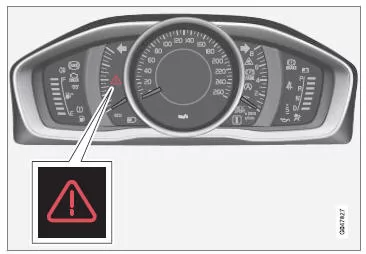
Warning triangle in the analog instrument cluster.
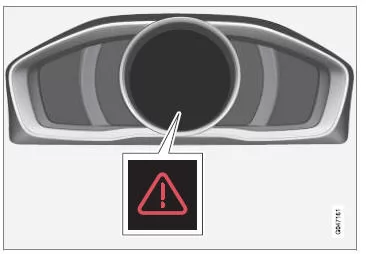
Warning triangle in the digital instrument cluster.
If the vehicle has been subjected to an impact, the message Safety mode See manual may appear in the information display of the instrument cluster.
This means that the vehicle's functions are restricted.
WARNINGNever attempt to repair the vehicle yourself or reset the electronics if the vehicle has been in safety mode. This could result in injury or cause the vehicle to malfunction.
We recommend always having an authorized Volvo workshop inspect the vehicle and reset it to normal status after Safety mode See manual has been displayed.
Related information
- Safety mode - Start attempt
- Safety mode - Moving the vehicle
The Volvo S80 (2nd generation, model years 2013–2016) combines numerous safety systems that work together perfectly in an emergency. The WHIPS system protects against whiplash in rear-end collisions, while safety mode becomes active when central vehicle functions could be at risk.
With these innovations, Volvo demonstrates how important comprehensive occupant protection is. Drivers and passengers benefit from an intelligent safety architecture that reduces the risk of serious injury in critical situations.
With the Volvo S80, you choose a vehicle that meets the highest demands for safety, comfort and reliability, on every journey and under all conditions.
Test yourself
A quick Volvo S80 quiz: every answer comes with an explanation and a link to the manual page.