General information on seat belts. Fastening the seat belt. Seat belts – pregnancy. Seat belt check
The seat belts in the Volvo S80 (2nd generation, 2013–2016) are central elements of occupant protection. This section describes correct fastening, special guidance for pregnant women, and monitoring by warning systems to ensure maximum safety in all seating positions.
General information on seat belts
Driving without the seat belt fastened can have serious consequences. Always make sure that all vehicle occupants have their seat belts fastened while the vehicle is moving.
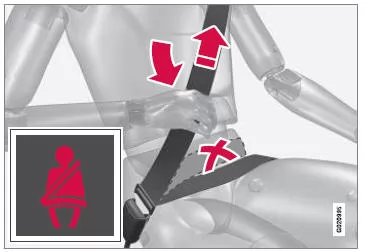
Pull the lap belt tight across the hips. To do so, pull the shoulder belt up over the shoulder.
The lap belt must sit low (i.e., it must not lie across the abdomen).
For the seat belt to provide the highest possible level of protection, it must fit snugly against the body. Do not recline the backrest too far. The seat belt is designed to provide the best protection in a normal seating position.
Occupants who have not yet fastened their seat belt are prompted to do so by an audible and visual signal.
Please note
- Do not use clips or similar devices that prevent the seat belt from fitting correctly.
- The seat belt must not be tangled or twisted.
The seat belt and the airbag work together. If the seat belt is not used, or is used incorrectly, this can reduce the effectiveness of the airbag in a collision.
WARNING Each seat belt is designed for one person only.
WARNINGNever make changes to or carry out repairs on the seat belts yourself. Volvo recommends that you contact an authorized Volvo dealer.
If a seat belt has been subjected to heavy loading, such as in an accident, the entire seat belt must be replaced. Even if the seat belt appears undamaged, it may have lost part of its protective capability. Also have the seat belt replaced if it is worn or damaged.
The new seat belt must be approved and designed for installation in the same position as the seat belt it replaces.
Related information
- Seat belts – pregnancy
- Seat belt – releasing
- Seat belt pretensioner
Seat belt – fastening
Fasten the seat belt before driving off.
Pull the belt out slowly and let it lock.
To do so, insert the latch plate into the buckle. A distinct click indicates that the belt is locked in place.
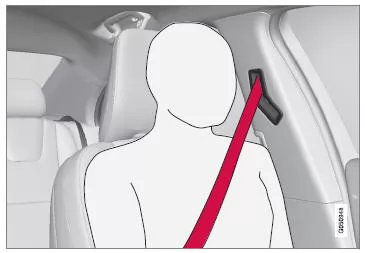
Correctly fastened seat belt.
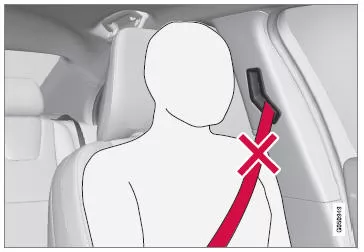
Incorrectly fastened seat belt. The belt must lie across the shoulder.
Incorrectly fastened seat belt. The belt must lie across the shoulder.
In the rear seats, the latch plate only fits the buckle provided for it.1
Please note
In the following cases, the seat belt locks and cannot be pulled out any further:
- if it is pulled out too quickly
- when braking and accelerating
- when the vehicle is at a steep angle.
Related information
- Seat belts – pregnancy
- Seat belt – releasing
- Seat belt pretensioner
- Seat belt check
1 Specific markets.
Seat belt – releasing
Release the seat belt only when the vehicle is stationary.
Press the red button on the buckle – the retractor automatically rewinds the belt.
If it does not retract fully, guide it in by hand so that it is wound up taut.
Related information
- Seat belt – fastening
- Seat belt check
Seat belts – pregnancy
The seat belt must always be worn during pregnancy.
It is extremely important that it is fastened correctly.

The shoulder belt must lie snugly against the shoulder; the diagonal section of the belt must pass between the breasts to the side of the abdomen.
The lap section of the seat belt must lie flat against the side of the thigh and sit as far below the abdomen as possible – it must not ride up.
The seat belt must sit as close to the body as possible and must not be loose. Also make sure that it is not twisted.
As pregnancy progresses, pregnant drivers must adjust the seat and steering wheel so that they always have full control of the vehicle (i.e. the steering wheel and pedals must be easy to reach). Maintain the greatest possible distance between the abdomen and the steering wheel.
Related information
- Seat belt – fastening
- Seat belt – releasing
Seat belt check
Occupants who have not yet fastened their seat belt are reminded to do so by an audible and a visual signal.

The audible signal depends on vehicle speed and, in certain cases, on time.
The visual signal is located in the overhead console and in the instrument cluster.
Child seats are not included in the seat belt reminder.
Rear seat
The rear seat belt reminder has two sub-functions:
- An information function showing which rear seat belts are in use. When a rear seat belt is used or when one of the rear doors is opened, a message appears in the instrument cluster. The message is cleared automatically after approx. 30 seconds of driving or when the OK button on the turn signal lever is pressed.
- Warning via a message in the information display, together with an audible and a visual signal, that a rear seat belt has been unbuckled while driving. The warning disappears as soon as the seat belt is fastened again, but it can also be acknowledged manually by pressing the OK button.
The message in the instrument cluster showing which seat belts are in use is always available. To view stored messages, press the OK button.
Certain markets
If the driver or front passenger has not fastened their seat belt, they are reminded to do so by an audible and a visual signal. At low speed, the audible signal sounds for the first six seconds.
The Volvo S80 (2nd gen) stands out for its holistic safety concept, in which the seat belts also play a central role. When used correctly, they are designed to provide optimum protection and, together with the airbags, can save lives.
Special attention is given to pregnant drivers and passengers: the special belt routing ensures that mother and child are protected as well as possible. Thanks to intelligent seat belt reminders, all occupants are reminded to buckle up.
This is how the Volvo S80 offers a maximum of safety and comfort, no matter who sits in which position. Rely on Volvo's experience and expertise.
Test yourself
A quick Volvo S80 quiz: every answer comes with an explanation and a link to the manual page.