Horn Check
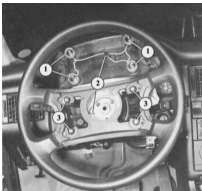
When the horn is pressed, the ground connection is provided by the contacts in the steering wheel (3) and in the horn pad (1). The path then continues through the connector (2).

The illustration shows the horns (1 and 2) with the bumper removed.
Routine Check
When the horn pad in the steering wheel is pressed with the ignition on, the standard or two-tone horn should sound. The horn button connects the horn relay circuit to ground (body) (see Instruments and Auxiliary Devices section). Power to the relay comes from terminal X, which receives voltage only when the ignition is on.
When the circuit is closed (that is, when the horn is pressed), the relay contacts close and power is supplied to the horn through the black-yellow wire. The ground connection for the horn is through the brown wire.
Faulty Horn?
PROCEDURE
Remove the lower engine compartment cover (see Body Elements section).
Disconnect the wire terminals.
Remove the corresponding horn.
Connect a auxiliary wire to each connector and connect it to the positive and negative battery terminals.
If nothing is heard, the horn is faulty.
A hoarse or completely silent horn can sometimes be adjusted or restored by turning the adjusting screw located on its rear side.
Clean the screw of sealing compound.
After adjustment, seal the screw again with body sealant.
The same testing method should be used for the two-tone audible signal.
Test yourself
A quick Audi 80 quiz: every answer comes with an explanation and a link to the manual page.