Engine. Description and Operation
Overview
The 4-cylinder 1.5 L GTDI engine has the following features:
- Dual overhead camshafts
- Four valves per cylinder
- Composite intake manifold
- Aluminum cylinder head
- Aluminum cylinder block
- Gasoline Turbocharged Direct Injection (GTDI)
- Twin Independent Variable Cam Timing (Ti-VCT)
- Charge Air Cooler (CAC) (part of the intake manifold)
Engine Identification
Always refer to these labels when installing new parts or when verifying engine calibration. Engine parts often differ within the same engine family. Checking the identification codes will ensure that the correct parts are obtained. These codes contain all relevant information regarding dates, optional equipment and changes.
Engine Code Label
The engine code identification label, located on the front face of the timing cover, contains the following:

| Item | Description |
|---|---|
| 1 | Engine part number |
| 2 | Engine displacement - 1.5 L. |
| 3 | Engine build date - 0GGM(A-L)DD |
| 4 | Plant code - Bridgend |
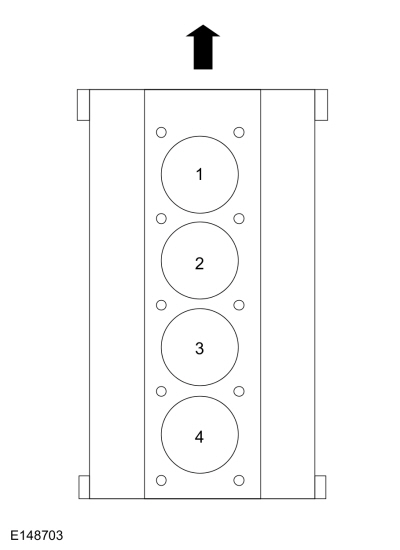
Engine Cylinder Identification
System Operation
Lubrication System
The engine lubrication system is a pressure feed system. Oil is supplied at full pressure to the crankshaft, connecting rod bearings, camshaft bearing caps and Variable Camshaft Timing (VCT) solenoids. Oil supply to the valve lifters and valvetrain is controlled by a restrictor orifice located in the cylinder head gasket. Conventional oil pumps can account for up to 10% of mechanical power loss at rated engine speed, which leads to increased fuel consumption. This is caused by the high capacity of the oil pump, especially at high engine speeds. When a variable oil pump is used, the output can be matched to the required oil flow in a flexible manner, depending on engine temperature and speed.
The main component of the variable oil pump is a vane pump with an adjustable outer ring (vane pump adjusting ring). The vane pump adjusting ring moves left or right depending on oil pressure.
The lubrication system is designed to provide optimum oil supply to critical engine components over the entire operating range.
The heart of the system is a positive displacement internal gear oil pump.
This design is commonly known as a variable displacement oil pump or vane-type pump, which operates as follows:
- The oil pump is driven by the crankshaft.
- At low engine speeds, with maximum eccentricity of the vane pump, maximum volume flow is delivered.
- At high engine speeds, the volume flow and oil pressure increase. At an oil pressure of approximately 3.25 bar, a valve in the oil pump housing (not shown in the illustration) opens, which causes the adjusting ring of the vane pump to move to the left.
- Due to the movement of the adjusting ring, the eccentricity decreases and, therefore, the delivery volume of the vane pump is reduced. As a result of the reduced delivery volume, the actual requirements of the internal combustion engine are met.
- Advantage: the output can be flexibly matched to the required oil volume flow. Because of this, the power loss to the oil pump is lower, which ultimately results in reduced fuel consumption and exhaust emissions.
Valvetrain
The valvetrain uses direct acting mechanical bucket tappets (DAMB). The camshaft lobes are located directly above the mechanical bucket tappets, which are located above the valves.
Twin Independent Variable Cam Timing (Ti-VCT)
The Ti-VCT system provides variable valve control that optimizes full-load combustion, increasing power and torque at low engine speeds (broadening the torque curve). By changing valve overlap, it improves fuel economy and emissions and provides optimized cold start operation with reduced exhaust emissions.
Test yourself
A quick Ford Fusion quiz: every answer comes with an explanation and a link to the manual page.