Compression Test
If the engine runs poorly or misfires, check the ignition system and the fuel system.
If the cause of poor engine performance cannot be found, perform a compression test. Performing this test regularly will also help you detect possible malfunctions in advance.
PROCEDURE
1. Check the engine oil level. Make sure the starter operates normally and the battery is fully charged.
2. Start the engine and warm it up to a temperature of 80–95 °C.
3. Turn off the engine and disconnect the high-tension cables from the spark plugs.
4. Remove the spark plugs.
5. Crank the engine.
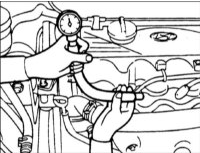
6. Install the compression gauge adapter into the spark plug hole.
7. Fully open the throttle valve.
8. Crank the engine with the starter for approximately 4 revolutions and read the compression on the gauge.
Compression: 1.62 MPa
Minimum allowable compression: 1.52 MPa
9. Repeat steps 6–8 on the remaining cylinders.
10. If compression is low in all cylinders, pour a few drops of engine oil into each cylinder through the spark plug holes and repeat steps 6–8.
1) If adding oil increases compression, the piston rings may be worn.
2) If compression remains at the same level, the valves may be burnt or the cylinder head gasket may be damaged.
3) Install the spark plugs and connect the high-tension cables to them.
Tightening torque: 20.4–30.6 N·m
Test yourself
A quick Hyundai Accent quiz: every answer comes with an explanation and a link to the manual page.