Diagnostic Trouble Code (DTC) Troubleshooting - DTC P0422

DESCRIPTION AND OPERATION
Catalyst efficiency refers to its ability to reduce the concentration of CO and HC in the exhaust gases. The engine control module (ECM) compares the signals from the front and rear oxygen sensors to determine the point at which the shape of the rear oxygen sensor signal begins to match the shape of the front oxygen sensor signal. As the catalytic converter deteriorates, the rear oxygen sensor signal curve begins to resemble the front oxygen sensor signal curve. This means that the catalytic converter is saturated with oxygen and cannot use it to convert CO and HC into H2O and CO2 with the same efficiency as when it was new. A fully deteriorated catalytic converter shows 100% matching between the front and rear oxygen sensor signal shapes.
DTC SET CONDITIONS
Catalyst efficiency is measured by comparing the activity of the front and rear oxygen sensors. The ECM will store the DTC and illuminate the malfunction indicator lamp (MIL) if, during two consecutive driving cycles, the front and rear oxygen sensor signal shapes match by more than 60% in two of four 170-second monitoring periods. Measurements are performed when the following conditions are met:
1. The ECM performs closed-loop air-fuel ratio control.
2. Engine speed is within 1800 - 3200 rpm.
3. Catalytic converter temperature is above 372°C.
4. EVAP canister purge ratio is above 0.9.
5. No transmission gear shifting occurs.
6. Engine load (fuel injector pulse width) is within 1.4 - 4.5 msec.
This DTC indicates that the catalytic converter has been judged to have low efficiency based on the front and rear oxygen sensor signals.
INSPECTION PROCEDURE
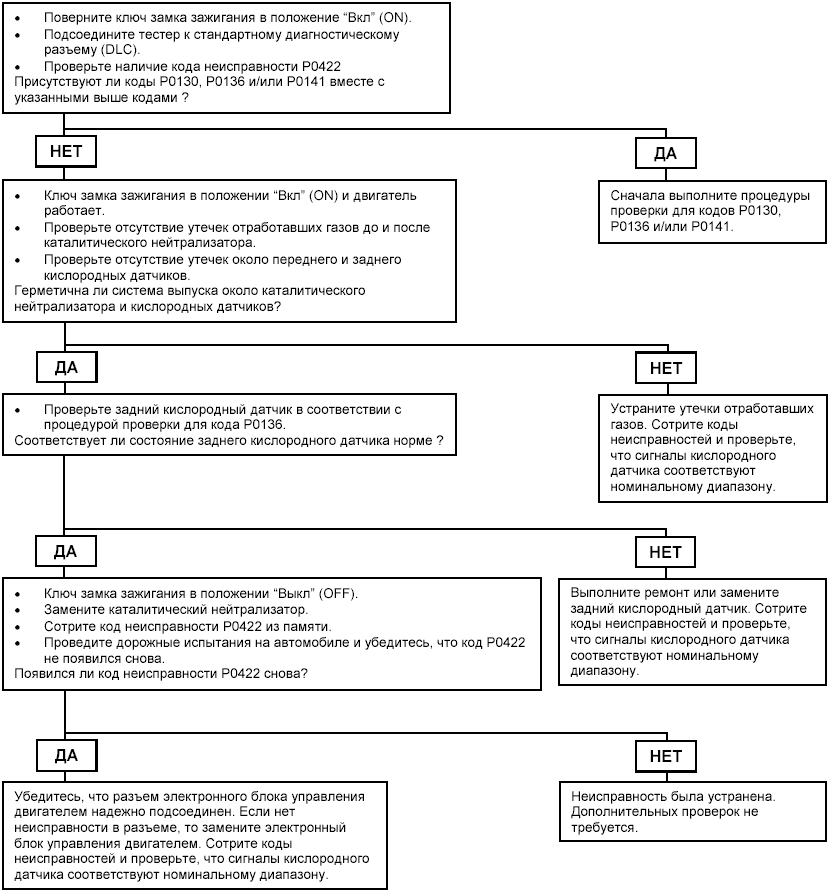
INSPECTION PROCEDURE
Test yourself
A quick Hyundai Elantra CN7 quiz: every answer comes with an explanation and a link to the manual page.