Manifold Absolute Pressure (MAP) Sensor
The manifold absolute pressure sensor is a variable resistor that is sensitive to pressure changes. It measures the change in intake manifold pressure, which depends on engine load and crankshaft speed, and converts this value into a signal voltage. The MAP sensor signal is also used by the ECM to measure barometric pressure at engine start-up and under other specified conditions, which allows the system operating parameters to be automatically adjusted at different altitudes. The ECM supplies a 5 V reference voltage to the MAP sensor and monitors the sensor signal voltage.
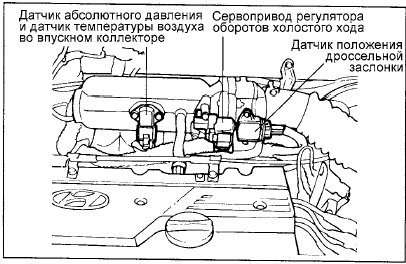
This voltage passes through a variable resistor circuit located in the sensor and is shorted to ground. The MAP sensor signal affects fuel delivery and ignition timing, which are controlled by the ECM.
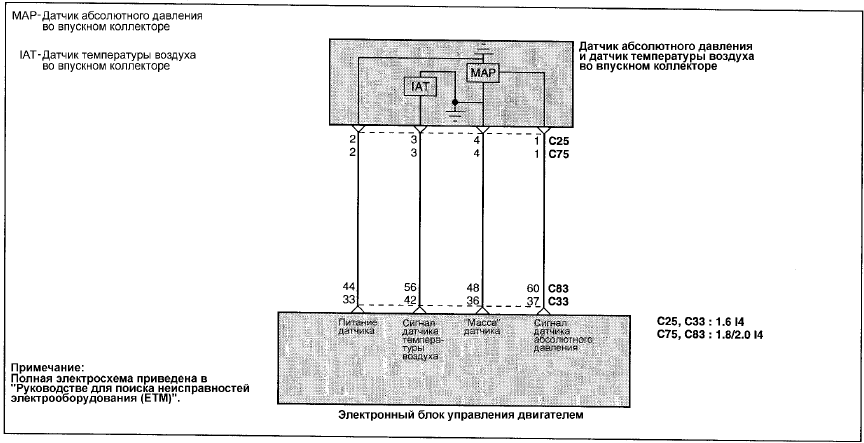
CIRCUIT DIAGRAM - MANIFOLD ABSOLUTE PRESSURE (MAP) SENSOR
TROUBLESHOOTING HINTS
Under the following conditions, the Malfunction Indicator Lamp (MIL) illuminates and the corresponding diagnostic trouble code is output to the HI-SCAN (PRO) tester.
1. When the intake manifold pressure is 11.8 kPa or lower for 0.1 second after the ignition switch is turned ON.
2. When the intake manifold pressure is 11.8 kPa or lower with the engine running at 1980 rpm or less.
3. When the intake manifold pressure is 98.6 kPa or higher and the engine speed is 2400 rpm or higher with the accelerator pedal released (for example, when the vehicle is coasting downhill).
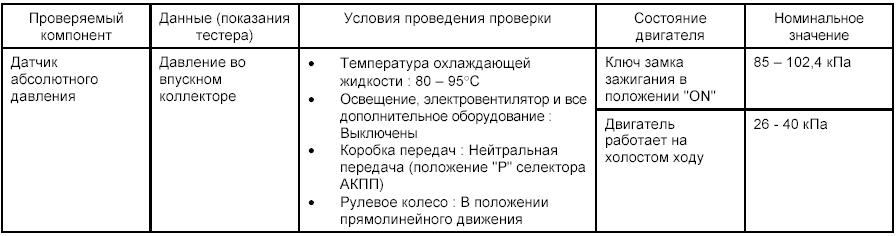
INSPECTION USING HI-SCAN (PRO) TESTER
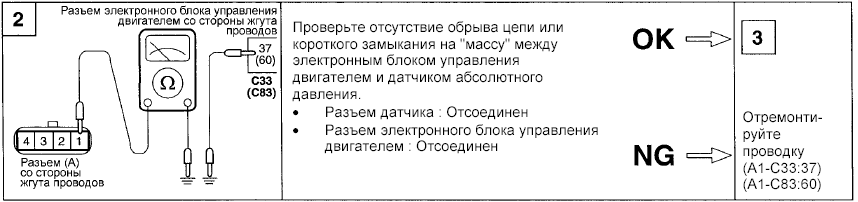
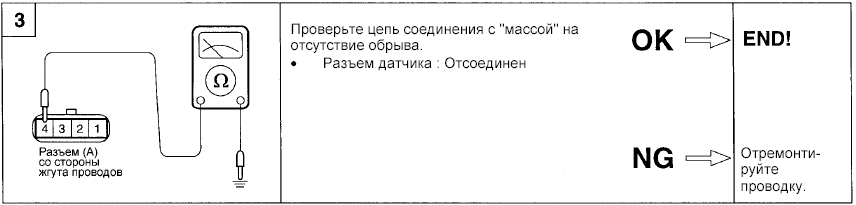
WIRING INSPECTION
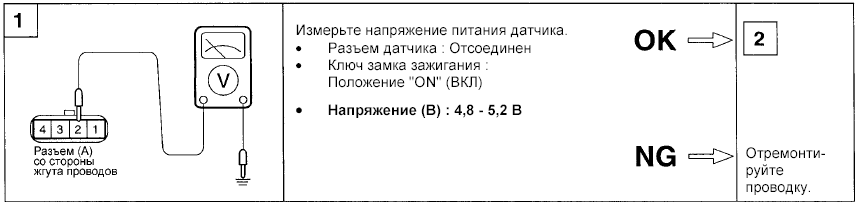
SENSOR INSPECTION
1. Measure the voltage between terminals 1 and 4 of the MAP sensor connector.
Terminal 4: MAP sensor ground. Terminal 1: MAP sensor signal.

2. If the measured voltage differs from the specified value, replace the Manifold Absolute Pressure (MAP) Sensor assembly.
Test yourself
A quick Hyundai Elantra CN7 quiz: every answer comes with an explanation and a link to the manual page.