Braking System
REAR DRUM BRAKE Repair Procedures
In this manual: Braking System
36steps
~216min
5/5difficulty
Done 0 of 36
DEPOSIT
- Release the parking brake.
- Remove the tire and rear wheel.
Tightening torque: 88.3 ~ 108 N·m
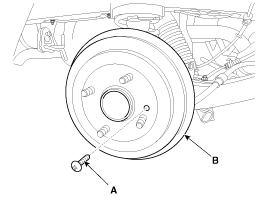
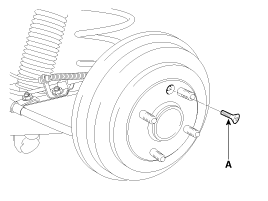
- Loosen the screw (A), then remove the drum (B).
Tightening torque: 4.9 - 5.9 N·m
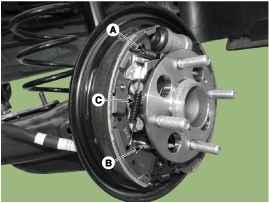
- Remove the upper shoe return spring (A), lower segment return spring (B), and adjusting spring (C).
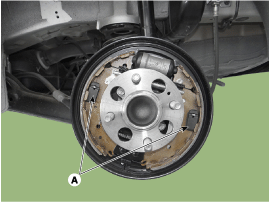
- Remove the shoe support (A), then remove the shoes.
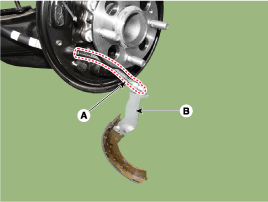
- Disconnect the parking brake cable (A) from the lever (B).
- Disconnect the brake tubes (A) from the wheel cylinder (B).
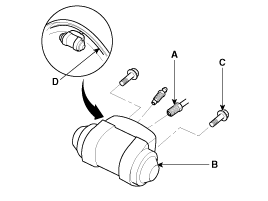
- Remove the bolt (C) and wheel cylinder (B) from the backing plate (D).
Inspection
- Raise the rear of the vehicle and make sure it is securely supported in this position.
- Release the brake pedal, then remove the rear brake drum.
- Inspect the wheel cylinder (A) for leaks.
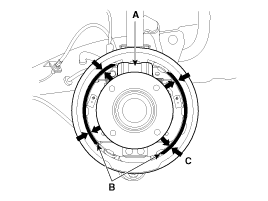
- Check the brake shoes (B) for possible wear, contamination, and cracks.
- Measure the brake lining thickness (C). Do not measure the thickness of the brake shoe. Brake lining thickness Standard value: 4.5 mm (0.177 in.) Service limit: 1.0 mm (0.039 in.)
- If the brake lining thickness is less than the service limit, replace all brake shoes at the same time.
- Make sure the hub bearings are in good condition. If they require service, replace them.
- Measure the inside diameter of the brake drum with calipers. Inside diameter of drum Standard value: 205.2 mm (8.079 in.) Service limit: 203.2 mm (8.0 in.) Drum out-of-round Service limit: 0.06 mm (0.00236 in.)
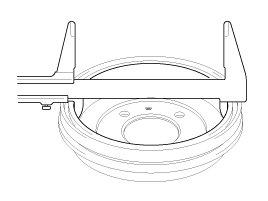
- If the inside diameter of the brake drum is greater than the service limit, replace the brake drum.
- Check the brake drum for scratches, grooves, or cracks.
- Check the brake shoe and drum for proper contact.
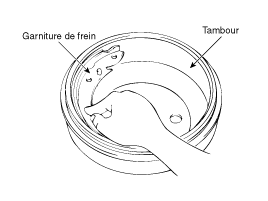
- Check the wheel cylinder exterior for excessive wear and damage.
- Check the backing plate for wear or damage.
REMEDY
- Apply sealant (C) between the wheel cylinder (B) and the backing plate (D), then install the wheel cylinder.
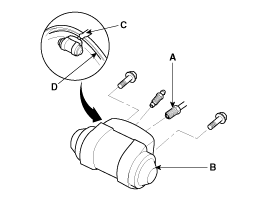
- Connect the brake lines (A) to the wheel cylinder.
Tightening torque: 12.7 - 16.7 N·m
- Secure the parking brake cable (A) to the brake shoe.
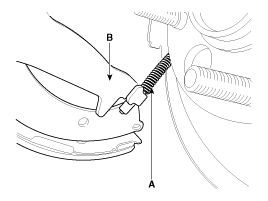
- Install the brake shoes (C) on the backing plate. Caution: Be careful not to damage the wheel cylinder boots.
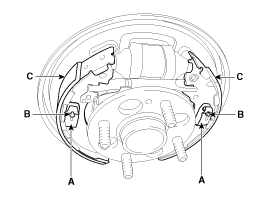
- Install the segment stopper pins (B) and the segment retaining springs (A).
- Clean the threads of the adjusting nut (A) and the internally threaded adjuster (B). Apply grease to the threads of the adjuster assembly. To shorten the pins, turn the adjuster bolt (C).
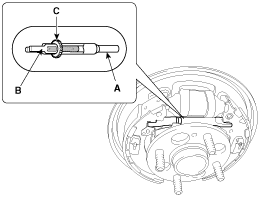
- Hook the adjuster lever (C), then install it on the brake shoe.
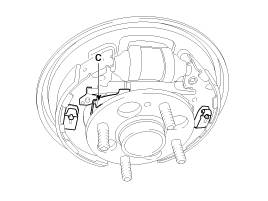
- Install the adjuster assembly (B) and the upper return spring (A) on the right side. Be careful not to damage the wheel cylinder boots.
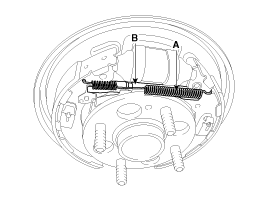
- Install the lower return spring (B).
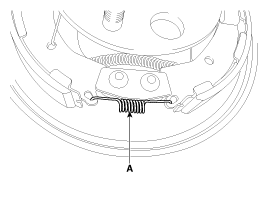
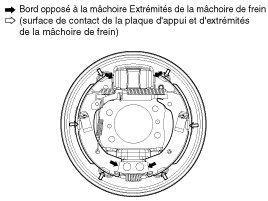
- Apply brake cylinder grease or equivalent rubber grease to the sliding surfaces as shown. Do not apply grease to the brake shoe linings.
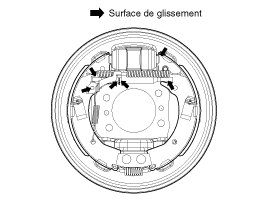
- Apply brake cylinder grease or equivalent rubber grease to the ends of the brake shoes and the opposite edges of the support as shown. Do not apply grease to the brake linings.
- Install the rear brake drum (A).
- If the wheel cylinder was removed, bleed the brake system.
- Depress the brake pedal several times to automatically adjust the brakes.
- Apply the parking brake.
Test yourself
A quick Hyundai i20 quiz: every answer comes with an explanation and a link to the manual page.
Was this page helpful?