System Limitations
The driver should be careful in the following situations, because the system may not detect other vehicles or objects under certain circumstances.
- The vehicle is driving on a curved road or through a toll gate.
- The vehicle turns left or right at an intersection.
- The sensor is contaminated with rain, snow, mud, etc.
- The rear bumper where the sensor is located is covered with foreign material, such as a bumper sticker, bumper guard, bicycle rack, etc.
- The rear bumper is damaged or the sensor is not in its original default position.
- The vehicle height becomes lower or higher due to a heavy load in the luggage compartment, abnormal tire pressure, etc.
- The vehicle is driving in bad weather conditions, such as heavy rain or snow.
- A stationary object such as a guardrail, pedestrian, animal, etc. is located next to the vehicle.
- The vehicle is driving near areas containing metallic substances, such as a construction zone, railway, etc.
- A large vehicle, such as a bus or truck, is nearby.
- A motorcycle or bicycle is nearby.
- A flat trailer is nearby.
- If the vehicle starts simultaneously with a vehicle next to you and accelerates.
- When another vehicle passes at a very high speed.
- When changing lanes.
- When driving down or up a steep road where the height of the lane is different.
- When another vehicle approaches very closely.
- When a trailer or carrier is installed.
- When the rear bumper is positioned high or low.
- When the sensors are blocked by other vehicles, walls, or parking lot pillars.
- When the detected vehicle is also moving backward while your vehicle is moving backward.
- If there is an object in the detection area, such as a shopping cart or baby stroller.
- If there is a low vehicle, such as a sports car.
- When other vehicles are next to your vehicle.
- When a vehicle in the adjacent lane moves away from you by two lanes, OR when a vehicle two lanes away moves into the next lane next to you.
- When driving on a narrow road with many trees or bushes.
- When driving in a large open area with few vehicles or structures around, such as a desert, rural area, etc.
- When driving on a wet road surface.
The BCW indicator on the outside rearview mirror may not illuminate properly when:
- The outside rearview mirror housing is damaged.
- The mirror is covered with mud, snow, or debris.
- The window is covered with mud, snow, or debris.
- The window is tinted.
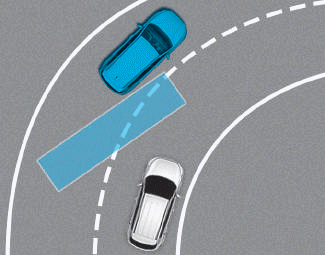
• Driving on curves
BCW may not operate properly when driving on a curved road. In some cases, the system may not detect a vehicle in the adjacent lane.
Always pay attention to the road and driving conditions while driving.
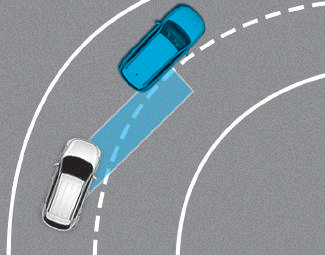
BCW may not operate properly when driving on a curved road. In some cases, the system may detect a vehicle in the same lane.
Always pay attention to the road and driving conditions while driving.
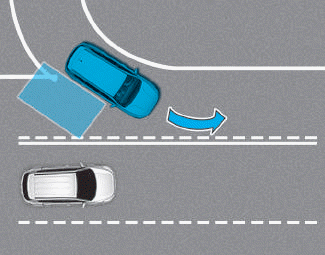
• Driving at a merging/diverging road
BCW may not operate properly when driving on a merging or diverging road. In some cases, the system may not detect a vehicle in the adjacent lane.
Always pay attention to the road and driving conditions while driving.
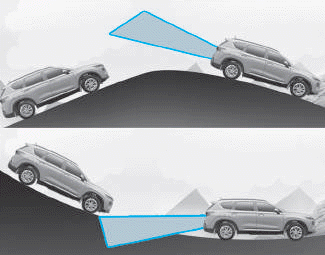
• Driving on slopes
BCW may not operate properly when driving on a slope. In some cases, the system may not detect a vehicle in the adjacent lane. In addition, in some cases, the system may misidentify the ground or structures.
Always pay attention to the road and driving conditions while driving.
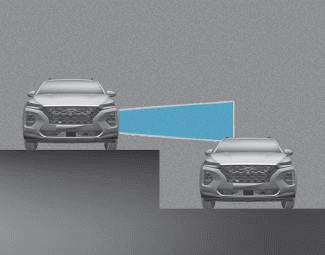
• Driving where the road height differs
BCW may not operate properly when driving where the road height differs.
In some cases, the system may not detect a vehicle on a road with different heights (underpass, connecting section, divided-level intersections, etc.).
Always pay attention to the road and driving conditions while driving.
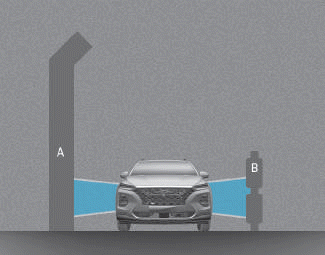
[A]: Noise barrier, [B]: Guardrail
• Driving where there is a structure near the road
BCW may not operate properly when driving where there is a structure near the road.
In some cases, the system may misidentify structures (noise barrier, guardrail, double guardrail, median strip, pole, street light, road sign, tunnel wall, etc.) near the road.
Always pay attention to the road and driving conditions while driving.
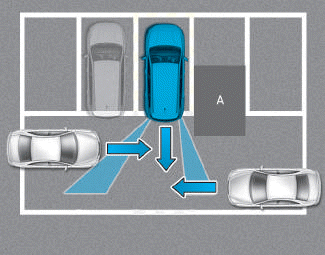
[A]: Structure
• Driving where there is a vehicle or structure nearby
The system may not operate properly while driving where there is a vehicle or structure nearby.
In some cases, the system may not detect an approaching vehicle from behind, and the warning or braking may not operate properly. Always pay attention to the surroundings while driving.
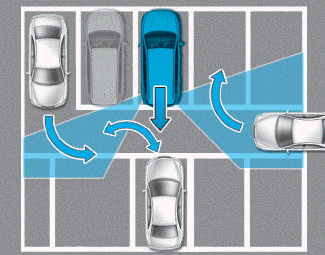
• When the vehicle is in a complex parking environment
The system may not operate properly when the vehicle is in a complex parking environment.
In some cases, the system may not accurately determine the collision risk for vehicles that are parking or leaving next to your vehicle (for example, a vehicle leaving next to your vehicle, a vehicle parking or leaving in the rear of your vehicle approaching your vehicle, a vehicle queuing, etc.).
In this case, the warning or braking may not operate properly.
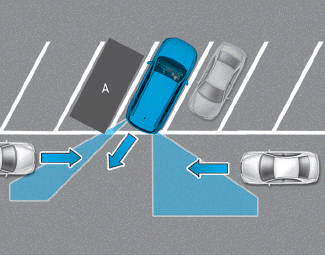
[Vehicle]
• When the vehicle is parked diagonally
The system may not operate properly when the vehicle is parked diagonally.
In some cases, when a diagonally parked vehicle is pulling out of a parking space, the system may not detect an approaching vehicle from the rear left/right of your vehicle. In this case, the warning or braking may not operate properly.
Always pay attention to the surroundings while driving.
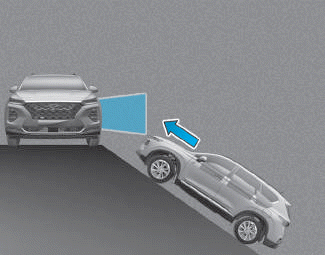
• When the vehicle is on/near a slope
The system may not operate properly when the vehicle is on or near a slope.
In some cases, the system may not detect an approaching vehicle from the rear left/right, and the warning or braking may not operate properly.
Always pay attention to the surroundings while driving.
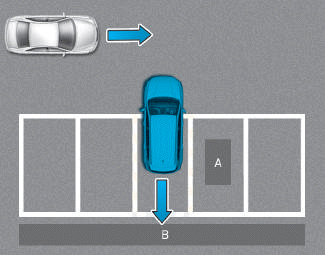
[A]: Structure, [B]: Wall
• Entering a parking space where there is a structure
The system may not operate properly when backing the vehicle into a parking space where there is a structure behind or beside the vehicle.
In some cases, when backing into a parking space, the system may not detect a moving vehicle in front of your vehicle. In this case, the warning or braking may not operate properly.
Always pay attention to the parking space while driving.
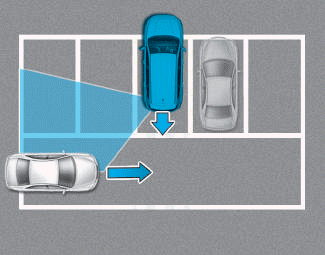
• When the vehicle is parked backward
If the vehicle is parked at the rear and the sensor detects another vehicle at the rear of the parking space, the system may warn or control braking. Always pay attention to the parking space while driving.
Test yourself
A quick Hyundai i30 quiz: every answer comes with an explanation and a link to the manual page.