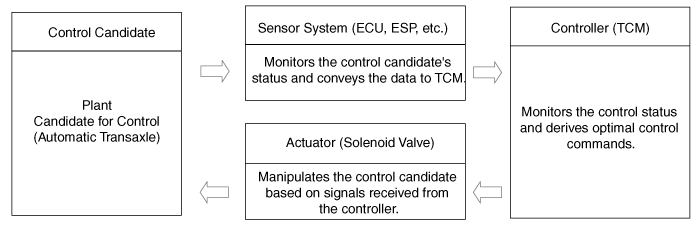
The automatic transmission system relies on various measurement data to determine the current control status and extrapolate the necessary compensation values. These values are used to control the actuators and achieve the desired control result. If a transmission problem, including the transmission itself, has been identified, perform self-diagnosis and a basic check of the transmission (check oil and fluids), then check the control system components using the diagnostic tool.
Control System Components
Fail-Safe and Limp Home: The fail-safe mechanism provides "limp home" 4th gear hold so the vehicle can be driven to the owner's home or dealer. Fail-Safe: the TCM provides 4th gear hold and reverse gear operation in the event of a malfunction. Limp Home: maintains minimum functionality (Drive (4th gear hold), Reverse) in the event of a malfunction, allowing the vehicle to reach a dealer. Self-Diagnosis: The Transmission Control Module (TCM) constantly communicates with control system elements (sensors and solenoids). If an abnormal signal is received for longer than the specified duration, the TCM recognizes a malfunction, stores the DTC in memory, and then sends a malfunction signal through the self-diagnosis terminal. Such DTCs are backed up independently and will not be erased even if the ignition switch is turned off, the battery is disconnected, or the TCM connector is disconnected.
Disconnecting the sensor or actuator connector while the ignition switch is ON generates a Diagnostic Trouble Code (DTC) and stores it in memory. In this case, disconnecting the battery will not clear the diagnostic trouble code memory. Use the scan tool to clear the diagnostic trouble code memory.
Before removing or installing any component, read the diagnostic trouble codes, then disconnect the negative (-) battery terminal.
Before disconnecting the battery cable from the battery terminal, turn the ignition switch to the OFF position. Removing or connecting the battery cable while the engine is running or the ignition is on may damage the TCM.
When checking the alternator charging condition, do not disconnect the battery "+" terminal to prevent engine stall. Module (ECM) damage from voltage surge.
When charging the battery with an external charger, disconnect the battery terminals from the vehicle side to avoid damaging the TCM.
Inspection Procedure (Self-Diagnosis)
When battery voltage is too low, diagnostic trouble codes cannot be read. Be sure to check the battery voltage and the charging system before starting the test.
Inspection Procedure (Using GDS)
Turn the ignition off.
Connect the GDS to the data link connector under the lower crash pad.
Turn the ignition on.
Use the GDS to check the diagnostic trouble code.
Repair the faulty part according to the diagnostic flow chart.
Erase the diagnostic trouble code.
Disconnect the GDS.
After replacing the automatic transmission, use GDS to reset (erase TCM learning values). Then perform the Transmission Control Module (TCM) learning procedure to ensure optimal shift quality. (Refer to Automatic Transmission Control System - "Repair Procedures")
Add automatic transmission fluid. (Refer to Hydraulic System - "Fluid")
After servicing the automatic transmission or TCM, clear the Diagnostic Trouble Code (DTC) using the GDS tool. DTCs cannot be cleared by disconnecting the battery.
?
Test yourself
A quick Kia Cadenza VG Owner's Manual quiz: every answer comes with an explanation and a link to the manual page.