Front Alignment
Repair Procedures
Front Wheel Toe
When using commercially available computerized wheel alignment equipment to check front wheel alignment angles, always place the vehicle on a level surface with the front wheels pointing straight ahead.
Before inspection, make sure the front suspension and steering system are in normal operating condition and that the tires are inflated to the specified pressure.
Toe
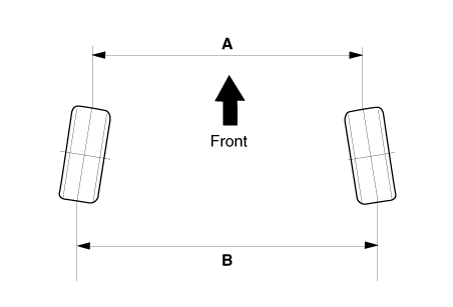
B - A > 0: Toe-in (+) B - A < 0: Toe-out (-)
Toe Adjustment
Loosen the steering tie-rod end jam nut.
Remove the bellows clamp to prevent the bellows from twisting.
Adjust the toe by screwing the tie rod in or out. Toe adjustment must be performed by turning the right and left tie rods by the same amount.
Total toe: 0.1° ± 0.2° Individual: 0.05° ± 0.1°
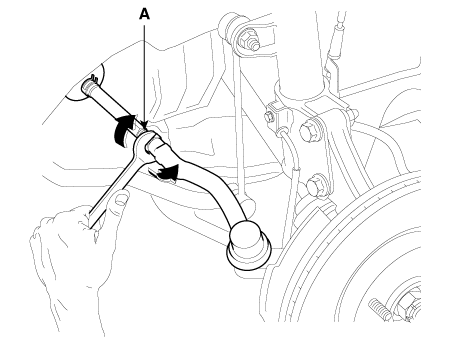
After completing the toe adjustment, install the boot clamp and tighten the tie rod end lock nut to the specified torque.
Tightening torque: 49.0–54 N·m
Perform calibration of the steering angle sensor.
(Refer to Steering System - "Steering Column and Shaft")
Camber and Caster
Camber and caster are preset at the factory and do not require adjustment. If camber and caster are not within specification, replace or repair the damaged parts, then inspect again.
Camber Angle
Australia: -0.5° ± 0.5°
General/Middle East/Europe/Russia/South America: -0.38° ± 0.5°
Brazil/Mexico: -0.31° ± 0.5°
Caster angle: 4.5° ± 0.5°
Test yourself
A quick Kia Forte BD quiz: every answer comes with an explanation and a link to the manual page.