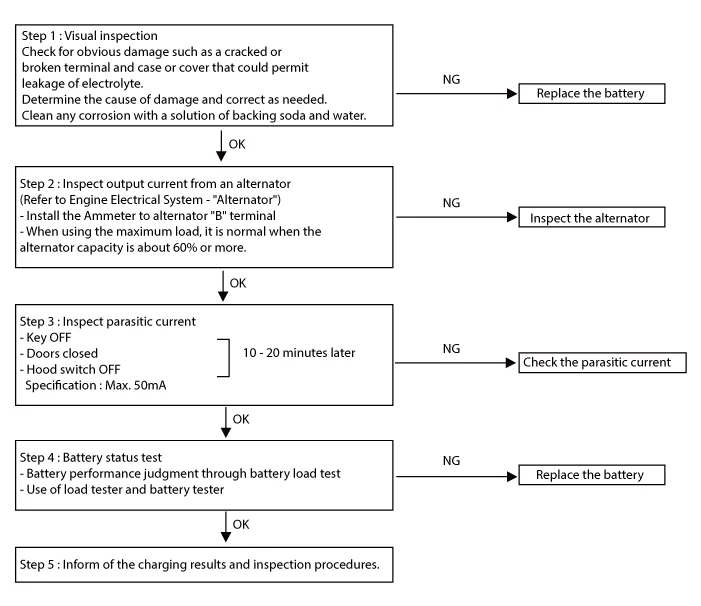
Check the battery terminal corrosion and connection.
Check the battery leakage or swelling.
Check the case for damage.
Check the alternator charging current. G1.6 T-GDI GAMMA II (Refer to Charging System - "Alternator") G2.0 MPI NU (Refer to Charging System - "Alternator")
Turn all electric devices OFF, and then turn the IG OFF.
Close all doors except the engine hood, and then lock all doors.
Disconnect the connector from the hood switch to prevent it from being operated.
Wait until the main system of the vehicle becomes sleep mode.
For an accurate measurement of a vehicle parasitic current, all electrical systems should go to sleep mode. (It takes at least one hour or at most one day.) However, an approximate vehicle parasitic current can be measured after 10 - 20 minutes.
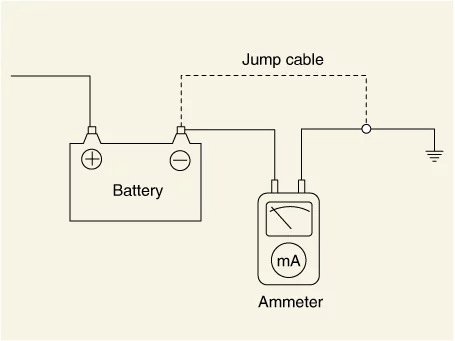
Connect an ammeter between the battery negative ( - ) terminal and the negative ( - ) cable terminal, and then disconnect the battery cable ( - ) terminal slowly.
Be careful not to let the lead wire of the ammeter come off the battery terminal and the cable so that the battery is not initialized.
If the battery is initialized due to disconnection of lead wire of ammeter from the battery cable or terminal, reconnect the battery and start the engine, or measure from the first step after the IG is on for more than 10 seconds.
To prevent battery initialization in advance, follow the procedure below.
Connect the jumper cable between the battery ( - ) terminal and the cable ( - ) terminal first.
Disconnect the negative ( - ) battery terminal.
Connect the ammeter in parallel to the jumper cable.
Disconnect the jumper cable and check the parasitic current value of the ammeter.
Check the parasitic current value of the ammeter.
If the parasitic current exceeds the limit value, remove the fuse one by one and measure it to find the problem circuit.
Re-measure the parasitic current and find the problem unit by removing the units connected to the problem circuit one by one.
Limit value (after 10 - 20 min.) : Below 50 mA
Turn all electric devices OFF, and then turn the IG OFF.
Close all doors except the engine hood, and then lock all doors.
Disconnect the connector from the hood switch to prevent it from being operated.
Wait until the main system of the vehicle becomes sleep mode.
For an accurate measurement of a vehicle parasitic current, all electrical systems should go to sleep mode. (It takes at least one hour or at most one day.) However, an approximate vehicle parasitic current can be measured after 10 - 20 minutes.
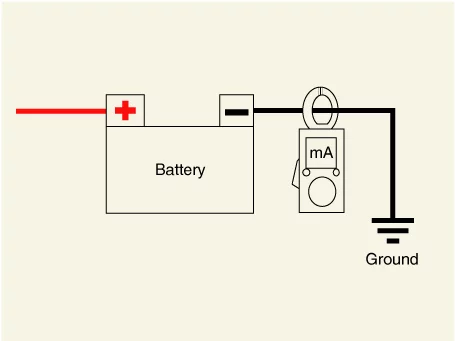
Install the clamp type ammeter on battery negative ( - ) cable.
When using a clamp type ammeter, use an ammeter that can measure mA. If not, it is difficult to measure the correct parasitic current.
When ( - ) sign appears on the ammeter of the clamp type, install the ammeter in the opposite direction.
Check the parasitic current value of the ammeter.
If the parasitic current exceeds the limit value, remove the fuse one by one and measure it to find the problem circuit.
Re-measure the parasitic current and find the problem unit by removing the units connected to the problem circuit one by one.
Limit value (after 10 - 20 min.) : Below 50 mA
Alternator Charging Current Inspection Vehicle Parasitic Current Inspection [Using an Ammeter] [[Using the Clamp Type Ammeter] Battery Performance Inspection
Check that the battery positive ( + ) and negative ( - ) terminals are properly connected.
Do not disconnect the battery while the engine is running.
Measure the performance of the battery by using the battery tester and battery load tester.
If it is within 20 minutes since the engine is stopped, turn on the ignition switch and operate the electric devices (headlamp, blower motor, rear defogger) for 60 seconds to get rid of residual voltage.
Turn the IG OFF.
Measure the voltage between the negative ( - ) terminal and battery positive ( + ) terminal of the battery.
Specified voltage : approximately 12.5 - 12.9 V [20 °C]
If the measured value is below the specified voltage, charge the battery.
Check the state of charge of the battery, and charge the battery if required. How to charge IU or WU IU or WU charging voltage : 14.7 V [20 - 30 °C] approximately 24 hours Minimum charging voltage [20 °C] : 14.4 V Maximum charging voltage [20 °C] : 14.8 V A capacity of 10% of the charging current is recommended (e.g. 80 Ah : 100% = 8.0 A of charging current)
Battery Voltage Inspection AGM Battery Charging
Do not charge with a voltage of 15.2 V or higher.
Do not open or remove the cap on the top of the AGM battery.
Since explosive gas is formed in each cell when charging the battery, any actions that may cause ignition such as fire, sparks, light rays, smoking, etc. during or immediately after charging the battery are prohibited.
Do not open the circuit while the battery is charging as it will generate the spark, keep away from nearby flammable material.
The temperature of the battery shall be maintained at approximately 20 - 30 °C during the charging.
If the battery sensor is charged while connected to the battery, the sensor may not accurately detect the state of the battery. Therefore, when the battery is fully charged, use it after about 10 hours (stabilizing time of the battery) at room temperature. Otherwise, it will result in a fault code or the Alternator Management System (AMS) function may not work.