Avoid towing a vehicle heavier than the vehicle doing the towing.
Press the brake pedal hard during braking as the performance may be reduced than usual.
As the steering wheel operation may not be usual, so operate stronger than the usual.
When driving down a long hill, the brakes may overheat and brake performance will be reduced, therefore stop the vehicle often to cool down the brakes.
When towing, passengers need to sit as far as possible from the vehicle except the driver.
The side airbags may deploy if the engine start button is 'on', be sure to turn off the vehicle before towing.
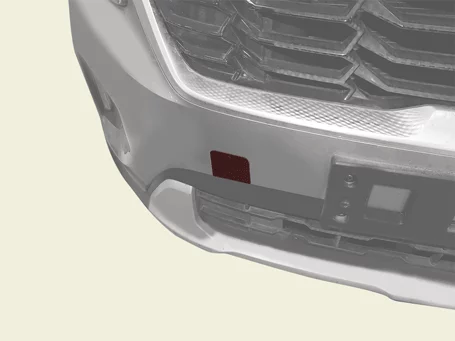
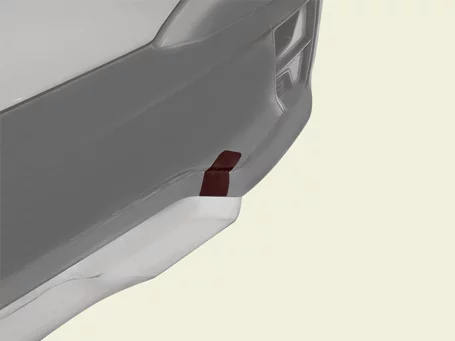
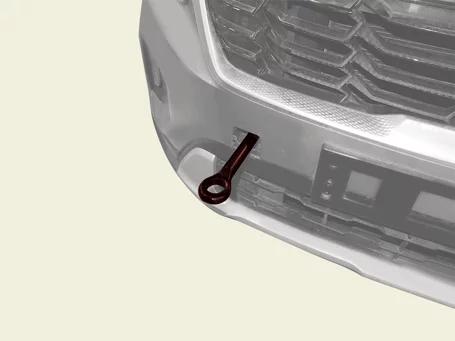
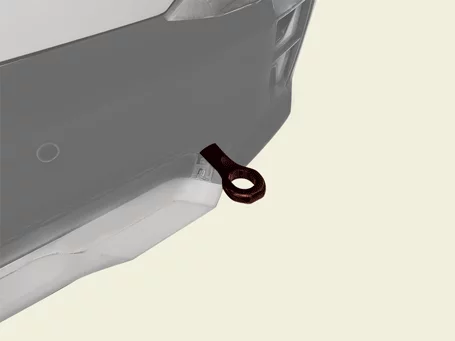
Towing hook Towing hook can be installed at the front and back of the vehicle.
When towing by connecting the towing hook to other part of the vehicle, as it may damage or deform the body of the vehicle.
Remove the cover by pressing the bottom of the hole cover of the bumper. [Front] [Rear]
Insert the towing hook by turning it clockwise into the hole until it is fully secured. [Front] [Rear]
Before towing, make sure the hook is installed properly.
Fasten rope or chain securely to the hook.
Use the rope or chain less than 5 m long, mark in the middle of these for easy visibility.
Put the transmission in Neutral (N).
Maintain the vehicle at 'ACC' state for steering wheel not to be locked.
Release the parking brake.
The drivers of both vehicles communicate with each other and tow the vehicle.
Passengers other than the driver must not be allowed to be on board.
The driver must be in the vehicle for steering and braking operations when the vehicle is towed.
Steer the steering wheel in the same direction as the tow vehicle.
Avoid reckless driving such as sudden start and braking, which may put excessive load on the towing hook, rope or chain.
Accelerate or decelerate the vehicle in a slow and gradual manner while maintaining the tension on the tow rope or chain to start or drive the vehicle.
How to tow with general vehicle How to tow with tow-truck These three methods can be used to tow for general vehicles. However, the sling-type towing method is not recommended as it may damage the vehicle except for the emergency situation.
Flatbed towing It is the safest and best way to tow a full time 4WD vehicle.
Under lift towing A method of lifting the drive shaft wheel of the vehicle to the tow truck and making the opposite wheel touch the floor or towing using auxiliary equipment. For full time 4WD vehicle, be sure to use auxiliary equipment such as dolly to prevent wheels from touching the ground.
Sling type towing A method of towing using a tow truck's hooked chain. Sling type towing is not recommended as it can seriously damage the vehicle's suspension and body.
To prevent the damage of the vehicle, full time 4WD vehicles must be towed by flat bed towing method or under lift towing method. When using under lift method, auxiliary equipment such as dolly must be used to prevent wheels from touching the ground.
If lifting or towing the vehicle using the bumper may damage the vehicle, so you must use the towing hook to tow the vehicle.