Special Driving Conditions
Hazardous Driving Conditions
When encountering hazardous driving conditions, such as water, snow, ice, mud, sand, or similar hazards, follow these recommendations:
- Drive carefully and allow extra stopping distance.
- Avoid sudden braking or steering.
- When braking with non-ABS brakes, pump the brake pedal with a light up-and-down motion until the vehicle stops.
WARNING - ABS
Do not pump the brake pedal on a vehicle equipped with ABS.
- When stopping in snow, mud, or sand, use second gear. Accelerate slowly to avoid wheel spin.
- Use sand, rock salt, snow chains, or other non-slip materials under the drive wheels to provide traction when stopping on ice, snow, or mud.
WARNING - Downshifting
Shifting to a lower gear with an automatic transmission on slippery surfaces may cause an accident. A sudden change in engine speed may cause the tires to skid. Be careful when shifting to a lower gear on slippery surfaces.
Reducing the Risk of Rollover
This multipurpose passenger vehicle is classified as a sport utility vehicle (SUV). SUVs have a higher ground clearance and a narrower track, which make them capable of operating in a wide variety of off-road conditions. These design features give them a higher center of gravity than conventional vehicles.
An advantage of higher ground clearance is a better view of the road, which allows you to anticipate problems. SUVs are not designed to negotiate turns at the same speeds as conventional passenger cars. Low-profile sports cars are designed to perform satisfactorily under normal road conditions, not off-road.
Because of this risk, the driver and passengers are strongly advised to fasten their seat belts. In a rollover accident, an unbelted person is more likely to die than a person wearing a seat belt. There are steps the driver can take to reduce the risk of rollover.
Whenever possible, avoid sharp turns and sudden maneuvers, do not load the roof rack with heavy cargo, and never modify your vehicle in any way.
WARNING - Rollover
As with other sport utility vehicles (SUVs), failure to operate this vehicle properly may result in loss of control, a crash, or rollover.
- Trucks have a considerably higher rollover rate than other types of vehicles.
- Design features (greater ground clearance, narrower track, etc.) give this vehicle a higher center of gravity than conventional vehicles.
- The vehicle is not designed to take turns at the same speeds as conventional vehicles.
- Avoid sharp turns and sudden maneuvers.
- In a rollover accident, an unbelted person is significantly more likely to die than a person wearing a seat belt. Make sure everyone in the vehicle is properly restrained.
WARNING
Your vehicle is equipped with tires and wheels designed to provide safe driving and handling capability. Do not use tire and wheel sizes and types different from those originally installed on your vehicle. This may affect the safety and operation of your vehicle and may result in steering failure, rollover, and serious injury. When replacing tires, make sure all four tires are of the same size, type, tread, brand, and load rating. If you decide to equip your vehicle with any tire/wheel combination not recommended by Kia for off-road driving, you must not use these tires for highway driving.
Rocking the Vehicle
If it is necessary to rock the vehicle to free it from snow, sand, or mud, first turn the steering wheel right and left to clear the area around the front wheels. Then shift between 1 (first) and R (reverse) in vehicles equipped with a manual transmission, or between R (reverse) and any forward gear in vehicles equipped with an automatic transmission. Do not race the engine and spin the wheels as little as possible.
If you are still stuck after several attempts, have the vehicle pulled out with a tow truck to avoid overheating the engine and possible damage to the transmission.
CAUTION
Continuous rocking may cause engine overheating, transmission damage or failure, and tire damage.
WARNING: Tire Spinning
Do not spin the wheels, especially at speeds above 35 mph (56 km/h). Spinning the wheels at high speed while the vehicle is stationary may overheat the tire, which may cause tire damage and injury to nearby persons.
✽ NOTICE
The ESC system (if equipped) should be turned OFF before rocking the vehicle.
WARNING
If your vehicle is stuck in snow, mud, sand, etc., you may try to rock the vehicle by shifting it back and forth between forward and reverse. Do not attempt this procedure if people or objects are anywhere near the vehicle. While rocking, the vehicle may suddenly move forward or backward as it frees itself, which may cause injury to, or damage to, nearby people or objects.
Cornering Smoothly
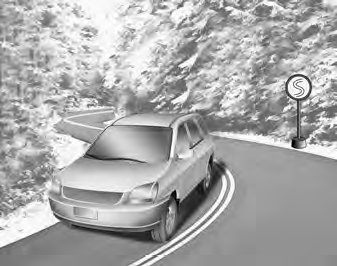
Avoid braking or shifting gears while cornering, especially on wet roads. Ideally, corners should always be taken with smooth acceleration. If you follow these recommendations, tire wear will be minimized.
Night Driving
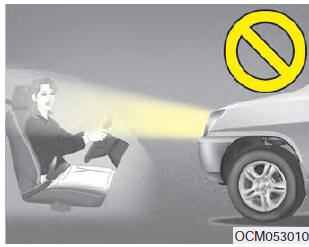
Since night driving presents more hazards than daytime driving, keep the following important recommendations in mind:
- Reduce speed and keep more distance between you and other vehicles, as it may be more difficult to see at night, especially in areas where there may not be any street lights.
- Adjust the mirrors to reduce glare from other drivers' headlights. • Keep the headlights clean and properly aimed. (On vehicles not equipped with automatic headlight aiming.) Dirty or misaimed headlights will be much harder to see by at night.
- Try not to look directly at the headlights of oncoming vehicles. You may be temporarily blinded, and it will take your eyes several seconds to adjust to the darkness.
Driving in the Rain
Rain and wet roads can make driving hazardous, especially if you are not prepared for slippery road surfaces.
Here are some things to consider when driving in the rain:
- Heavy rain will reduce visibility and increase the distance needed to stop your vehicle, so slow down.
- Keep the windshield wiper equipment in good condition. Replace the windshield wiper blades when streaks appear on the windshield or when areas are missing.
- If your tires are not in good condition, a sudden stop on wet asphalt may cause skidding and possibly an accident. Make sure your tires are in good condition.
- Turn on the headlights so that others can see you more easily.
- Driving too fast through large puddles may affect brake performance. If you must drive through puddles, drive through them slowly.
- If you think your brakes may be wet, lightly apply them while driving until normal braking is restored.
Driving in Flooded Areas
Avoid driving through flooded areas unless you are certain the water level is no higher than the bottom of the wheel hub. Drive slowly through any water.
Allow extra stopping distance, as this may affect braking performance.
After driving through water, dry the brakes by lightly applying them several times while driving slowly.
Off-Road Driving
Drive carefully off-road, because your vehicle may be damaged by rocks or tree roots. Familiarize yourself with the off-road conditions you intend to drive in before you start driving.
Highway Driving
Tires
Adjust tire pressure to the specification. Low tire pressure will cause overheating and possible tire failure.
Avoid using worn or damaged tires, which may result in reduced traction or tire failure.
✽ NOTICE
Never exceed the maximum tire pressure indicated on the tire.
WARNING
- Underinflated or overinflated tires can result in poor handling, loss of vehicle control, and sudden tire failure, leading to accidents, injury, or even death. Always check tire inflation before driving.
- Driving on worn-out or insufficient tread tires is dangerous. Worn tires may result in loss of vehicle control, collisions, injury, or even death. Replace worn tires as soon as possible and never use them for driving. Always check the tire tread before driving the vehicle.
Fuel, Engine Coolant, and Engine Oil
Driving at high speeds consumes more fuel than city driving. Be sure to check both the engine coolant and the engine oil.
Drive Belt
A loose or damaged drive belt may cause the engine to overheat.
Test yourself
A quick Kia Sorento Owner's Manual quiz: every answer comes with an explanation and a link to the manual page.