Electric Parking Brake (EPB)
Description and Operation
Description
EPB Description
EPB is an electronic parking brake. The EPB differs from existing parking systems, which are operated by the brake pedal or a lever type. The EPB system sends a signal to the ECU when the driver presses the EPB switch. The ECU controls the EPB actuator, which consists of a motor reducer. The EPB performs several functions.
Static Apply
Emergency braking function due to hydraulic brake malfunction
Automatic Apply
EPB Function
Switch operation while stationary (Static Park)
Manually apply the parking brake using the EPB switch when the vehicle is stationary.
With the ignition ON, the parking brake is applied with reduced clamping force on a grade of less than 8%.
Except for the above, it is always applied with full clamping force.
Switch release while stationary (Static Release)
Release the parking brake manually by pressing the EPB switch when the vehicle is stationary.
For safety, it is released only when the ignition is ON and the brake pedal is depressed.
Dynamic Emergency Braking (Dynamic Braking)
Electronic Controlled Deceleration (ECD)
: When the EPB switch is used while driving, a request is sent to the VDC only while the switch is operated, so that hydraulic braking is performed by the VDC instead of the EPB actuator.
Rear Wheel Unlock (RWU)
: If the VDC is not operating normally (VDC Fail) when the EPB switch is operated while driving and wheel speed information can be received, the EPB actuator will independently maintain braking safely only while the switch is operated.
Slow Acceleration (SRU):
If the VDC is not operating normally (VDC Fail) when the EPB switch is operated while driving and wheel speed information cannot be received, the EPB will independently and gradually increase the parking force to perform braking only while the switch is operated.
Automatic EPB Apply (Auto Apply)
Stop the vehicle with the Automatic Vehicle Hold (AVH) function enabled, and the EPB will then be applied automatically when the engine is turned off.
Automatic EPB Release (Release on Acceleration)
The parking brake is automatically released when the accelerator pedal is depressed with the EPB applied.
To ensure safety, the parking brake will be released automatically only when all of the following conditions are met:
Engine running
The seat belt is fastened.
Driver's door, trunk and hood are closed.
To prevent the vehicle from rolling downhill, it will be released automatically only when the drive torque exceeds a certain level based on the grade.
Re-application of EPB force when the vehicle moves downhill (Roll-back Re-clamping)
Additional EPB clamping force is generated when the vehicle moves downhill. It is detected after the EPB force is applied.
With the engine off, this function is active only when wheel speed information can be obtained (that is, within 3 minutes after the engine is turned off).
P to X (automatic release of EPB force for gear shifting)
When the shift lever is moved from P or N to D or R, the parking brake is automatically released.
However, this is only possible when the engine is running and the brake pedal is depressed, to ensure safety for automatic release.
Auto Hold
Auto Hold helps keep the vehicle stationary by applying the hydraulic brake system when the vehicle is stopped.
Operating Conditions
Engine running
The Auto Hold switch is ON.
The driver's door, hood and trunk lid must be closed.
Driver seat belt fastened
The shift lever is not in the P range.
Vehicle stopped condition is maintained when the brake pedal is depressed.
(2) The Auto Hold function keeps the vehicle in a stationary state for a maximum of 10 minutes.
The ESP valve maintains the stopped state by blocking the oil passage when the brake pedal is depressed.
(3) Total Auto Hold operating time: 30 minutes maximum
(4) Automatic Release Function
Auto Hold is canceled when the driver starts to accelerate the vehicle by depressing the accelerator pedal in D/S/R range.
(5) Automatic Transition from Auto Hold to EPB
Auto Hold automatically transitions to EPB operation if any of the conditions below are met.
[Normal Transition Case]
When the driver door is opened and the driver seat belt is unfastened at the same time
When the hood is opened with the shift lever in D or S
When the trunk is opened with the shift lever in P
When Auto Hold has been operating for more than 10 minutes
Stopped on a 25-degree slope
[Abnormal conversion cases]
When detailed vehicle movement is detected.
When a malfunction of the ESP hydraulic system is detected.
Indicator Lamp
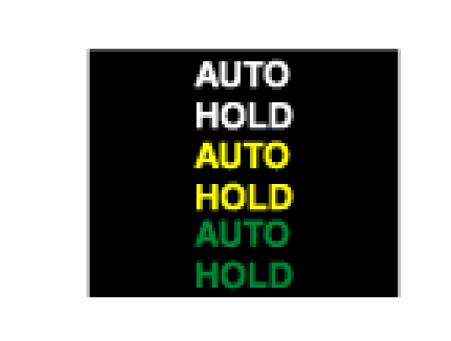


EPB Warning Light
The EPB warning light indicates EPB release and EPB malfunction.
The EPB warning light is located under the cluster.
The EPB warning lamp illuminates for 3 seconds after the ignition switch is turned ON. If the EPB system operates normally, the EPB warning lamp turns off.
If the EPB system does not operate properly, the EPB warning lamp illuminates.
The EPB warning lamp illuminates in diagnostic mode.
2. AUTO HOLD Indicator / AUTO HOLD Function Indicator
AUTO HOLD ON
A. The brake system operates automatically when vehicle speed is "0", such as when parked or waiting at a red light, during braking (AUTO HOLD function indicator: green).
B. The brake system is automatically released when the accelerator pedal is depressed. (AUTO HOLD indicator: white)
AUTO HOLD switch OFF: The AUTO HOLD function does not operate.
Components and Component Location
Components
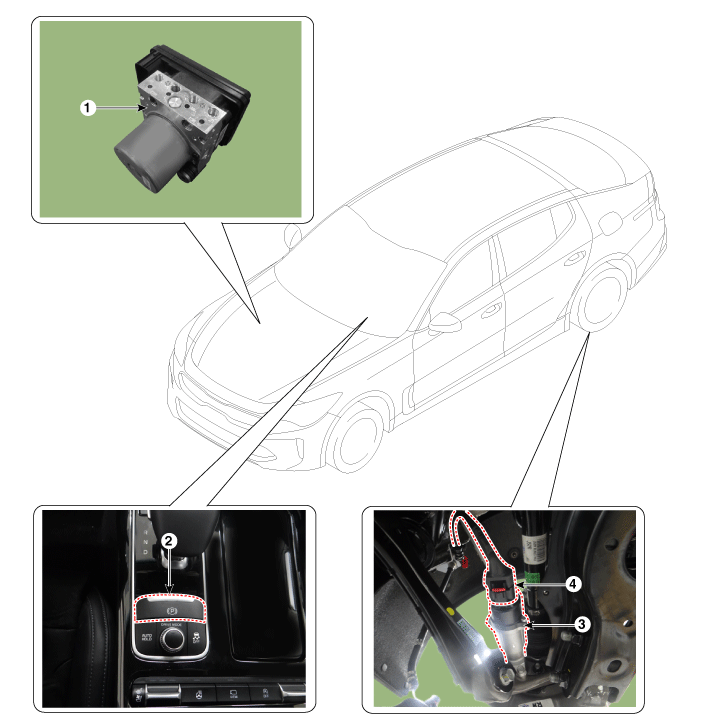
| 1. HECU Module 2. EPB Switch |
3. Electric Parking Brake (EPB) Actuator 4. EPB Actuator Extension Wire. |
Repair Procedures
Removal
[EPB Type]
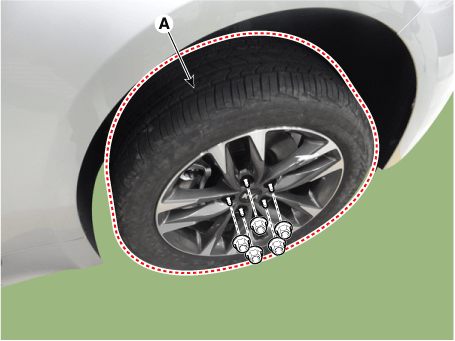
Remove the wheel nuts, wheel and tire (A) from the hub.
Tightening torque: 107.9–128 N·m
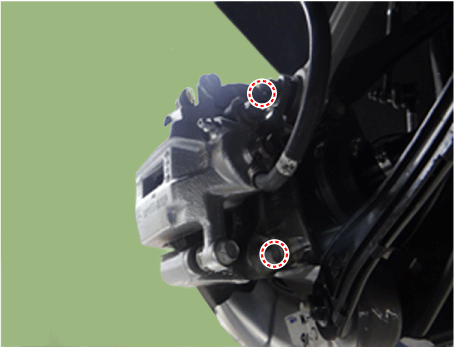
Loosen the caliper guide bolts and remove the brake caliper.
Tightening torque: 78.5–98 N·m
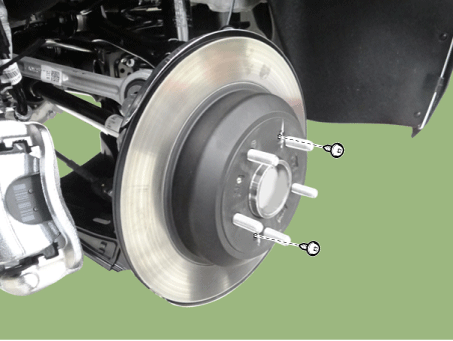
Loosen the brake disc screw and remove the brake disc.
Tightening torque: 4.9–5.9 N·m
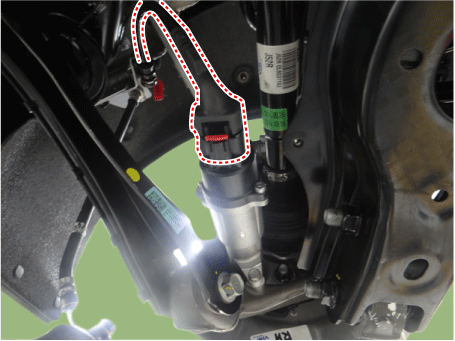
Disconnect the EPB actuator connector.
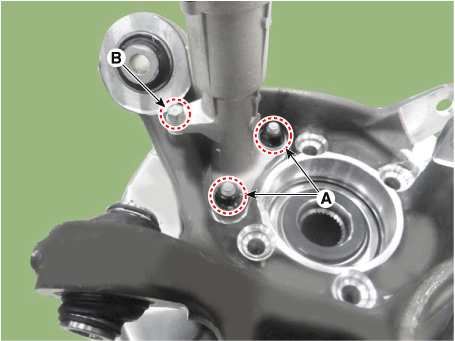
Loosen the nuts and bolt (B) of the EPB actuator (A).
Remove the pin.
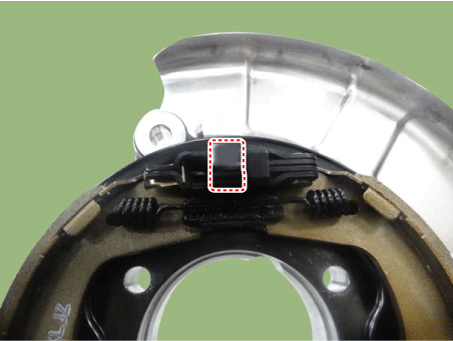
Using a screwdriver, press the rod, then remove the EPB actuator.
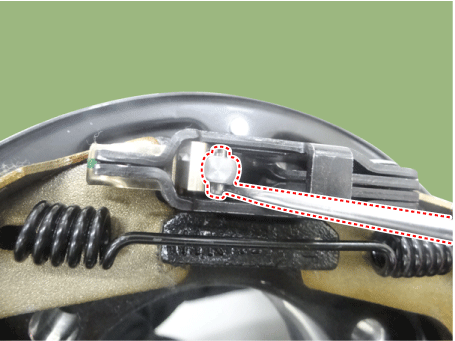
Install in the reverse order of removal.
Test yourself
A quick Kia Stinger CK quiz: every answer comes with an explanation and a link to the manual page.