Tire Pressure Monitoring System
Components and Component Location
Components
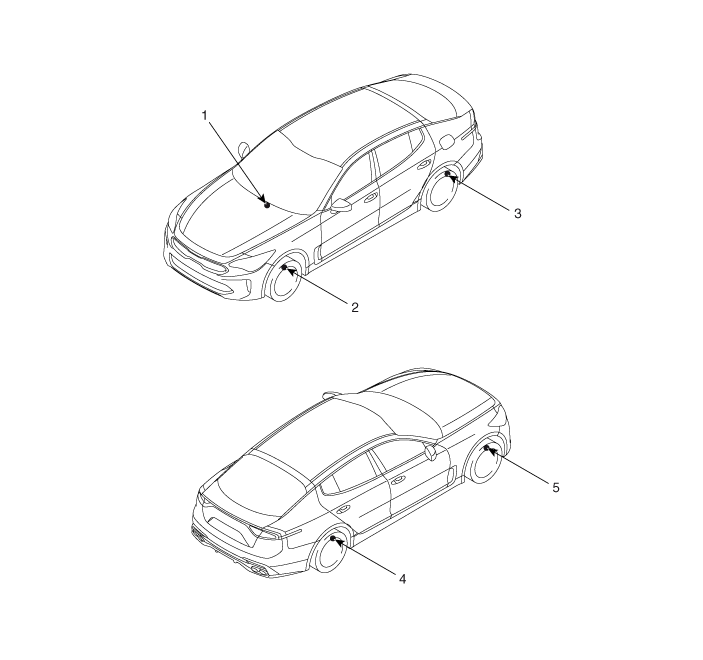
| 1. IBU (TPMS) 2. TPMS Sensor (FL) 3. TPMS Sensor (RL) |
4. TPMS Sensor (RR) 5. TPMS Sensor (FR) |
Description and Operation
Description
TPMS Warning Lamp
Tire Inflation / Leak Warning

Turn-on condition
When tire pressure is below the threshold
When the sensor detects a rapid leak.
Indicates that the tire must be reinflated to the specified pressure. / Repair.
Turn-off condition
Low Pressure: When the tire pressure is above [warning threshold + hysteresis].
Rapid Leakage: When the tire pressure is above [leakage warning threshold].
Warning Trouble Code
Turn-on condition
When the system detects a malfunction outside the receiver/sensor.
When the system detects a receiver malfunction.
When the system detects a sensor malfunction.
Turn-off condition
If the malfunction is considered "critical", the warning lamp remains on during the current ignition cycle (even if the DTC has been downgraded). This is because it is important to bring the problem to the driver's attention. At the next ignition cycle, the downgrade conditions will be rechecked. If the downgrade conditions occur, the lamp will turn off. It will remain on until the DTC downgrade check is complete.
"Non-critical" malfunctions are those that may occur temporarily, for example, due to a drop in battery voltage. Therefore, the lamp turns off when the DTC downgrade condition occurs.
System error
General Function
The system monitors a number of inputs over time to determine whether a malfunction is present.
Malfunctions are ranked according to which is the most likely cause.
Up to 15 malfunctions can be stored.
Some malfunctions are not covered by DTCs. These include:
a. Thermal shutdown of sensor (above 257°F/125 °C).
b. Ignition line sticking: Observe the warning lamps when the ignition is turned on for diagnosis.
Troubleshooting
TPMS Inspection Method
Inspection
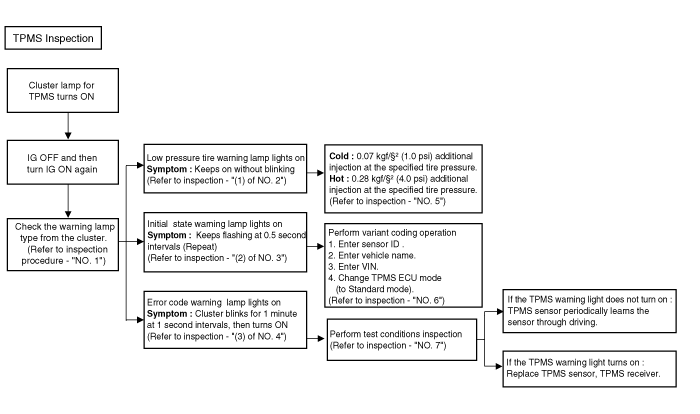
Types of Warning Lights
Steady illumination: Low tire pressure warning light
Flashes constantly at 0.5-second intervals: Initial state warning light
Flashes for 1 minute at 1-second intervals, then remains on: DTC warning light
(1) Check the condition of the warning light.
Check the condition of the vehicle warning light.
Check whether the warning light condition is caused by low tire pressure.
Symptom: Illuminates steadily.
(2) Check the condition of the warning light.
Check the condition of the vehicle warning light.
Check whether the warning light condition is caused by the initial state (initial mode) of the TPMS receiver.

Symptom: Flashes constantly at 0.5-second intervals.
(3) Check the condition of the warning light.
Check the condition of the vehicle warning light.
Check whether the warning lamp condition is caused by a malfunction code (TPMS receiver and TPMS sensor malfunction).
Symptom: The cluster flashes for 1 minute at 1-second intervals, then stays on.
Low Tire Pressure Warning Light
Cold: Vehicle has been stopped for more than 60 minutes.
→ Add 0.07 kgf/cm² (1.0 psi) above the specified tire pressure.
Hot: Vehicle
→ Add 0.28 kgf/cm² (4.0 psi) above the specified tire pressure.
Inspect the initial state warning light
A. TPMS warning lamp
(1) Check the status of the TPMS warning lamp.
(2) Flashes continuously at 0.5-second intervals. -> Initial state of the warning lamp
B. Items to check if the warning lamp is flashing
(1) Enter the sensor ID.
(Refer to TPMS Receiver - Repair Procedures)
(2) Enter the vehicle name.
(Refer to TPMS Receiver - Repair Procedures)
(3) Enter the VIN.
(Refer to TPMS Receiver - Repair Procedures)
(4) Change the TPMS ECU mode (to standard mode).
DTC checklist for performance check.
Test yourself
A quick Kia Stinger CK quiz: every answer comes with an explanation and a link to the manual page.