Anti-Lock Brake System (ABS)
WARNING
ABS (or ESC) will not prevent accidents resulting from improper or dangerous driving maneuvers. Even though vehicle controllability is improved during emergency braking, always maintain a safe distance between you and objects ahead. Vehicle speed should always be reduced in extreme road conditions. The braking distance for a vehicle equipped with an anti-lock brake system (or electronic stability control) may be longer than for vehicles without it, under the following road conditions.
Under these conditions, the vehicle should be driven at reduced speed:
- Rough, gravel, or snow-covered roads.
- With snow chains installed.
- On roads where the road surface has potholes or other surface irregularities.
The safety features of an ABS (or ESC) equipped vehicle must not be tested by driving at high speed or cornering. This may endanger your safety or the safety of others.
The ABS constantly monitors wheel speed. If the wheels are about to lock, the system repeatedly modulates the hydraulic brake pressure to the wheels.
When you depress the brake pedal under conditions that may lock the wheels, you may hear a ticking sound from the brakes, or feel a corresponding sensation in the brake pedal. This is normal and means that your ABS is active.
To get the maximum benefit from your ABS in an emergency, do not attempt to modulate brake pressure and do not pump your brakes. Depress the brake pedal as firmly as possible, or as hard as the situation requires, and allow the ABS to control the force applied to the brakes.
✽ NOTICE
A clicking sound may be heard from the engine compartment when the vehicle starts to move after the engine is started. These conditions are normal and indicate that the anti-lock brake system is operating properly.
- Even with an anti-lock brake system, your vehicle still requires adequate braking distance. Always maintain a safe distance from the vehicle ahead of you.
- Always reduce speed when cornering. The anti-lock brake system cannot prevent accidents resulting from excessive speed.
- On loose or uneven road surfaces, the operation of the anti-lock braking system may increase braking distance compared with vehicles equipped with a conventional brake system.
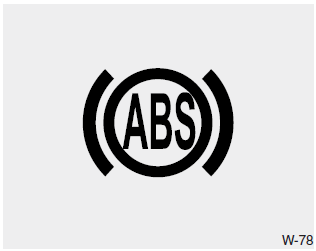
CAUTION
- If the ABS warning lamp stays on, you may have a problem with the ABS. In this case, however, your normal brakes will still function normally.
- The ABS warning lamp will remain on for approximately 3 seconds after the ignition switch is turned on. During this time, the ABS performs a self-diagnosis, and the lamp will turn off if everything is normal. If the lamp remains on, there may be a problem with your ABS. We recommend that you contact an authorized Kia dealer.
CAUTION
- When driving on a road with poor traction, such as an icy road, and repeatedly depressing the brakes, the ABS will be active continuously and the ABS warning lamp may illuminate. Pull the vehicle over to a safe place and stop the engine.
- Restart the engine. If the ABS warning light does not illuminate, the ABS system is normal. Otherwise, there may be a problem with the ABS. We recommend that you contact an authorized Kia dealer.
✽ NOTICE
When you start your vehicle with a discharged battery, the engine may not run smoothly and the ABS warning light may illuminate at the same time. This is caused by low battery voltage. It does not mean that the ABS is malfunctioning.
- Do not pump the brakes!
- Charge the battery before driving the vehicle.
Test yourself
A quick Kia Cee'd quiz: every answer comes with an explanation and a link to the manual page.