Radio operating principle
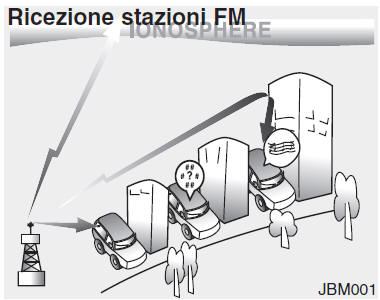
AM (MW, LW) and FM radio signals are broadcast by radio transmitters located near cities. These signals are picked up by the vehicle's antenna. The radio then receives these signals and plays them through the vehicle's speakers. When the vehicle receives a strong signal, the advanced audio system technology ensures maximum playback quality. However, the signal reaching the vehicle is not always this strong and clear.
This may be due to several factors, such as the distance from the radio station, the proximity of other stations with strong signals, or the presence of buildings, bridges or other large obstacles nearby.
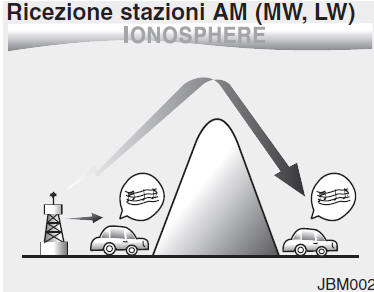
Compared with FM stations, AM (MW, LW) stations can be received from a greater distance. This is because AM (MW, LW) radio waves are transmitted at a low frequency.
Rather than travelling in a straight line through the atmosphere, these long, low-frequency radio waves can follow the curvature of the earth. They also provide better coverage because they can go around obstacles.
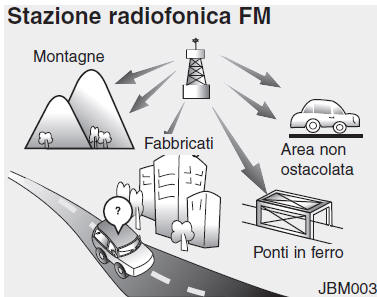
FM stations transmit at a high frequency, so the radio waves do not follow the curvature of the earth. For this reason, the FM signal generally begins to weaken already at a short distance from the transmitter. FM signals are also easily disturbed by buildings, mountains and other obstacles.
All of this can create certain listening conditions that may lead you to believe the radio is not working as it should. The situations described below are normal conditions and do not indicate a problem with the radio's operation.
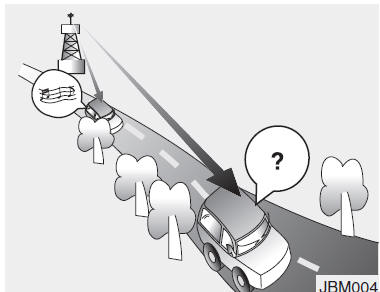
- Fading - As the vehicle moves away from the radio station, the signal weakens and the sound begins to fade. In this case, we suggest tuning to another station with a stronger signal.
- Distortion/Crackling - Weak FM signals, as well as large obstacles between the transmitting station and the vehicle, can cause interference such as crackling or distortion. When this type of interference occurs, its effect can be reduced by lowering the treble level.
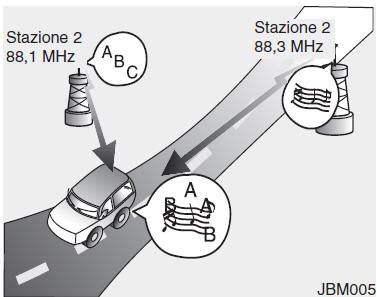
- Station switching - When the FM signal becomes weak, the radio may tune to another nearby frequency with a stronger signal.
This occurs because the radio is designed to tune to the strongest signal. If this happens, tune the radio to another station with a stronger signal.
This may be caused by the signal from the same station being received both directly and by reflection, or by the signals of two stations with nearly identical frequencies.
If this happens, tune the radio to another station until the phenomenon disappears.Use of mobile phones or two-way radios When a mobile phone is used inside the vehicle, the sound from the speakers may be disturbed. This does not indicate a malfunction of the audio system.
If this occurs, use the mobile phone as far away from the audio system as possible.
WARNING When using communication systems such as mobile phones or transceivers inside the vehicle, a dedicated external antenna must be installed. Using mobile phones or transceivers that use their own antenna inside the vehicle can interfere with the vehicle's electrical system and compromise the operation of safety systems. CAUTION Do not use the mobile phone while driving. To use the mobile phone, stop in a safe place.Test yourself
A quick Kia Picanto JA quiz: every answer comes with an explanation and a link to the manual page.