Battery Sensor
Description and Operation
Description
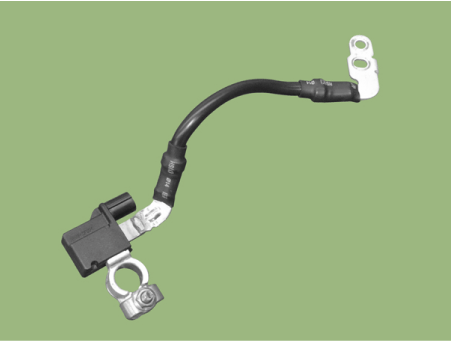
Vehicles have many control units that consume more electrical power. These units control their own systems based on information from various sensors. It is important to have a stable power supply because different sensors provide different information. The battery sensor (A) is installed on the battery negative (-) terminal. It transmits battery voltage and current and temperature information to the ECM. The ECM controls the charging voltage duty cycle based on these signals.
Repair Procedures
Removal
Turn the ignition off.
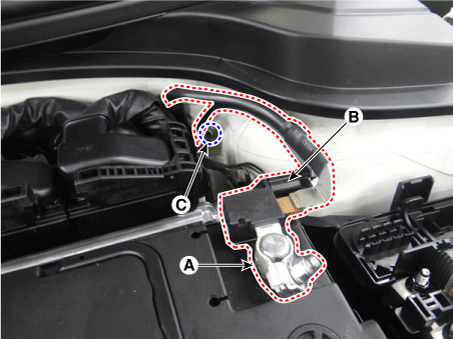
Disconnect the negative (-) terminal (A) from the battery.
Disconnect the battery sensor connector (B).
Remove the battery sensor by loosening the mounting bolts (C).
Negative (-) battery terminal nut tightening torque:
4,0–6 N·m
Battery sensor cable mounting bolt (chassis ground):
10,8–13.7 N·m
Installation
Install in the reverse order of removal.
Battery Sensor Recalibration Procedure
After reconnecting the battery negative cable, the AMS function does not operate until the system stabilizes, approximately 4 hours. When disconnecting the negative (-) battery cable from the battery during repair work on a vehicle equipped with the AMS function, the battery sensor recalibration procedure must be performed after the repair work is completed.
Turn the ignition switch ON and OFF.
Park the vehicle for approximately 4 hours with the hood closed and all doors closed.
Test yourself
A quick Kia Rio YB quiz: every answer comes with an explanation and a link to the manual page.