System Limitations
FCA is a driver assistance system for certain hazardous driving conditions and does not take full responsibility for all risks associated with driving conditions. FCA monitors road conditions using a camera sensor. Therefore, for situations outside the detection range, FCA may not function normally. The driver must exercise caution in the following situations. FCA performance may be limited.
Vehicle Recognition
- The camera is contaminated with foreign substances.
- Heavy rain or snow.
- The vehicle ahead has a narrow body (e.g., motorcycle or bicycle).
- The driver's view is unclear due to glare, reflected light, or darkness.
- The camera cannot capture the complete image of the vehicle ahead.
- The vehicle ahead is a special vehicle, such as a heavily loaded truck or trailer.
- External brightness changes significantly, such as when entering or exiting a tunnel.
- Vehicle movement is unstable.
- Camera sensor recognition is limited.
- The driver's field of view is poorly lit (either too dark or too bright, reflections, or excessive backlight blocking the view).
- The vehicle ahead moves erratically.
- Light is reflected in the direction of travel (including headlights from the vehicle ahead).
- Moisture on the windshield is not fully removed or has frozen.
- Foggy weather.
- The vehicle ahead does not turn on its tail lights, has no tail lights, has asymmetrical tail lights, or the tail lights are not angled.
- The vehicle is on a gravel or uneven rough surface, or on a road with sharp gradient changes.
- The vehicle is driving underground or inside a building.
- When passing over a speed bump.
- When the vehicle vibrates excessively.
- When driving through a roundabout behind the vehicle ahead.
- If the front of the camera lens is contaminated by windshield tint, film, water-repellent coating, glass damage, or foreign objects (stickers, insects, etc.).
- The camera or camera lens is damaged.
- If the vehicle headlights are not used at night or in tunnel sections, or the light is too weak.
- If a street lamp or the headlights of an oncoming vehicle are reflected, or when sunlight is reflected by water on the road surface.
- When tail light is projected in the direction of travel (including vehicle headlights).
- Road sign, shadow on the road, tunnel entrance, toll gate, partial coverage.
- If there is moisture on the windshield surface or the windshield is frozen.
- Driving in fog.
- When objects are outside the camera's coverage area.
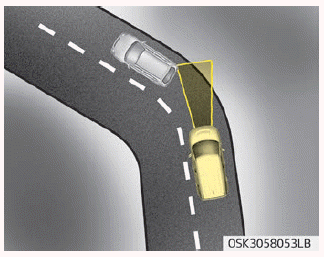
- Driving on curves
FCA performance is reduced when driving through a curve. FCA may not recognize a vehicle ahead even in the same lane. This may result in an unnecessary warning message and warning signal, or it may not issue a warning message and warning signal at all.
When driving through a curve, exercise maximum caution and, if necessary, depress the brake pedal.
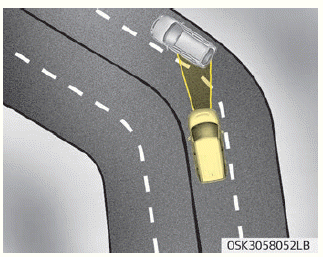
When driving through a curve, FCA may recognize a vehicle ahead in the adjacent lane. Exercise maximum caution and, if necessary, depress the brake pedal. Or, depress the accelerator pedal to maintain driving speed. Always look around the vehicle for your safety.
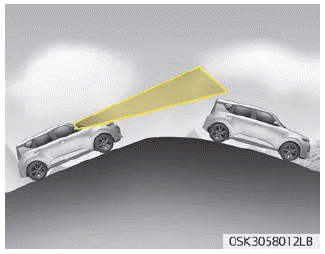
- Driving on slopes
FCA performance is reduced when driving uphill or downhill, and it may not recognize a vehicle ahead in the same lane. This may result in an unnecessary warning message and warning signal, or it may not issue a warning message and warning signal at all.
When FCA suddenly recognizes a vehicle ahead while driving on a slope, you may experience sudden deceleration.
Always look ahead when driving uphill or downhill and, if necessary, depress the brake pedal.
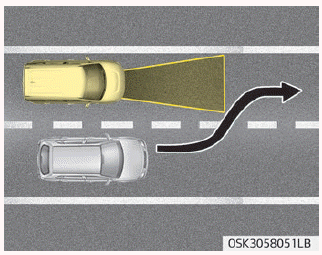
- Lane change
Even if a vehicle in the adjacent lane moves into your lane, it may not be recognized by FCA until it enters the FCA detection range.
Especially when a vehicle in the adjacent lane cuts sharply into your lane, it is likely not to be recognized. Always pay close attention.
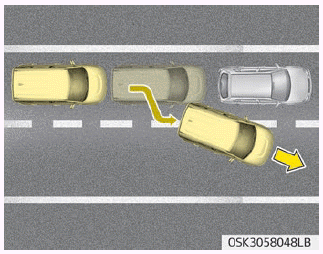
When a stopped vehicle ahead leaves the lane, it may not be recognized by your FCA. Always pay close attention.
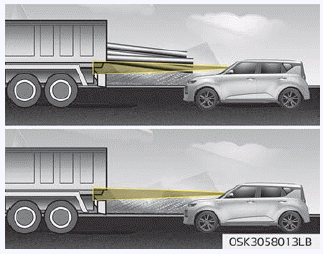
- Vehicle Recognition
When the vehicle ahead has a heavy load extending rearward, or when the vehicle ahead has greater ground clearance, this may create a dangerous situation.
WARNING
- Turn off FCA in the user settings on the LCD display before towing another vehicle. During towing, braking may adversely affect your vehicle safety.
- Be especially careful with a vehicle ahead when it has a heavy load extending rearward, or when it has greater ground clearance.
- The sensor detects only vehicles ahead on the road, not carts, bicycles, motorcycles, luggage bags, or strollers.
- FCA does not operate in certain situations. Therefore, never test FCA by using a person or object as a target. This may result in serious injury or even death.
- When replacing or reinstalling the windshield or camera after removal, have the vehicle inspected at a professional workshop. Kia recommends visiting an authorized Kia dealer/service partner.
Test yourself
A quick Kia Soul Owner's Manual quiz: every answer comes with an explanation and a link to the manual page.