Towing
Towing a caravan and a utility trailer (Europe/Russia/Turkey/Israel/South Africa).
Your Mazda is designed and built primarily to carry passengers and luggage.
If you tow a trailer, follow the instructions below, as the safety of the driver and passengers depends on correct equipment and safe driving practices. Towing a trailer affects vehicle handling, braking performance, durability, performance and running economy.
Never overload the vehicle or the trailer. Consult a Mazda Authorized Service Center if you need additional information.
CAUTION
Do not tow a trailer during the first 1000 km of operation of your Mazda, as you may damage the engine, transmission, differential, wheel bearings and other drivetrain components.
Damage resulting from towing a trailer/caravan is not covered by the vehicle warranty for the following models and countries:
- All models in Turkey
- Sedan body models in South Africa
Weight limits
The total trailer weight, the total combination weight and the tongue load of the vehicle must be within the values given in the Towable Trailer Weight Table.
TOTAL TRAILER WEIGHT:
The sum of the trailer weight and its load.
COMBINATION WEIGHT: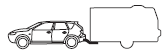
The sum of the total trailer weight and the weight of the towing vehicle, including the towbar, vehicle occupants and vehicle cargo.
TONGUE LOAD:
The force acting on the vehicle's towbar. This value varies depending on how the load is distributed when loading the trailer.
As the altitude at which the vehicle is operated increases, engine output decreases. For this reason, it is recommended to reduce the total trailer weight and the combination weight by 10% for every 1000 m above sea level.
Maximum towable trailer weight table
Europe/Gradient up to 12%
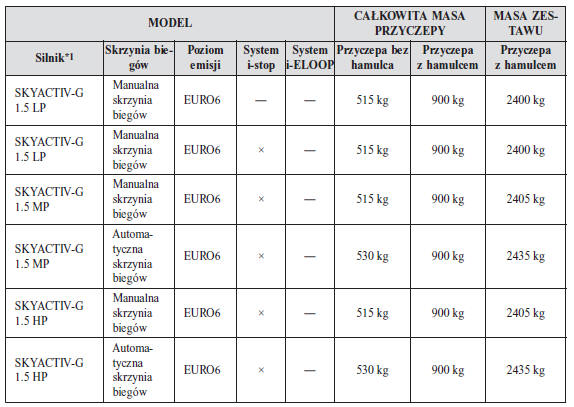
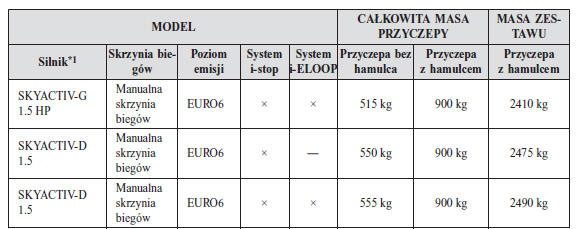
×: Available
-: Not available
TONGUE LOAD: 50 kg
*1 The letter abbreviations at the end of engine types have the following meanings: LP: Low-Power MP: Medium-Power HP: High-Power
Germany and Austria/Gradient up to 8%
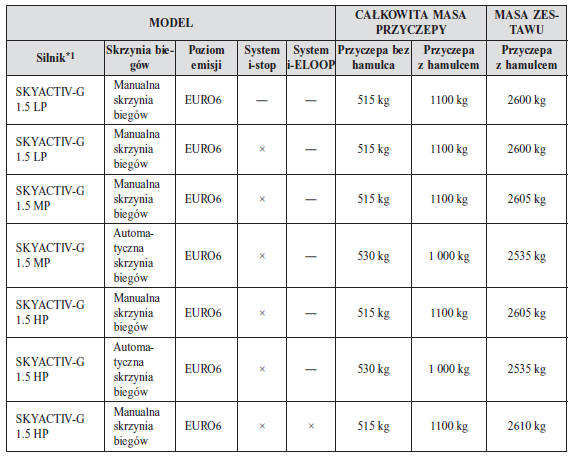
×: Available
-: Not available
TONGUE LOAD: 50 kg
*1 The letter abbreviations at the end of engine types have the following meanings: LP: Low-Power MP: Medium-Power HP: High-Power
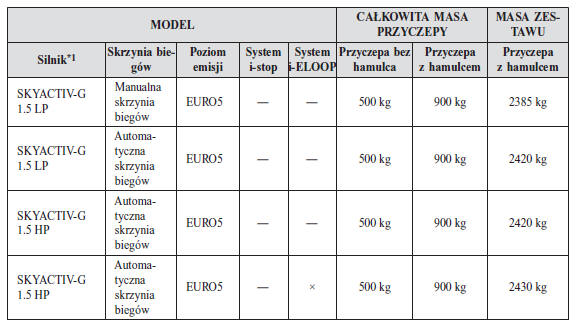
Russia/Gradient up to 12%
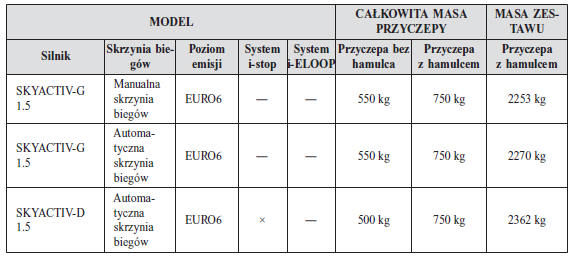
Israel/Gradient up to 12%
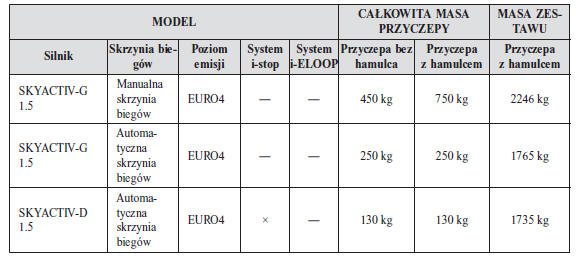
South Africa/Gradient up to 12%
WARNING
The trailer weight must always remain within the limits specified in the Maximum Towing Capacity table. Towing loads heavier than the values in the table is a safety hazard, as it may make the vehicle harder to control and reduce its performance. This may result in injury and/or damage to the vehicle.
The tongue load value must always remain within the limits specified in the Maximum Towing Capacity table. Loading the trailer with more weight at the rear than at the front is a safety hazard.
This may lead to loss of control of the vehicle and an accident.
CAUTION
The total trailer weight and the tongue load can be determined by weighing the trailer on a platform scale at a highway weigh station or at a freight forwarding company.
The correct total trailer weight and tongue load of the tow vehicle help prevent the trailer from swaying due to crosswinds, uneven road surfaces or other causes.
Towbar
Use an appropriate tow hitch when towing a trailer. We recommend using an original Mazda tow hitch. Use only the bolt holes made by the manufacturer for mounting the tow hitch. Contact a Mazda Authorized Service Center for more information.
Tow hitch mounting location
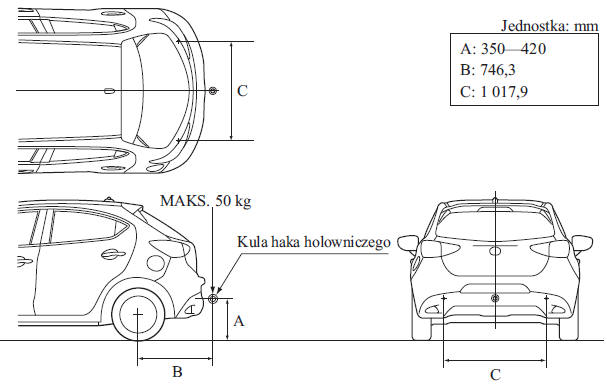
Tyres
When towing a trailer, make sure the tire pressure, measured at ambient temperature, matches the recommendations on the label on the driver's door. The trailer tire size, load and tire pressure must match the data specified by the tire manufacturer.
WARNING
Never use the temporary spare tire while towing: Using the temporary spare tire on your vehicle while towing a trailer is a safety hazard, as it may cause tire failure, loss of vehicle control and injury to passengers.
Safety chains
Safety chains must be used as a precaution in case the trailer accidentally detaches or is unhitched. The chains should cross under the trailer tongue and be attached to the tow hitch. Leave enough slack in the chains to allow full turns of the vehicle with the trailer. See the information published by the trailer or tow hitch manufacturer for more details.
WARNING
Before driving, make sure each safety chain is securely attached to the trailer and to the hitch: Towing a trailer without safety chains securely attached to the trailer and the hitch is a safety hazard. If the tow hitch or trailer coupling is damaged, the trailer may swerve into an adjacent lane and cause an accident.
Trailer lighting
CAUTION
Do not connect the trailer lighting directly to the lights of your Mazda. This may damage the electrical system and the lighting components of your vehicle.
To connect the trailer lighting correctly, consult a Mazda Authorized Service Center.
Trailer Brakes
Check the permissible towed trailer weight in the Maximum Towing Capacity table (page 3-61). If the weight of the towed trailer exceeds the values in the TOTAL TRAILER WEIGHT column (trailer without brakes), a trailer with brakes must be used.
If your trailer is equipped with brakes, make sure they meet applicable standards and regulations.
WARNING
Do not connect the trailer's hydraulic brake system to your vehicle's brake system: Connecting the trailer's hydraulic brake system directly to the vehicle's brake system causes improper braking and is a safety hazard.
Towing recommendations
Getting to know your Mazda
- Check that your Mazda behaves correctly after hitching a loaded or empty trailer. Do not start the trip if the trailer is in an incorrect position, the front is raised significantly or tilted downward. Check that the tongue load is correct, suspension components are not worn and the trailer is not overloaded. If there are any irregularities, consult a specialist service; we recommend a Mazda Authorized Service Center.
- Make sure the trailer load is secured against shifting.
- Make sure the rear-view mirrors comply with applicable regulations. Check them.
- Before driving, check the operation of all vehicle and trailer lights and the connections between the vehicle and trailer. Stop and check all lights and connections again after driving a short distance.
Driving
- Your Mazda will handle differently when towing a trailer. Practice turning, reversing and braking in an open area away from traffic.
- Allow yourself time to get used to the additional weight and length of the vehicle combination.
- Do not exceed 100 km/h when towing a trailer. If the maximum speed permitted by local regulations when towing is below 100 km/h, do not exceed the permitted speed.
CAUTION
Exceeding 100 km/h with the vehicle towing a trailer may cause damage to the vehicle.
- When driving uphill, use a lower gear to reduce the possibility of overloading and/or overheating the engine.
- When driving downhill, use a lower gear and brake with the engine. Keep an eye on your speed at all times and use the brakes only when necessary. Using the brakes for a prolonged period may cause them to overheat and reduce the efficiency of the braking system.
Parking
Avoid parking with a trailer on a sloped road. If this is necessary, follow the instructions provided.
Parking on a slope
1. Apply the parking brake and press the brake pedal.
2. Ask someone to chock the wheels of the vehicle and trailer while you press the brake pedal.
3. When the wheels are locked, slowly release the parking brake lever and take your foot off the brake pedal so that the wheel chocks take the load.
4. Apply the parking brake.
5. If the vehicle has an automatic transmission, shift the selector lever to P. If it has a manual transmission, engage first or reverse gear.
Starting on an Incline
1. Start the engine (see page 4-6).
2. Release the parking brake and slowly drive away from the wheel chocks.
3. Stop on the nearest level road, apply the parking brake and remove the wheel chocks from the road.
Test yourself
A quick Mazda 2 quiz: every answer comes with an explanation and a link to the manual page.