Tires
For optimum performance, safety, and maximum fuel economy, tires must always be inflated to the recommended tire pressures and must also comply with the recommended load limits and weight distribution.
WARNING
Using tires of different types:
Driving with tires of different types is dangerous. It may result in poor handling and poor braking performance, and may cause loss of vehicle control.
Except when using the temporary-use spare tire on a limited basis, use only tires of the same type (radial, belted-bias, bias-ply) on all four wheels.
Using tires of incorrect size:
Using tires of sizes other than those recommended for this Mazda vehicle (page 9-7) is dangerous. It may seriously affect comfort, handling, ground clearance, wheel well clearance, and speedometer readings.
This may lead to an accident.
Use only tires of the sizes specified for this Mazda vehicle.
Tire Inflation Pressure
WARNING
Always keep tires inflated to the correct pressure:
Overinflating or underinflating the tires is dangerous. Poor handling or sudden tire failure may cause a serious accident.
Refer to Tires on page 9-7.
Use only a genuine Mazda valve cap:
Using a non-genuine part is dangerous, because the correct tire inflation pressure cannot be maintained if the tire valve is damaged. If the vehicle is driven in this condition, tire inflation pressure will decrease, which may lead to a serious accident. Do not use any valve cap other than a genuine Mazda part.
The inflation pressures of all tires (including the temporary-use spare tire) must be checked monthly, when the tires are cold. The recommended pressures must be maintained to achieve optimum driving and handling and minimum tire wear.
Refer to the tire inflation pressure table on page 9-7.
After adjusting the tire pressures, the tire pressure monitoring system must be initialized for the system to operate normally.
Refer to Initializing the Tire Pressure Monitoring System on page 4-123.
NOTE
- Always check tire pressure when the tires are cold.
- When tires are hot, inflation pressures will generally exceed the recommended values. Do not let air out of the tires to adjust the pressure when they are hot.
- Underinflation may cause reduced fuel economy, uneven and premature tire wear, and poor tire bead sealing. It may deform the wheel and cause the tire to separate from the rim.
- Overinflation may cause harsh riding, uneven and premature tire wear, and greatly increases the possibility of damage from road hazards. Make sure tire pressures are always at the correct levels. If you often need to add air to a tire, have it checked.
Tire Rotation
WARNING
Rotating the tires periodically:
Using a tire with uneven wear is dangerous.
To even out tire wear and maintain good driving and braking performance, rotate the tires according to the schedules in the maintenance tables.
Refer to Periodic Maintenance on page 6-4.
When rotating, check that the wheel balance is correct.
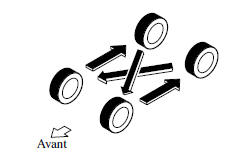
Do not include the temporary-use spare tire (TEMPORARY USE ONLY) in the rotation.
Each time the tires are rotated, check whether they are damaged or unevenly worn. Abnormal tire wear is generally caused by one or more of the following:
- Incorrect tire inflation pressure
- Improper wheel alignment
- Incorrect wheel balance
- Hard braking
After rotating, be sure to set the front and rear tire inflation pressures to the specifications (page 9-7) and check the wheel nut tightening torque.
After adjusting the tire pressures, the tire pressure monitoring system must be initialized for the system to operate normally.
Refer to Initializing the Tire Pressure Monitoring System on page 4-123.
WARNING
Rotate unidirectional tires and radial-ply tires with asymmetrical or studded tread from front to rear only, not from side to side. Tire performance will be reduced if the tires are rotated from one side to the other.
Tire Replacement
WARNING
Use only tires in good condition:
Driving with worn tires is dangerous. Reduced braking, steering and traction performance can cause an accident.
Always replace all four tires at the same time:
Replacing only one tire is dangerous. It may cause poor handling and braking performance, which can lead to loss of vehicle control. Mazda strongly recommends replacing all four tires at the same time.
If a tire is worn evenly, a wear indicator appears across the tread.
In this case, replace the tire.
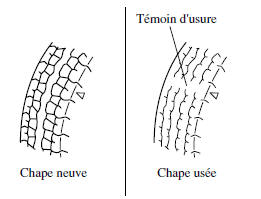
The tire must be replaced before the wear indicator appears across the tread.
After adjusting the tire pressures, the tire pressure monitoring system must be initialized for the system to operate normally.
Refer to Initializing the Tire Pressure Monitoring System on page 4-123.
NOTE
Tires deteriorate over time, even if they are not used on the road. It is generally recommended to replace tires that are 6 years old or older. Heat from use in hot climates or under heavy loads can accelerate the aging process. The spare tire should be replaced when the other tires are replaced, as it also ages. The tire manufacturing date (week and year) is indicated by a 4-digit number.
Refer to Tire Labeling on page 8-25.
Temporary Spare Tire
Check the temporary spare tire at least once a month to make sure it is always properly inflated and stored.
NOTE
The condition of the temporary spare tire gradually deteriorates even if it has not been used.
The temporary spare tire is easier to handle because it is lighter and smaller than a conventional wheel. This tire should only be used in an emergency and for a limited distance.
Use the temporary spare tire only for the time needed to repair the conventional tire, and have the repair done as soon as possible.
Refer to Tires on page 9-7.
WARNING
- Do not mount a snow tire or regular tire on the temporary spare wheel. These tires will not fit properly and may damage the rim and the tire.
- The temporary spare tire has a tread life of less than 5,000 km (3,000 miles). The tread life may be even shorter depending on driving conditions.
- Use of the temporary spare tire must be limited. However, if the wear indicator appears across the tread, replace this temporary spare tire with one of the same type (page 6-41).
NOTE
Tires deteriorate over time, even if they are not used on the road. It is generally recommended to replace tires that are 6 years old or older. Heat from use in hot climates or under heavy loads can accelerate the aging process. The spare tire should be replaced when the other tires are replaced, as it also ages. The tire manufacturing date (week and year) is indicated by a 4-digit number.
Refer to Tire Labeling on page 8-25.
Wheel Replacement
WARNING
Use only wheels of the correct size on this vehicle:
Using wheels of a size not specified for this vehicle is dangerous. It can affect braking and handling, which may cause loss of vehicle control and an accident.
WARNING
A wheel of a size other than the specified one may affect:
- Tire fit
- Wheel and wheel bearing life
- Ground clearance
- Chain clearance
- Speedometer reading
- Headlight alignment
- Bumper height
- Tire Pressure Monitoring System
When replacing a wheel, make sure the new wheel matches the original in diameter, rim width and offset (inset/outset).
Proper wheel balance provides a more comfortable ride and reduces tire wear. Unbalanced wheels can cause vibration and uneven tire wear.
Test yourself
A quick Mazda 6 quiz: every answer comes with an explanation and a link to the manual page.