Adaptive cruise control
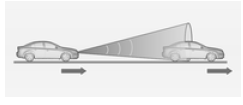
Adaptive cruise control is an enhancement of conventional cruise control with an additional function that maintains a set distance from the vehicle ahead.
Adaptive cruise control automatically slows the vehicle when approaching a vehicle travelling much more slowly. It then adjusts the vehicle speed to follow the vehicle ahead at the selected following distance. The vehicle speed increases or decreases to follow the vehicle ahead, but will not exceed the set speed. It can apply limited braking with the brake lights activated.
Adaptive cruise control can store and maintain speeds above approximately 25 km/h and it can brake automatically to follow a slower vehicle ahead down to a minimum speed of 15 km/h.
 Adaptive
cruise control uses a radar sensor to detect the vehicle ahead. If no vehicle is detected in the lane, adaptive cruise control will behave like conventional cruise control.
For safety reasons, the system can only be activated after the brake pedal has been pressed for the first time after the ignition has been switched on. Activation in first gear is not possible.
It is recommended to use adaptive cruise control mainly on long straight roads such as motorways or country roads with steady traffic.
Do not activate the system when maintaining a constant speed is not advisable.
Indicator light 3 100,
 3 100.
Caution
Full driver attention is required at all times when driving the vehicle with adaptive cruise control.
The driver must keep constant control of the vehicle, as the brake pedal, accelerator pedal and cancel switch override any adaptive cruise control operation.
Switching on

Press the button to
activate adaptive cruise control. The indicator lights up white.
Activation by setting the speed
Adaptive cruise control can be activated between 25 km/h and 180 km/h.
Accelerate to the desired speed and turn the thumbwheel to SET/-; the current speed is stored and maintained.
The warning lightLights up green.
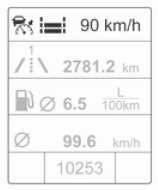 The adaptive cruise control symbol, the following distance setting and the set speed are shown on the top line of the driver information centre.
The accelerator pedal can be released. Adaptive cruise control remains active during gear changes.
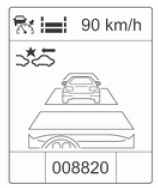 To display the adaptive cruise control control page on the driver information centre, press the MENU button on the turn signal lever and turn the adjustment wheel to select the adaptive cruise control control page.
Cancelling the set speed
It is always possible to drive at speeds higher than the selected set speed by pressing the accelerator pedal.
When the brake pedal is released, the vehicle returns to the set following distance if a slower vehicle is ahead. Otherwise, it returns to the stored speed.
Once the system is activated, adaptive cruise control slows down or brakes if it detects a vehicle ahead that is slower or closer than the set following distance.
Caution
Driver acceleration deactivates braking by the system. This is indicated by a warning shown in the driver information centre.
Increasing speed
With adaptive cruise control activated, hold the thumbwheel turned to RES/+: speed increases continuously in large increments, or press RES/+ repeatedly: speed increases in small increments.
If the vehicle is continuously driven faster than the desired speed, for example after pressing the brake pedal, the current speed can be set and maintained by turning the thumbwheel to SET/-.
Reducing speed
With adaptive cruise control activated, hold the thumbwheel turned to SET/-: speed decreases continuously in large increments, or press SET/- repeatedly: speed decreases in small increments.
If the vehicle is continuously driven slower than the desired speed, for example when a slower vehicle is ahead, the current speed can be set and maintained by turning the thumbwheel to SET/-.
Resuming the stored speed
If the system is on but not active, turn the thumbwheel to RES/+ at a speed above 25 km/h to store the speed.
Following distance setting
When adaptive cruise control detects a slower vehicle in the lane, it adjusts the vehicle speed to maintain the following distance selected by the driver.
The following distance can be set to near, medium or far.

Press the button to
display the current setting in the driver information centre. Press button E again to change the following distance.
The setting is also shown on the top line of the driver information centre.
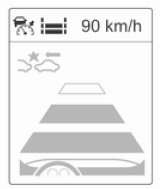 The selected following distance is shown by the filled distance bars on the adaptive cruise control page.
Note that the following distance setting is shared with the forward collision alert sensitivity setting.
Example: If setting 3 (far) is selected, the driver is warned earlier of a possible collision; this is also the case when adaptive cruise control is inactive or switched off.
Caution
The driver accepts full responsibility for the following distance, based on visibility, weather and traffic conditions.
Vehicle ahead detection
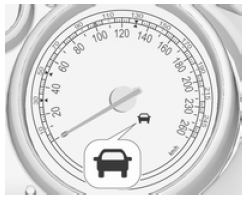
Vehicle ahead indicator lit in green is displayed in the
speedometer when the system detects a vehicle in the driving lane.
If this symbol is not displayed, or is displayed only briefly, the adaptive cruise control will not respond to a vehicle ahead.
Deactivation
The adaptive cruise control is deactivated by the driver when:
- the button
 is pressed,
- the brake pedal is pressed,
- the clutch pedal is pressed for more than four seconds,
- the automatic transmission selector lever is moved to N.
The system is also automatically deactivated when:
- the vehicle accelerates above 190 km/h or decelerates below 15 km/h,
- the traction control system is active for more than 20 seconds,
- the Electronic Stability Control is operating,
- there is no traffic and nothing is detected at the sides of the road for several minutes.
When the adaptive cruise control is deactivated automatically, the indicator lights up white
and a warning symbol is displayed as a pop-up message on the driver information centre.
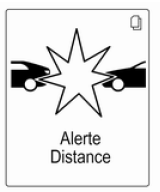 The stored speed
is retained.
Caution
When the adaptive cruise control is deactivated, the driver must take control of the engine and braking.
Deactivation
Press the button to
deactivate the adaptive cruise control.
The warning light goes out. The stored
speed is cleared.
Switching off the ignition also switches off the adaptive cruise control and clears the stored speed.
Driver attention
- Use the adaptive cruise control with caution on hilly or winding roads, as it may lose the vehicle ahead and needs time to detect it again.
- Do not use the system on slippery roads, as it may cause rapid changes in tyre grip (wheel slip) and the driver may then lose control of the vehicle.
- Do not use the adaptive cruise control when it is raining, snowing or in extremely dusty conditions, as the radar sensor may be covered by a water film, dust, frost or snow. This reduces or completely interrupts visibility. If the sensor is blocked, clean the sensor cover.
System limitations
- The automatic braking force of the system does not allow heavy braking, and the braking level may not be sufficient to avoid a collision.
- After an unexpected lane change, the system needs some time to detect the next vehicle ahead. Therefore, if a new vehicle ahead is detected, the system may accelerate instead of decelerating.
- The adaptive cruise control ignores oncoming traffic.
- The adaptive cruise control does not brake for pedestrians, animals or any other objects.
Curves
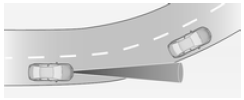 The adaptive
cruise control calculates an estimated lane based on centrifugal force. This estimated lane takes into account the actual curve characteristics, but cannot take into account a future change in curve. The system may lose the vehicle ahead or consider a vehicle that is not in the current lane. This may be reduced when entering or leaving a curve, or if the curve becomes sharper or less sharp.
If no vehicle ahead is detected any longer, the indicator
will go out.
If the centrifugal force is too high in the curve, the system slightly decelerates the vehicle. This braking level is not designed to prevent wheel slip when exiting a curve.
The driver is responsible for reducing the selected speed before entering a curve and, in general, for adapting the speed to the type of road and the existing speed limits.
 Motorways
On motorways, adapt the set speed to the situation and the time. Always bear in mind that the adaptive cruise control has a limited field of view, limited braking capacity and a certain reaction time to check whether a vehicle is in the driving lane or not. The adaptive cruise control may not be able to brake the vehicle in time to avoid a collision with a much slower vehicle or after a lane change. This is especially true if the vehicle is driven at high speed or if visibility is reduced due to weather conditions.
When entering or leaving a motorway, the adaptive cruise control may lose the vehicle ahead and accelerate to the set speed. For this reason, reduce the set speed before leaving or joining a motorway.
Vehicle lane changes
 If another vehicle
enters the same driving lane, the adaptive cruise control will only consider the vehicle once it is fully in your lane. Be ready to act and press the brake pedal if faster braking is required.
Considerations on gradients and when towing
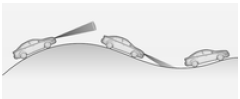 The performance of the
system on gradients and when towing depends on the vehicle speed, the vehicle load, traffic conditions and the gradient of the slope. It may not detect a vehicle in the same lane when driving on slopes. On steep gradients, the accelerator pedal may need to be used to maintain vehicle speed. When driving downhill, especially when towing, the brake may need to be used to maintain or reduce speed.
Note that applying the brakes deactivates the system. Adaptive cruise control is not recommended on steep slopes, especially when towing.
Radar
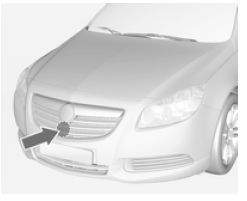
The radar is mounted behind the radiator grille, below the brand emblem.
Caution
The radar unit is precisely aligned at the factory. Therefore, after a frontal collision, do not use the system. The front bumper may appear undamaged, but the sensor behind the bumper may have moved and may not respond correctly.
After an accident, always have a workshop check and correct the position of the adaptive cruise control sensor.
Settings
Settings can be changed in the Collision Preparation menu of vehicle personalisation, 116.
Malfunction
If adaptive cruise control does not operate due to temporary conditions (e.g. blocked by ice) or if there is a permanent system fault, a message is displayed in the driver information center.
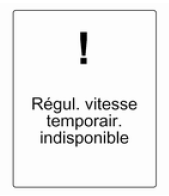 Vehicle messages 109.
Test yourself
A quick Opel Insignia quiz: every answer comes with an explanation and a link to the manual page.