Mixture adaptive correction
PRINCIPLE
In closed-loop phase (see chapter 17 "Mixture control"), mixture control (#35) corrects the injection time so as to obtain a mixture as close as possible to lambda 1. The correction value is close to 128, with limits of 0 and 255.
However, variations in the fuel injection system components may shift the correction toward 0 or 255 in order to achieve lambda 1.
The adaptive correction shifts the injection map to re-center mixture control on 128 and maintain constant correction authority towards enrichment or leaning.
The mixture adaptive correction consists of two parts:
- adaptive correction predominant at medium and high engine loads (read #30),
- adaptive correction predominant at idle and low engine loads (read #31).
After initialization (memory erase), the adaptive corrections take 128 as their average value, and they have limit values:
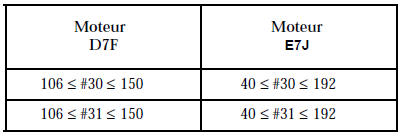
The adaptive corrections only operate when the engine is warm, in closed-loop phase (#35 variable), and over a given manifold pressure range.
The engine must have run in closed-loop mode over several pressure ranges for the adaptive corrections to start changing and compensate for variations in the engine's operating fuel richness.
Therefore, after resetting the ECU (#30 and #31 returned to 128), a specific road test must be carried out.
ROAD TEST
Conditions:
- Engine warm (coolant temperature > 75 °C).
- Do not exceed an engine speed of 4,400 rpm for the D7F engine and 4,800 rpm for the E7J engine.
For this test, it is advisable to start at a fairly low engine speed, in 3rd or 4th gear, with very gradual acceleration so as to stabilize the desired pressure for 10 seconds in each range (see table).
NOTE: for the D7F engine, for example, for range no. 1, try to hold an average of 320 mbar for at least 10 seconds.
Manifold pressure ranges to sweep during the test (reading #01)
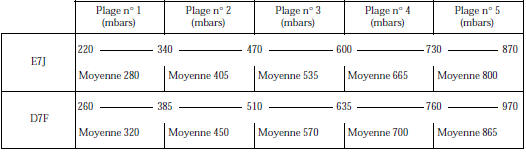
Following this test, the corrections are operational.
#31 varies more noticeably at idle and low loads, and #30 at medium and high loads, but both work across the entire manifold pressure range.
Continue the test by driving normally, smoothly and varied, over a distance of 5 to 10 kilometers.
After the test, read the values of #30 and #31. Initially at 128, they should have changed. If not, repeat the test, taking care to strictly observe the test conditions.
INTERPRETATION OF VALUES OBTAINED AFTER A ROAD TEST
In the case of a fuel shortage (dirty injectors, fuel pressure and flow too low, etc.), the richness control in #35 increases in order to obtain a richness closest to 1, and the adaptive correction in #30 and #31 increases until the richness correction oscillates back around 128.
In the case of excess fuel, the reasoning is reversed: the richness control in #35 decreases and the adaptive correction in #30 and #31 decreases likewise, in order to re-center the richness correction (#35) around 128.
NOTE: analysis of #31 remains difficult, since this correction acts mainly at idle and low loads and is, moreover, very sensitive.
Therefore, do not draw hasty conclusions from this parameter; instead, analyze the position of #30.
The information provided by these two parameters gives an indication of the engine's operating richness, which helps guide diagnosis. For them to be useful in diagnosis, conclusions may only be drawn from their values if they are at the minimum or maximum correction limit and if both parameters have drifted in the same direction.
IMPORTANT: #30 and #31 must only be used and analyzed following a customer complaint or a malfunction, and only if they are at a limit with #35 drifting (#35 varying above 175 or below 80).
Test yourself
A quick Renault Kangoo quiz: every answer comes with an explanation and a link to the manual page.