Idle speed adaptive correction
PRINCIPLE
During normal operation when warm, the idle R.C.O. value varies between a high value and a low value to obtain the nominal idle speed.
Due to operating variations (running-in, engine fouling, etc.), the idle R.C.O. value may be close to the high or low limits.
The adaptive correction (#21) on the idle R.C.O. (#12) compensates for slow changes in the engine's air requirement, re-centering the R.C.O. (#12) on an average nominal value.
This correction is only active if the coolant temperature is above 75°C, 20 seconds after engine start, and when the idle speed is under nominal idle control.
IDLE R.C.O. VALUES AND ADAPTIVE CORRECTION
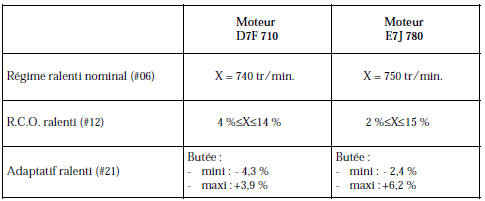
INTERPRETATION OF THESE DATA
In the case of excess air (air intake leak, misadjusted throttle stop, etc.), the idle speed increases: the idle R.C.O. value (#12) decreases to return to nominal idle speed, and the adaptive correction value (#21) decreases to re-center the idle R.C.O. (#12).
In the case of insufficient air (fouling, etc.), the logic is reversed: the idle R.C.O. (#12) increases and the adaptive correction (#21) also increases, to re-center #12 on an average nominal value.
IMPORTANT: after clearing the ECU memory (disconnecting the battery), the engine must be left running at idle before returning the vehicle to the customer so that the adaptive correction can re-adjust correctly.
Test yourself
A quick Renault Kangoo quiz: every answer comes with an explanation and a link to the manual page.