Test and measurement work that can be performed with a pressure gauge set
Reading on pressure gauge set
- Temperature scale for refrigerant R134a CF3-CH2F or CH2F-CF3.
- Pressure scale
In addition to the pressure scale, the pressure gauges may have one or more temperature scales. The scale values for R134a are assigned according to the vapor pressure table. Because different refrigerants develop different vapor pressures at the same temperature, each temperature scale is marked for the corresponding refrigerant.
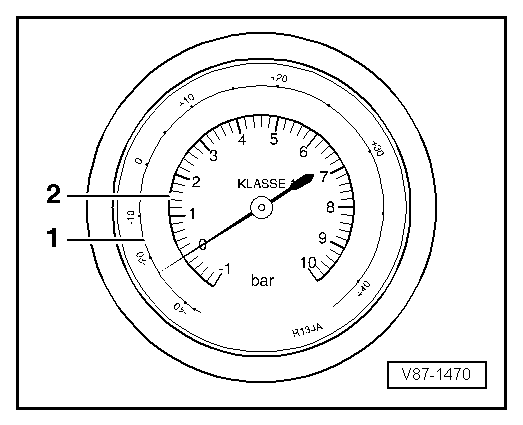
Pressure gauges enable the following test and measurement work
a - Pressure and temperature measurement on the refrigerant circuit
- The high-pressure gauge is used to measure the pressure and temperature which spread evenly from the compressor outlet, through the condenser, up to the restriction (orifice tube or expansion valve) when the air conditioning system is switched on.
- The low-pressure gauge is used to measure the pressure and temperature which spread evenly from the restriction (orifice tube or expansion valve), through the evaporator, up to the compressor inlet when the air conditioning system is switched on.

Note
The relationship between pressure and temperature shown on the pressure gauge only exists where the refrigerant circuit contains liquid or vapor, but not gas. In the gaseous state, the temperature is approx. 10 ºC to 30 ºC higher than the pressure gauge indicates.
b - Detection of refrigerant in a closed container
Refrigerant R134a is present in a closed container or in the refrigerant circuit if the temperature reading on the pressure gauge corresponds to the temperature of the refrigerant (standing liquid assumes the ambient temperature).
A closed container or a switched-off refrigerant circuit is empty if the temperature reading on the pressure gauge is below the temperature of the refrigerant.

Note
The relationship between pressure and temperature shown on the pressure gauge no longer applies if no liquid is contained and the pressure builds up only through gas.