Limitaciones del sensor de cámara/radar
La cámara y el sensor de radar utilizados por varias funciones de asistencia al conductor tienen ciertas limitaciones, que también afectan a las funciones que usan la cámara y el sensor de radar. El conductor debe conocer las siguientes limitaciones:
Limitaciones normales de la cámara y el radar
Cámara obstruida
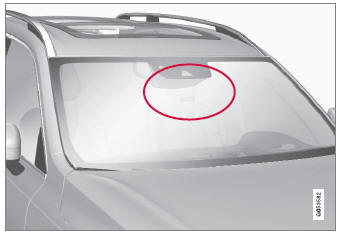
The area marked in the illustration must be cleaned regularly and kept free of decals, objects, solar film, etc.
The camera is located on the upper interior section of the windshield along with the radar sensor.
Do not place, affix or mount anything on the inside or outside of the windshield, or in front of or around the camera and radar sensor – this could disrupt camera and radar-based functions. It could cause functions to be reduced, deactivated completely or to produce an incorrect function response.
Temperatura alta
If the temperature in the passenger compartment is very high, the camera/radar sensor will switch off temporarily for approx. 15 minutes after the engine is started to protect its electronic components. When the temperature has cooled sufficiently, the camera/radar sensor will automatically restart.
Parabrisas dañado
To avoid the risk of malfunction of the driver support systems that use the radar sensor, the following also apply:
- If there are cracks, scratches or stone chips on the windshield in front of any of the camera and radar sensor "windows" and this covers an area of about 0.5 × 3.0 mm (0.02 × 0.12 in.) or more, contact a workshop to have the windshield replaced1.
- Volvo recomienda no reparar grietas, arañazos ni impactos de piedra en la zona situada delante de la cámara y del sensor de radar; en su lugar, debe sustituirse todo el parabrisas.
- Before replacing the windshield, contact a workshop1 to verify that the right windshield has been ordered and installed.
- The same type of windshield wipers or wipers approved by Volvo should be used for replacement.
- If the windshield is replaced, the camera and radar sensor must be recalibrated by a workshop1 to help ensure proper functioning of all of the vehicle's camera and radar-based systems.
Limitaciones adicionales del radar
Velocidad del vehículo
The radar sensor's ability to detect a vehicle ahead is significantly reduced if the speed of the vehicle ahead differs greatly from your vehicle's speed.
Campo de visión limitado
El sensor de radar tiene un campo de visión limitado. En algunas situaciones, puede detectar un vehículo más tarde de lo esperado o no detectarlo en absoluto.
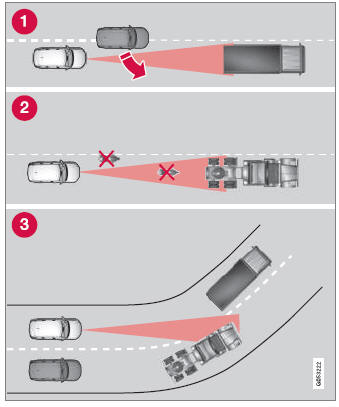
Campo de visión del sensor de radar
 The radar sensor's detection of vehicles very close to your vehicle may be delayed in certain situations, e.g. if a vehicle pulls in between your vehicle and the vehicle directly ahead.
 Small vehicles, such as motorcycles, or vehicles that are not driving in the center of the lane may remain undetected.
 In curves, the radar may detect the a different vehicle than intended or lose sight of a target vehicle.
Remolques bajos
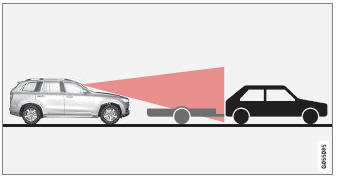
Remolque bajo en la sombra del radar
Los remolques bajos también pueden ser difíciles o incluso imposibles de detectar para el radar. El conductor debe extremar la precaución al conducir detrás de vehículos que remolquen remolques bajos cuando Adaptive Cruise Control* o Pilot Assist* esté activado.
Limitaciones adicionales de la cámara
Visibilidad reducida
Las cámaras tienen las mismas limitaciones que la vista humana. Es decir, su "visión" se ve afectada por condiciones meteorológicas adversas, como nevadas o lluvias intensas, niebla densa, polvo o nieve arremolinados, etc. Estas condiciones pueden reducir el funcionamiento de los sistemas que dependen de la cámara o hacer que dichos sistemas dejen de funcionar temporalmente.
Strong sunlight, reflections from the road surface, ice or snow covering the road, a dirty road surface, or unclear lane marker lines may drastically reduce the camera’s ability to detect the side of a lane, a pedestrian, a cyclist, a large animal or another vehicle.
Limitaciones adicionales de la cámara de aparcamiento*
Ángulos muertos

Existen ángulos muertos entre los campos de visión de las cámaras.
With the Park Assist Camera's 360° view* selected, objects/obstacles may not be detected if they are located in the "joints" where the edges of the individual camera views meet.
Condiciones de iluminación
La imagen de la cámara se ajusta automáticamente según las condiciones de iluminación actuales. Esto significa que el brillo y la calidad de la imagen pueden variar ligeramente. Las malas condiciones de iluminación pueden reducir la calidad de la imagen.
1 Se recomienda un taller autorizado Volvo.
* Opción/accesorio.
Pon a prueba tus conocimientos
Un test rápido sobre el Volvo XC90: cada respuesta trae una explicación y un enlace a la página del manual.