Engine Vacuum Gauge Test
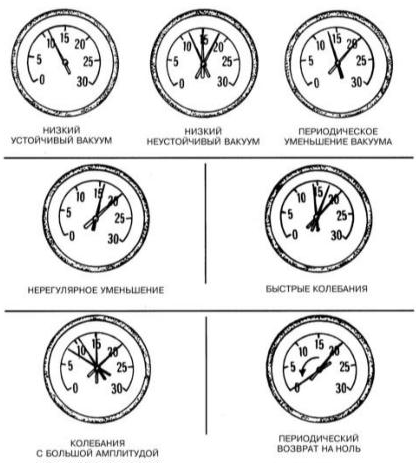 General Information and Vacuum Gauge Needle Fluctuations in Engine Diagnosis
A vacuum gauge can provide information about the engine's condition and help identify a leaking cylinder head gasket, a faulty fuel system, worn piston rings, incorrect fuel system adjustment, damaged valves, and so on. Vacuum gauge readings can be misinterpreted, so these measurements must be used together with other engine test methods. Both the absolute reading and the rate of change of the reading are important for correct diagnosis.
Connect the vacuum gauge to the intake manifold. Start and warm up the engine to normal operating temperature. Read the vacuum gauge. If the engine is in normal condition, the reading should be 430–560 mm Hg and the needle should remain steady.
A low, steady vacuum gauge reading indicates a damaged seal between the intake manifold and the throttle body, a damaged vacuum hose, incorrect ignition timing, or incorrect valve timing.
If the vacuum gauge reading is 80–200 mm Hg below normal and fluctuates, the intake manifold gasket near the inlet opening may be damaged, or an injector may be faulty.
If the reading steadily drops by 50–100 mm Hg from a stable value, the valves may be damaged. In this case, measure the cylinder compression.
If the reading drops but not regularly, a valve may be sticking or there may be an ignition misfire.
If the reading fluctuates rapidly with an amplitude of about 100 mm Hg at constant idle speed, and smoke comes from the exhaust, the valve guides may be damaged. If the reading fluctuates rapidly as engine speed increases, the intake manifold gasket or cylinder head gasket may be damaged, the valve springs may be weak, the valves may be burned, or there may be an ignition misfire.
Small fluctuations of about 25 mm Hg are usually caused by ignition system misfires.
If the reading fluctuates strongly, the cylinder head gasket or a cylinder may be damaged.
If the needle moves slowly over a wide range of values, the crankcase positive ventilation system may be clogged, the intake manifold gasket may be damaged, or the gasket between the throttle body and the manifold may be damaged.
Check how quickly the vacuum gauge reading recovers after the throttle is opened fully and suddenly and then returned to its initial position. If the engine is in normal condition, the reading drops almost to zero, then rises about 130 mm Hg above normal, and returns to the previous value at constant idle speed. If the reading recovers slowly and peaks after the throttle closes, the piston rings may be damaged. If there is a long delay, the exhaust system may be clogged.
Test yourself
A quick Audi A3 quiz: every answer comes with an explanation and a link to the manual page.