General Description
GENERAL INFORMATION
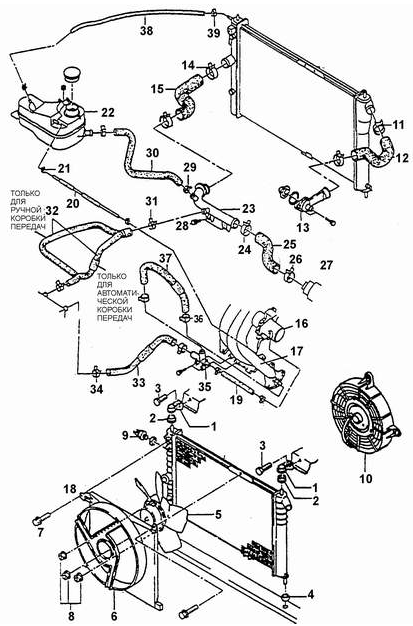
Cooling system, engine with single overhead camshaft (1.5 L, SOHC)
1. RADIATOR BRACKET.
2. CUSHION.
3. BOLT.
4. CUSHION.
5. ELECTRIC FAN.
6. FAN SHROUD.
7. BOLT.
8. NUT.
9. FAN SWITCH (LOW SPEED).
10. AUXILIARY CONDENSER FAN.
11. CLAMP.
12. RADIATOR UPPER HOSE.
13. THERMOSTAT HOUSING.
14. CLAMP.
15. RADIATOR LOWER HOSE.
16. THROTTLE BODY.
17. INTAKE MANIFOLD.
18. Clamp.
19. Throttle body inlet hose.
20. Throttle body outlet hose.
21. Clamp.
22. Expansion tank.
23. Pipe.
24. Clamp.
25. Water pump hose.
26. Clamp.
27. Water pump.
28. Bolt.
29. Clamp.
30. Expansion tank hose.
31. Clamp.
32. Heater outlet hose.
33. Heater inlet hose.
34. Clamp.
35. Tee.
36. Clamp.
37. Hose.
38. Bleed pipe.
39. Clamp
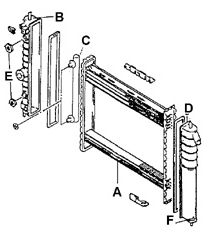
Aluminum radiator. A. Radiator core.
B. Outlet tank.
C. Automatic transmission fluid cooler (automatic transmission only).
D. Inlet tank.
E. Heat exchanger mounting nut.
F. Drain cock.
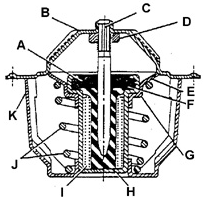
Wax-type thermostat. A. Sealing washer.
B. Rod bracket (valve seat).
C. Rod.
D. Nut.
E. Conical valve edge.
F. Teflon seal.
G. Valve.
H. Bulb.
I. Wax element.
J. Spring.
K. Housing.
The cooling system maintains the engine temperature within the operating range under all operating conditions and at various engine load modes.
When the engine is cold, the cooling system operates with low efficiency, promoting rapid attainment of the normal engine operating temperature.
The cooling system includes the engine cooling jacket, radiator,
expansion tank, fan, thermostat housing, and belt-driven water pump.
Coolant is drawn by the pump from the radiator and supplied to the cooling jacket
of the block, cylinder head, and intake manifold. The coolant then returns
to the radiator, where it is cooled.
The radiator is connected to the expansion tank, which allows
the coolant to expand when heated and maintains the correct coolant level
in the system. A feature of the vehicle cooling system is
the absence of a filler neck on the radiator. The cooling system is filled with coolant
through the expansion tank filler neck.
The vehicle is equipped with a cross-flow radiator consisting of
aluminum tubes and fins connected to plastic side tanks.
On vehicles equipped with an automatic transmission, a transmission fluid cooler is installed in the left radiator tank.
The radiator is fitted with a drain cock for draining coolant from the system.
The transparent expansion tank, similar to the one used for washer fluid, is connected to the radiator by a hose. When the engine warms up, the coolant temperature rises and it expands.
Part of the coolant flows from the radiator and cooling jacket into the expansion tank.
Air pockets that have entered the cooling system are also removed here. After
the engine is switched off, the coolant temperature drops and its volume decreases.
Part of the coolant returns to the radiator and cooling jacket. Thus, the expansion tank maintains the correct
coolant level at all times and prevents coolant loss. To check the coolant level,
MAX and MIN marks are provided on the wall of the expansion tank; the coolant level must be between them.
The centrifugal pump consists of a housing and a shaft with an impeller and a gear pulley.
The pump is driven by a toothed belt. The pump is installed at the front of the transversely mounted engine and is driven by the timing belt. The pump is not serviceable; if it fails, it is replaced as an assembly.
The wax-type thermostat regulates coolant circulation through the cooling system. The thermostat is installed near the cooling jacket outlet pipe.
On a cold engine, the thermostat valve blocks the coolant flow to the radiator, thereby promoting rapid engine warm-up to
normal operating temperature. After normal temperature is reached, the thermostat valve opens and coolant begins to circulate through the radiator. With
the thermostat valve closed, coolant circulates through the cooling jacket
and through the heater core, which heats up quickly and
ensures efficient operation of the heating system and windshield defrosting. After the engine warms up
and the thermostat valve opens, coolant circulation through the
radiator begins. The radiator has a high capacity for dissipating coolant heat to the air. The thermostat action, which regulates coolant flow through the radiator, keeps the engine operating temperature range
within limits under various vehicle operating conditions. The thermostat is closed at
temperatures below 86°C, begins to open at 87°C, and is fully open at 102°C.
Warning.
The electric fan may switch on unexpectedly, regardless of whether
the engine is running or not.
The five-blade fan diameter is 300 mm. The fan is driven by
driven by the built-in electric motor. The fan operates as follows.
1) When the air conditioner is off or if the vehicle is not equipped with air conditioning. When the engine coolant temperature is above 90° C, the fan turns on automatically.
switches on at low speed according to the signal from the radiator temperature sensor.
The high fan speed switches on when the engine coolant temperature is above
105° C, using the fan relay controlled by the engine control module (ECM).
2) When the air conditioner is on.
The low fan speed is switched on by the air conditioning compressor clutch relay. When the compressor is switched on, the fan runs continuously at low speed.
The high fan speed is switched on by the fan relay, which is controlled by the ECM depending on the engine coolant temperature (above 105° C), air conditioner operating mode and vehicle speed.
The electric engine coolant temperature (ECT) sensor is connected to the ECM input. If the ECT sensor signal corresponds to a coolant temperature above 105° C, the ECM
switches the fan to maximum speed. When the coolant temperature drops to 102° C, the ECM switches the fan to low speed.
Warning.
If the clamps were removed for maintenance or repair, install them in their original positions after the work is completed. If clamps need to be replaced,
use genuine parts supplied as
spare parts.
Test yourself
A quick Daewoo Nexia quiz: every answer comes with an explanation and a link to the manual page.