Battery
1. A maintenance-free battery, as the name implies, requires no maintenance and has no cell vent plugs.
2. There is no need to add water to the electrolyte of a maintenance-free battery.
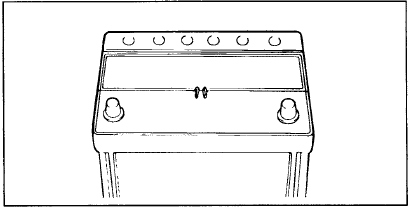
3. The battery is fully sealed, except for a small vent hole in the cover.
VISUAL BATTERY INSPECTION (1)
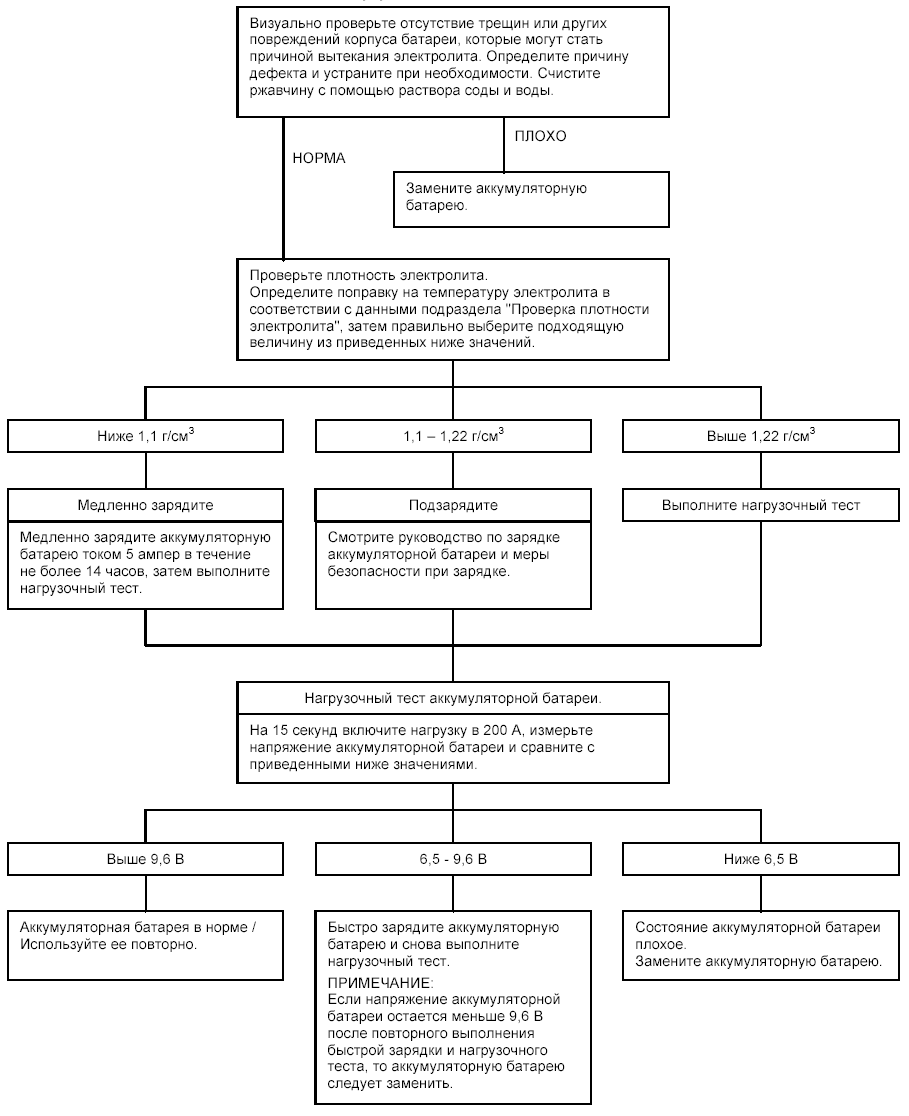
VISUAL BATTERY INSPECTION (1)
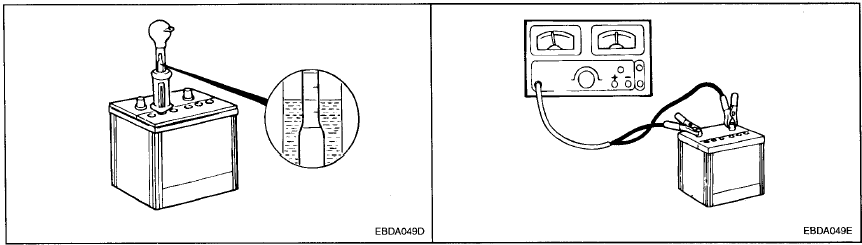
ELECTROLYTE SPECIFIC GRAVITY CHECK
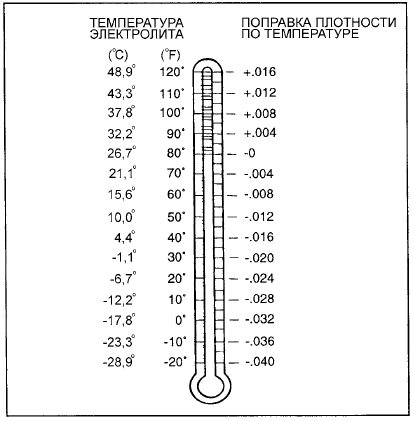
Battery electrolyte specific gravity changes with temperature. Heating dilutes the solution and reduces electrolyte specific gravity. Cooling thickens the solution and increases electrolyte specific gravity.
For a fully charged battery, the electrolyte specific gravity must be 1.260 - 1.280 g/cm3 at 26.7°C. If the actual electrolyte temperature differs from the standard value, correct the reading: add 4 points (0.004 g/cm3) for every 5.56°C above 26.7°C, or subtract 4 points (0.004 g/cm3) for every 5.56°C below 26.7°C.
Example: The hydrometer reads a specific gravity of 1.280 g/cm3 and the thermometer shows an electrolyte temperature of 12.2°C (10°F). According to the figure, the measured specific gravity must be reduced by 7 points (0.028 g/cm3). Thus, the corrected electrolyte specific gravity at 26.7°C will be 1.252 g/cm3.
1.280 – 0.028 = 1.252. Do not measure electrolyte specific gravity with a hydrometer immediately after adding water to the electrolyte.
To mix the water and electrolyte and obtain uniform density, either slowly charge the battery at 5 A for several minutes, or leave the battery at rest for approximately one hour.
If the electrolyte specific gravity in any cell (one or more) differs from the average value by 50 points (0.05 g/cm3) or more, this indicates internal damage. In this case, replace the battery.
BATTERY CHARGING TIME
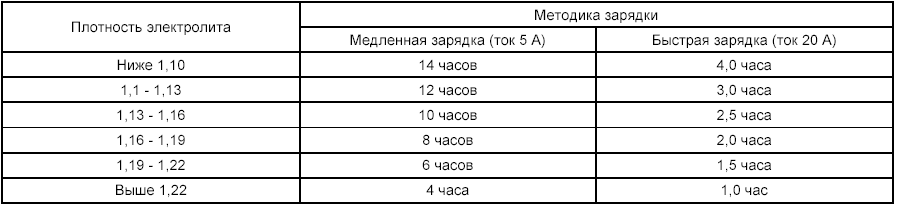
BATTERY CHARGING TIME
Test yourself
A quick Hyundai Elantra CN7 quiz: every answer comes with an explanation and a link to the manual page.