Brake System
EBD (Electronic Brake Force Distribution) Description and Operation
In this manual: Brake System
~1min read
Operation
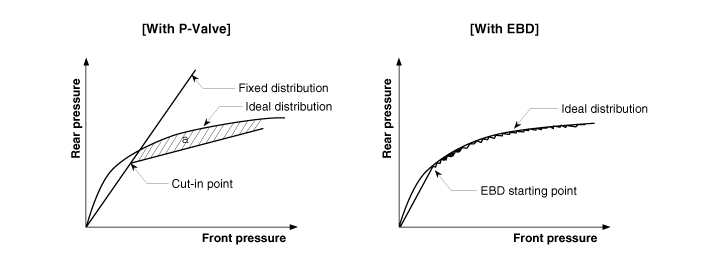
The EBD (Electronic Brake Force Distribution) system, as a subsystem of the ABS, is designed to control the braking efficiency of the rear wheels to the maximum. It also uses the efficiency of the highly developed ABS hardware by monitoring rear wheel slip in the partial braking range. Braking force approaches the optimum and is electronically controlled, which eliminates the need for a proportioning valve. The proportioning valve, due to its mechanical design, has limitations in achieving ideal brake force distribution to the rear wheels, as well as in providing flexible brake force distribution in proportion to increased load or vehicle weight. In case of a malfunction, the driver may not notice the failure. EBD, controlled by the ABS control module, calculates the slip ratio of each wheel at all times and controls rear wheel brake pressure so that it does not exceed front wheel pressure. If EBD fails, the EBD warning lamp (parking brake lamp) illuminates. Advantages- Improved performance of the basic brake system.
- Compensation for different friction coefficients.
- Elimination of the proportioning valve.
- Malfunction recognition by warning lamp.
Test yourself
A quick Hyundai Genesis DH quiz: every answer comes with an explanation and a link to the manual page.
Was this page helpful?