Warning

- If you cross a lane line, the lane line you are crossing will flash (yellow) on the LCD display along with a steering wheel vibration warning.
- If the steering wheel is required, the system will control the vehicle's steering so that the vehicle does not cross the lane line.

If the conditions for LKAS activation are not met, the system switches to LDWS and warns the driver only when the driver crosses the lane line.

If the driver removes hands from the steering wheel while LKAS is active, the system will warn the driver after a few seconds with a visual and audible warning.
WARNING
The warning message may be delayed depending on road conditions. Therefore, always keep hands on the steering wheel while driving.

If the driver still does not have hands on the steering wheel after several seconds, the system will automatically turn off.
WARNING
- The driver is responsible for accurate steering.
- Turn off the system and drive the vehicle in the following situations.
- In bad weather
- In poor road conditions
- When steering must be controlled by the driver frequently.
✽ NOTICE
- Even though steering is assisted by the system, the driver can still control the steering wheel.
- The steering wheel may feel heavier when steering is assisted by the system than when it is not.
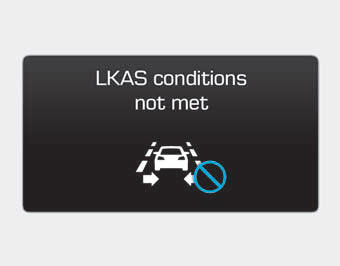
A message will appear on the LCD display if the conditions for LKAS activation are not met. An audible warning will also sound. The warning will disappear when the conditions are met.
The system will be cancelled when:
- Vehicle speed is below 40 mph (60 km/h) or above 180 km/h.
- Only one lane is detected.
- The turn signal is used to change lanes. If you change lanes without the turn signal on, the steering wheel may be controlled by the system.
- The hazard warning flasher is on.
- Lane width is below 10 ft (3.1 m) or above 15 ft (4.5 m).
- ESC (Electronic Stability Control) is activated.
- When the system is turned on or after a lane change, drive in the center of the lane.
- Steering assistance will not operate when driving fast through a sharp curve.
- Steering assistance will not operate when changing lanes quickly.
- Steering assistance will not operate when braking suddenly.
DRIVER ATTENTION
The driver should be careful in the following situations, as the system may not operate properly when:
- The lane is not visible due to snow, rain, stains, puddles, or other factors.
- The brightness outside changes suddenly, such as when entering or exiting a tunnel.
- The headlights are not on at night or in a tunnel, or the illumination level is low.
- It is difficult to distinguish the color of lane markings from the road, or the lane lines are damaged or unclear.
- Driving on a steep slope or curve.
- Light such as from street lamps, sunlight, or oncoming vehicle headlights is reflected from water on the road.
- The lens or windshield is covered with foreign matter.
- The sensor cannot detect the lane due to fog, heavy rain, or heavy snow.
- The temperature around the inside rearview mirror is high due to direct sunlight.
- The lane is very wide or narrow.
- The windshield is fogged up by humid air inside the vehicle.
- There is a shadow on the lane line.
- There is a marking that resembles a lane line.
- There is a boundary structure, such as a concrete barrier.
- The distance to the vehicle ahead is very short, or the vehicle ahead covers the lane line.
- The vehicle vibrates strongly due to road conditions.
- The number of lanes increases or decreases, or lane lines intersect.
- Something is placed on the instrument panel.
- Driving with the sun in front of you.
- Driving in construction areas.
- There are more than two lane lines.
- The lane is merged or divided.
- Passing through a toll collection point or toll gate.
Test yourself
A quick Hyundai Genesis DH quiz: every answer comes with an explanation and a link to the manual page.