System Limitations
FCA is a driver assistance system for certain hazardous driving conditions and does not take full responsibility for all risks associated with driving conditions.
FCA monitors road conditions using the radar and camera sensors. Therefore, in situations outside the detection range, FCA may not operate normally. The driver must exercise extra caution in the following situations. FCA operation may be limited.
Vehicle Recognition
The sensor may be limited when:
- The radar sensor or camera is blocked by a foreign object or debris.
- The camera lens is contaminated by tinted, filmed or coated windshield, damaged glass, or foreign objects (stickers, insects, etc.) stuck to the glass.
- Severe weather, such as heavy rain or snow, blocks the field of view of the radar sensor or camera.
- There is electromagnetic wave interference.
- Strong uneven reflection from the radar sensor is present.
- Recognition by the radar/camera sensor is limited.
- The vehicle ahead is too small to be detected (for example, a motorcycle, etc.).
- The vehicle ahead is an oversized vehicle or trailer that is too large to be detected by the camera recognition system (e.g., tractor trailer, etc.).
- The camera's field of view is poorly lit (either too dark, too much reflection, or too much backlight blocking the field of view).
- The vehicle ahead has no tail lights, the tail lights do not come on, or its tail lights are positioned unusually.
- External brightness changes suddenly, for example when entering or exiting a tunnel.
- When light from a street lamp or an oncoming vehicle is reflected on a wet road surface, such as a puddle.
- The forward field of view is limited by sun glare.
- The windshield is fogged; clear view of the road is obstructed.
- The vehicle ahead is driving erratically.
- The vehicle is on a gravel or rough, uneven surface, or on a road with sudden changes in gradient
- The vehicle is driven near areas containing metallic structures, such as construction zones, railroad tracks, etc.
- The vehicle is driving inside a building, such as an underground parking garage.
- The camera does not recognize the entire vehicle ahead.
- The camera is damaged.
- External brightness is too low, for example, when headlights are not on at night or the vehicle is driving through a tunnel.
- A shadow falls on the road from the median strip, trees, etc.
- The vehicle passes through a toll gate.
- The windshield is fogged; clear view of the road is obstructed.
- The rear of the vehicle ahead is not normally visible (the vehicle is turning in another direction or the vehicle is overturned).
- Adverse road conditions cause excessive vehicle vibration while driving.
- Sensor recognition changes abruptly when driving over a speed bump.
- The vehicle ahead moves vertically in the direction of travel.
- The vehicle ahead stops vertically.
- The vehicle ahead moves toward your vehicle or moves in reverse.
- You are at a roundabout and the vehicle ahead is circling.
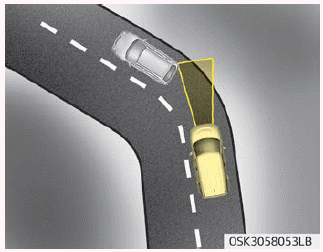
- Driving on curves
FCA performance is reduced when driving through a curve. FCA may not recognize a vehicle ahead even in the same lane. This may result in an unnecessary warning message and warning signal, or it may not issue a warning message and warning signal at all.
When driving through a curve, exercise maximum caution and, if necessary, depress the brake pedal.
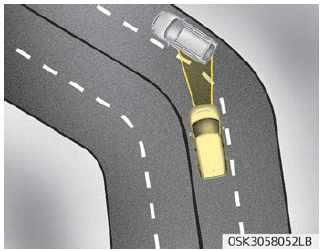
When driving through a curve, FCA may recognize a vehicle ahead in the adjacent lane. Exercise maximum caution and, if necessary, depress the brake pedal. Or, depress the accelerator pedal to maintain driving speed. Always look around the vehicle for your safety.
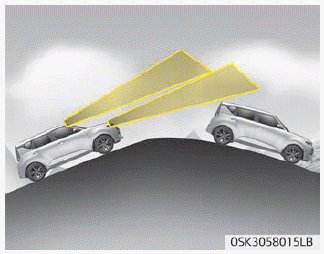
- Driving on slopes
FCA performance is reduced when driving uphill or downhill if it does not recognize a vehicle ahead in the same lane. This may cause an unnecessary warning message and warning signal, or it may not output a warning message and warning signal at all. When FCA suddenly recognizes a vehicle ahead while overtaking on a slope, sudden deceleration may occur.
Always look ahead when driving uphill or downhill and, if necessary, depress the brake pedal.
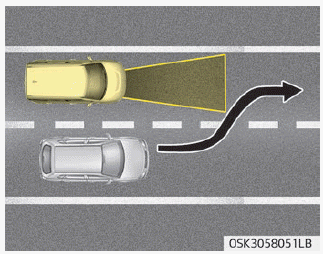
- Lane change
Even if a vehicle in the adjacent lane moves into your lane, it may not be recognized by FCA until it enters the FCA detection range.
Especially when a vehicle in the adjacent lane cuts sharply into your lane, it is likely not to be recognized. Always pay close attention.
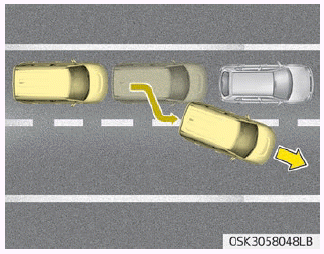
When driving in stop-and-go traffic, and a vehicle ahead moves out of the lane while a vehicle stops in front of you, the FCA system may not immediately detect the new vehicle in front of you. In this case, keep a safe braking distance and, if necessary, depress the brake pedal to reduce vehicle speed and maintain a safe distance.
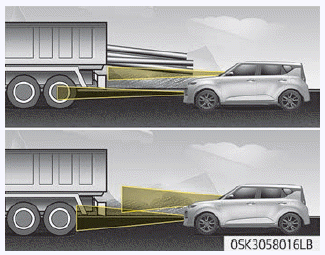
- Vehicle Recognition
Extra special attention is required when detecting a vehicle ahead if there is cargo protruding rearward from the cab, or when the vehicle ahead has a higher ground clearance. The FCA system may not be able to detect cargo protruding from the vehicle. In these cases, you must maintain a safe braking distance to the rearmost object and, if necessary, press the brake pedal to reduce speed and maintain distance.
Pedestrian Recognition
- The pedestrian is not fully captured by the camera sensor, or the pedestrian is not standing upright.
- The pedestrian is moving very fast.
- A pedestrian suddenly appears ahead.
- The pedestrian is wearing clothing of the same color as the background.
- It is too light or too dark outside.
- The vehicle is driving at night or in darkness.
- There is an element resembling the shape of a human body.
- The pedestrian is small.
- The pedestrian has limited mobility.
- It is difficult to distinguish the pedestrian from the surroundings.
- Sensor recognition is limited.
- A group of pedestrians is walking.
- When passing over a speed bump.
- When the vehicle is shaking excessively.
- When driving through a roundabout behind a preceding vehicle.
- If the front of the camera lens is contaminated by window tint, film, water-repellent coating, damage to the glass, or foreign objects (stickers, insects, etc.).
- The radar, camera, or camera lens is damaged.
- If the vehicle headlights are not used at night or in a tunnel, or the light is too weak.
- If street lights or headlights of oncoming vehicles are reflected, or when sunlight is reflected by water on the road surface.
- When tail lights are projected in the direction of vehicle travel (including headlights of other vehicles).
- Road sign, shadow on the road, tunnel entrance, toll gate, partial coverage.
- If there is moisture on the windshield surface or if the windshield is frozen.
- Driving in fog.
- When objects are outside the detection range of the sensor or radar.
- When a cyclist ahead crosses the direction of travel.
- In the presence of any other electromagnetic interference.
- When a construction site, rail, or other metal object is near the cyclist.
- If the bicycle material does not reflect radar signals well.
WARNING
- Turn off FCA in the user settings on the LCD display before towing another vehicle. Braking during towing may adversely affect your vehicle safety.
- Be especially careful with a vehicle ahead when it has a heavy load extending rearward, or when it has greater ground clearance.
- The sensor detects only pedestrians, not carts, bicycles, motorcycles, luggage bags, or strollers.
- FCA does not operate in certain situations. Therefore, never test FCA by using a person or object as a target. This may result in serious injury or even death.
- When replacing or reinstalling the windshield, front bumper, or radar/camera after removal, have the vehicle inspected at a qualified repair facility. Kia recommends visiting an authorized Kia dealer/service partner.
NOTICE
The system may temporarily turn off due to strong electrical waves.
Test yourself
A quick Kia Soul Owner's Manual quiz: every answer comes with an explanation and a link to the manual page.