SRS airbags
The immobilizer system of the Lexus GS (2016–2020) reliably protects your vehicle from unauthorized starting. A transponder built into the key communicates with the engine control module and prevents starting with unauthorized keys. This chapter provides practical tips on handling the electronics, recognizing malfunctions, and the correct procedure in case of a lost key. A key element of theft protection for your Lexus.
The SRS airbags deploy when the vehicle is subjected to certain severe impacts that could cause serious injury to occupants. Together with the seat belts, they help reduce the risk of fatal or serious injuries.
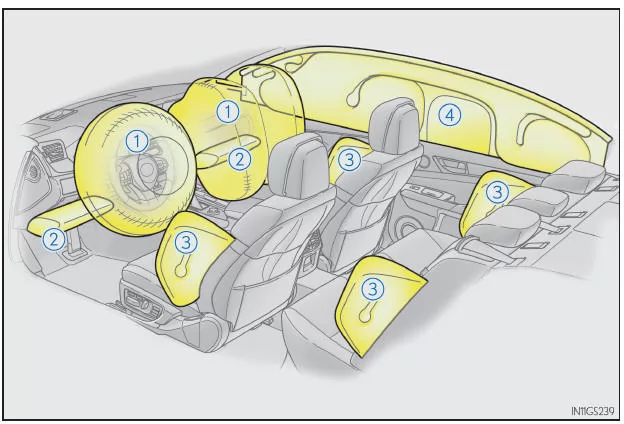
SRS front airbags
- SRS driver and passenger airbags. Can help protect the head and chest of the driver and front passenger from striking interior components
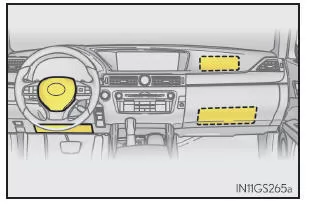
- SRS knee airbags. Can provide additional protection for the driver and front passenger. The passenger SRS knee airbag is built into the glove box door.
SRS side and curtain/shoulder airbags
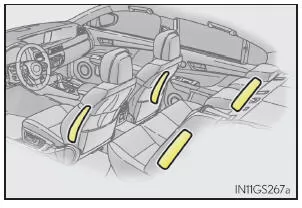
- Front SRS side airbags. Can help protect the body of occupants in the front seats. Rear SRS side airbags. Can help protect the body of occupants in the outer rear seats
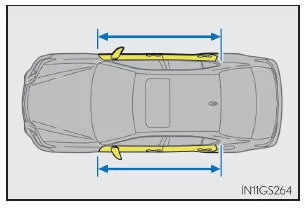
- SRS curtain/shoulder airbags. Can help protect mainly the heads of occupants in the outer seats
Components of the SRS airbag system
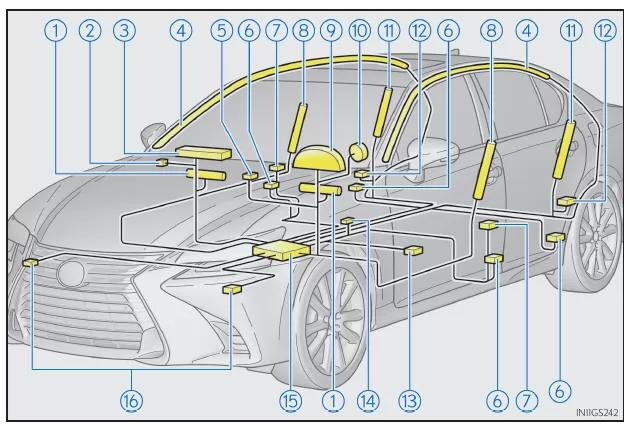
- Knee airbags
- Manual passenger airbag ON/OFF switch
- Front passenger airbag
- Curtain/shoulder airbags
- "PASSENGER AIR BAG" indicator lights
- Seat belt pretensioner
- Side impact sensors (front)
- Front side airbags
- SRS warning light
- Driver airbag
- Rear side airbags
- Side impact sensors (rear)
- Driver seat position sensor
- Driver seat belt buckle sensor
- Airbag sensor assembly
- Front impact sensors
The main SRS airbag system components are shown above. The SRS airbag system is controlled by the airbag sensor assembly. When deployed, the airbags are instantly filled with non-toxic gas by a chemical reaction in the airbag inflators to cushion the movement of the occupants.
WARNING
SRS airbag precautions
Observe the following precautions for the SRS airbags.
Otherwise, fatal or serious injuries may result.
- The driver and all occupants of the vehicle must wear their seat belts properly. The SRS airbags are supplemental restraint devices that must be used together with the seat belts.
- The SRS driver airbag deploys with considerable force and can cause fatal or serious injury if the driver is positioned too close to the airbag. Since the danger zone of the driver airbag is within the first 50 - 75 mm in front of the deployment point, keep a distance of 250 mm for safety. This distance refers to the distance between the center of the steering wheel and your breastbone. If your seating position does not currently allow this 250 mm distance, there are several ways to adjust your position:
Adjust the seat as described above, but make sure you can comfortably reach the pedals and steering wheel and have a clear view of the controls on the instrument panel.
WARNING
SRS airbag precautions
- The SRS passenger airbag also deploys with considerable force and can cause fatal or serious injury if the passenger is positioned too close to the airbag. The front passenger seat should be adjusted as far away from the airbag as possible. The seatback should be adjusted so that the passenger sits upright.
- Infants and children who are improperly positioned and/or inadequately restrained can be killed or seriously injured if an airbag deploys. Infants and children who are too small to wear the seat belt properly must be secured correctly in a child restraint system. Lexus strongly recommends that infants and children always be placed in properly secured child restraint systems on the rear seats.The rear seats are safer for infants and children than the front passenger seat.
- Do not sit on the very edge of the seat, and do not lean against the instrument panel.
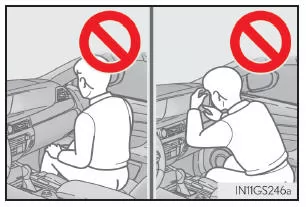
- Never allow children to stand in front of the SRS passenger airbag or sit on the lap of a passenger in the front seat.
- Do not allow occupants of the front seats to carry objects on their laps.

- Do not lean against the door, roof rail, or the A-, B- or C-pillar.
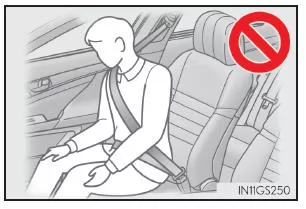
WARNING
SRS airbag precautions
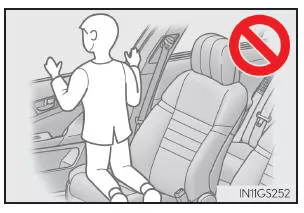
- Do not allow anyone to kneel on the front passenger seat facing the door, or to stick their head or hands out of the vehicle.
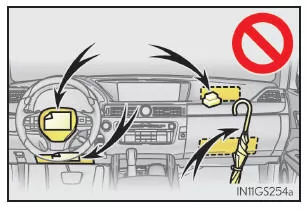
- Make sure that there are no objects in the areas in front of the instrument panel, the steering wheel pad, the lower area of the instrument panel, and the glove box lid.These objects can become projectiles if the SRS driver and passenger airbags and the knee airbags deploy.
- Do not attach any objects in the areas of the doors, windshield, side door windows, the A- or C-pillar, the roof rail, and the grab handles. (Except for the speed limit sticker)
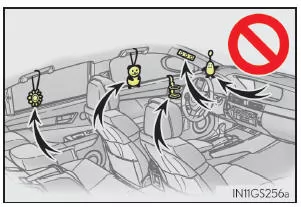
- Do not hang clothes hangers or other hard objects on the coat hooks.Such objects can become projectiles when the SRS head/shoulder airbags deploy and cause fatal or serious injuries.
- If there is a vinyl cover in an area where the SRS knee airbag deploys, remove this cover.
- Do not use seat accessories that cover areas where the SRS side airbags deploy, as they may interfere with the inflation of the airbags. Such accessories may impair the proper activation of the side airbags, cause the system to fail, or cause the side airbags to deploy unexpectedly, resulting in fatal or serious injuries.
WARNING
SRS airbag precautions
- Do not apply force or excessive pressure to the SRS airbag components. Otherwise, the SRS airbags may malfunction.
- Do not touch any of the components immediately after the SRS airbags have deployed, as they may be hot.
- If you experience breathing difficulties after the SRS airbags have deployed, open a door or window to let in fresh air, or leave the vehicle if it is safe to do so. Wash off any residue as soon as possible to prevent skin irritation.
- If the areas where the SRS airbags are housed, such as the steering wheel pad, glove box lid, and the A- and C-pillar trim, show damage or cracks, have them replaced by a Lexus dealer or authorized service center, or another qualified and properly equipped repair shop.
Modifying and disposing of SRS airbag system components
Do not dispose of your vehicle or make any of the following modifications without first consulting a Lexus dealer or authorized service center, or another qualified and properly equipped repair shop. The SRS airbags may malfunction or deploy unexpectedly, which may result in fatal or serious injuries.
- Installing, removing, disassembling, and repairing the SRS airbags
- Repairs, modifications, removal, or replacement of the steering wheel, instrument panel, dashboard, glove box, seats or seat cushions, A-, B- or C-pillar, or roof rail
- Repairs or modifications to the front fenders, front bumper, or interior side panels
- Installation of front bumper guards (bull bars, etc.), snow plows, or winches
- Modifications to the suspension and damping system of the vehicle
- Installation of electronic devices, such as mobile two-way radios (RF transmitters) or CD players
- Modifications for persons with disabilities
When the SRS airbags deploy
- SRS airbags may cause minor abrasions, burns, bruises, etc., because they inflate extremely quickly with hot gases when they deploy.
- A loud noise occurs and white powder is released.
- Parts of the airbag module (steering wheel hub, airbag cover, and airbag gas generator), the seats, the glove box, parts of the A- and C-pillars, and the roof rail may remain hot for several minutes. The airbag itself may also be hot.
- The windshield may crack.
Conditions for SRS airbag deployment (SRS front airbags)
- The SRS front airbags deploy in a collision where the set threshold is exceeded (the force is equivalent to a frontal impact at approx. 20 - 30 km/h into a fixed wall that does not move or deform).
However, the required deployment threshold increases considerably in the following situations:
- Depending on the type of impact, only the seat belt pretensioners may be activated.
Conditions for Activation of the SRS Airbags (SRS Side and Curtain Shield Airbags)
- The SRS side and curtain shield airbags activate in an impact that exceeds the set threshold (the force is equivalent to the impact force of a vehicle weighing approx. 1500 kg striking the passenger compartment at right angles at a speed of approx. 20 - 30 km/h).
- The SRS side and curtain shield airbags may also activate in a severe frontal impact.
Possible Conditions for Activation of the SRS Airbags Other Than a Collision
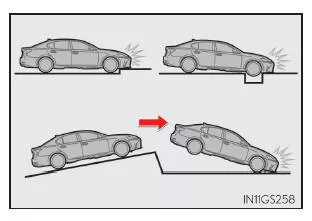
The SRS front airbags, side airbags and curtain shield airbags may also be activated by a severe impact to the underside of the vehicle. Possible examples are shown in the illustration.
- Striking a curb or a hard object
- Driving into or over deep potholes
- Dropping the vehicle or a hard landing
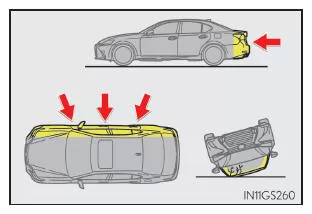
Collisions in Which the SRS Airbags May Not Activate (SRS Front Airbags)
In a side or rear impact, in a rollover, or in a frontal impact at low speed, the SRS front airbags generally do not activate. However, if a collision causes a sudden, severe deceleration of forward movement, the SRS front airbags may activate.
- Side impact
- Rear impact
- Vehicle rollover
Collisions in Which the SRS Airbags May Not Activate (SRS Side and Curtain Shield Airbags)
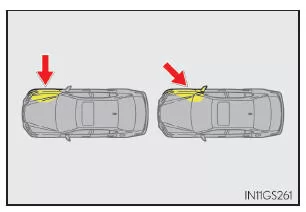
In an offset side impact or a side impact to a body area other than the passenger compartment, the SRS side and curtain shield airbags may not activate.
- Side impact to a body area other than the passenger compartment
- Offset side impact
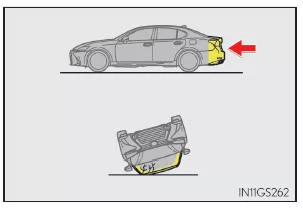
In a rear impact, in a rollover, or in a side or frontal impact at low speed, the SRS side and curtain shield airbags generally do not activate.
- Rear impact
- Vehicle rollover
Cases in Which You Must Contact a Lexus Dealer or Authorized Repairer, or Another Qualified and Properly Equipped Repair Facility
In the following cases, the vehicle must be inspected and/or repaired. Contact a Lexus dealer or authorized repairer, or another qualified and properly equipped repair facility, as soon as possible.
- After an SRS airbag has activated.
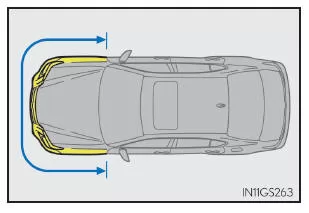
- The front of the vehicle is damaged or deformed, or was involved in a collision that did not cause the SRS front airbags to activate.
- A door or the adjacent area is damaged or deformed, or the vehicle was involved in a collision that did not cause the SRS side and curtain shield airbags to activate.
- The steering wheel pad, the instrument panel in the area of the passenger airbag, the lower part of the instrument panel, or the glove box door has scratches, cracks, or other damage.
- The surface of the seat areas where the side airbags are located has scratches, cracks, or other damage.
- The area of the A-pillar and C-pillar trim and the roof rail trim where the curtain shield airbags are located has scratches, cracks, or other damage.

The Lexus GS (4th generation) SRS airbag system provides a high standard of safety through a range of front, side, and head airbags. Precise sensors ensure that the airbags activate only when truly necessary. Detailed warnings keep the driver fully informed in order to minimize risks.
This safety concept makes the Lexus GS one of the most reliable vehicles in its class. It combines technical precision with maximum occupant protection, a hallmark of Lexus.
Test yourself
A quick Lexus GS quiz: every answer comes with an explanation and a link to the manual page.