Fuel tank (refuelling)
Usable fuel tank capacity: approximately 45 litres.
Depending on the vehicle, the 0.9 TCe engine has a fuel tank capacity of 40 litres or 45 litres.
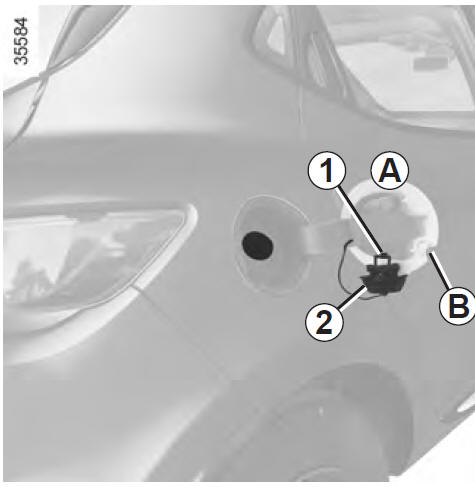
To open the filler flap A, pass your finger through the cutout B.
While refuelling, use the cap holder 1 on the filler flap A to hang the cap 2.
After refuelling, check that the cap and the filler flap are properly closed.
Fuel quality
Use good quality fuel that complies with the standards in force in each country and that strictly conforms to the information on the label located on the filler flap A. Refer to the "Engine specifications" section in chapter 6.
Diesel version
Always use diesel that conforms to the information on the label located inside the filler flap A.
 Filler cap
is specific to the vehicle.
If you need to replace it, make sure it is identical to the original cap.
Contact a brand Representative.
Do not handle the cap near an open flame or a heat source.
Do not wash the filler area with a high-pressure cleaner.
Petrol version
Always use unleaded petrol. The Octane Number (RON) must conform to the information on the label located on the filler flap A. Refer to "Engine specifications" in chapter 6.
Do not mix unleaded petrol or E85 with diesel, even in small quantities. Do not use ethanol-based fuel if your vehicle is not designed for it. Do not add fuel additives, as you risk damaging the engine.
Refuelling
With the ignition off, insert the nozzle to push open the filler flap A and move it fully to the stop before triggering it to fill the tank (risk of splashing).
Hold it in this position throughout the refuelling operation.
After the first automatic cut-off at the end of refuelling, you may trigger the nozzle a maximum of two more times in order to preserve an expansion volume.
During refuelling, make sure no water gets in. The filler flap A and its surround must remain clean.
Petrol versions
Using leaded petrol would damage the emission control systems and could result in loss of warranty.
To prevent refuelling with leaded petrol, the fuel tank filler neck has a restriction fitted with a safety system that only allows use of an unleaded petrol nozzle (at the pump).
Vehicle fitted with Stop and Start function
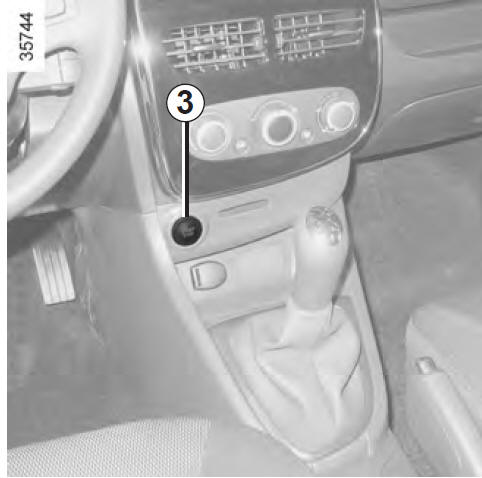
For refuelling, the engine must be switched off (not in standby): always stop the engine by pressing the engine stop button 3 (refer to the "Starting, Stopping the Engine" section in chapter 2).
 Persistent
smell of fuel
If a persistent smell of fuel appears, please:
- stop the vehicle safely, in accordance with traffic conditions, and switch off the ignition;
- switch on the hazard warning lights, get all occupants out of the vehicle and keep them away from the traffic;
- contact a brand Representative.
Running out of fuel, Diesel version
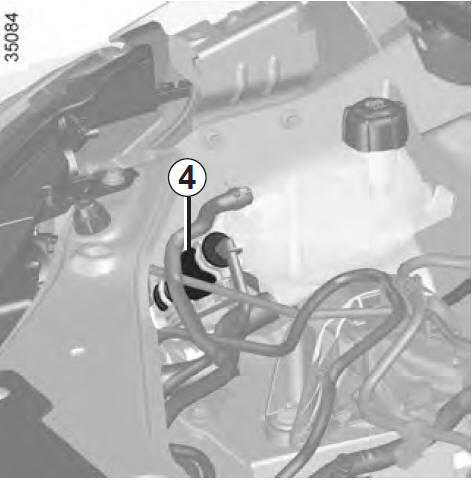
Vehicles with priming bulb 4
After a breakdown caused by the fuel tank running completely dry, you must prime the fuel circuit before attempting to restart the engine.
Fill the tank with at least 8 litres of diesel.
Press the priming bulb 4 several times.
You can then restart the engine.
If the engine does not restart after several attempts, contact a brand Representative.
Vehicles without priming bulb 4
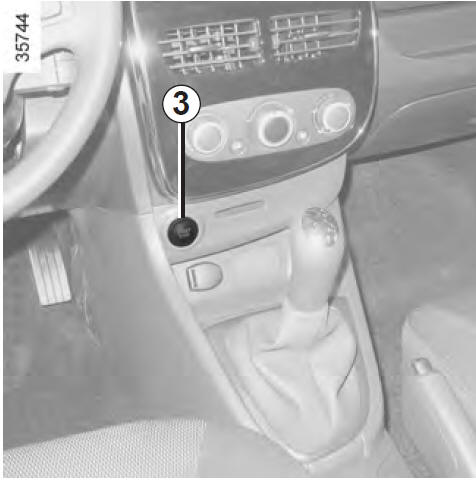
Insert the RENAULT card into the card reader. Press the start button 3 without touching the pedals. Wait a few minutes before starting. This allows the fuel circuit to prime. If the engine does not start, repeat the procedure.
 Any
work on or modification to the fuel supply system (electronic control units, wiring, fuel circuit, injectors, protective covers, etc.) is strictly prohibited due to the risks it may present to your safety (except by qualified personnel of the brand's Network).
When working near the engine, it may be hot. In addition, the cooling fan may start at any time.
Risk of injury.
Test yourself
A quick Renault Clio quiz: every answer comes with an explanation and a link to the manual page.