Trip computer

Trip computer 1
Depending on the vehicle, it combines the following functions:
- distance travelled;
- journey parameters;
- information messages;
- malfunction messages (associated with the warning light
 ) ;
- alert messages (associated with the warning light
 ) ;
- vehicle settings personalisation menu.
All these functions are described on the following pages.
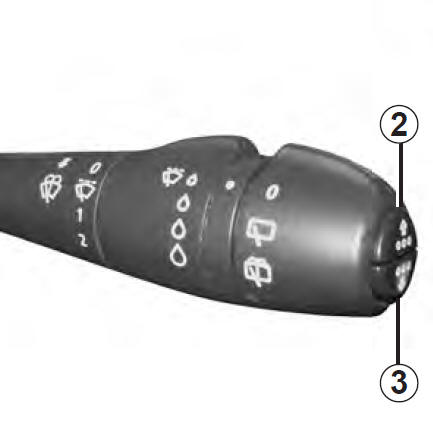
Display selection buttons 2 and 3
Scroll up (button 2) or down (button 3) through the following information by briefly pressing repeatedly (the display depends on vehicle equipment and country).
- total and trip distance odometer;
- fuel used;
- average fuel consumption;
- instantaneous fuel consumption;
- estimated range;
- distance travelled;
- average speed;
- range to service:
- service reminder counter;
- oil change counter;
- speed limiter/cruise control set speed;
- time and temperature;
- logbook, scrolling of information and malfunction messages.
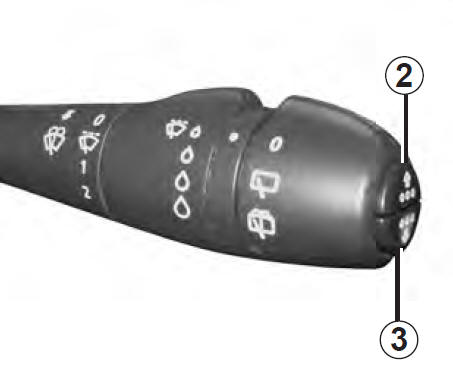
Resetting the trip odometer
With the display set to total and partial odometer, press button 2 or 3 until the trip odometer resets to zero.
Resetting the trip parameters (Top Départ)
With the display set to one of the trip parameters, press and hold button 2 or 3 until the display resets to zero.
Interpreting certain values displayed after a Top Départ
The average fuel consumption, range and average speed values become more stable and meaningful the greater the distance driven since the last Top Départ.
During the first kilometres after a Top Départ, you may notice the range increasing as you drive. This is because it takes into account the average fuel consumption recorded since the last Top Départ.
However, average fuel consumption may decrease when:
- the vehicle comes out of an acceleration phase;
- the engine reaches its operating temperature (Top Départ: cold engine);
- you switch from urban driving to road driving.
Automatic resetting of the trip parameters
The reset is automatic when the capacity of one of the 2 parameters is exceeded.
THE DISPLAY OF THE INFORMATION DESCRIBED BELOW DEPENDS ON VEHICLE EQUIPMENT AND COUNTRY.
| Display selection examples | Interpreting the selected display |
 | a) Total and partial odometer. |
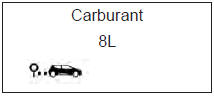 | b) Trip parameters. |
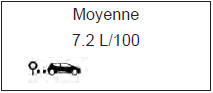
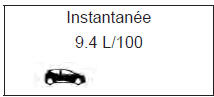
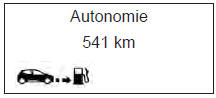
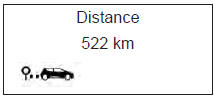
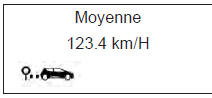
| Display selection examples | Interpreting the selected display | |
| Trip computer without the service range message | ||
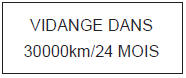 | 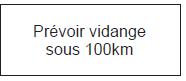  | h) Service range. Distance remaining until the next service (displayed in kilometres and months). When the range approaches zero, several cases apply:
The vehicle then requires a service as soon as possible. |
| Note: depending on the vehicle, the service range adapts to the driving style (frequent driving at low speeds, stop-and-go traffic, prolonged idling, towing a trailer, etc.). The distance remaining until the next service may therefore in some cases decrease faster than the distance actually driven. The service interval is independent of the vehicle maintenance schedule: refer to your vehicle's maintenance document. Reset: to reset the service range, press and hold one of the display reset buttons for about 10 seconds until the service range is shown steadily. |
||
 .
| Display selection examples | Interpreting the selected display |
| Trip computer with the service range message | |
 | h) Service or oil change range.Service rangeWith the ignition on and the engine off, when the message “Service range” is displayed, press button 2 or 3 for about 5 seconds to display the service range. Distance remaining until the next service (displayed in kilometres and months). When the range approaches zero, several cases apply:
The vehicle then requires a service as soon as possible. |
| Reset: to reset the service range, press and hold button 2 or 3 for about 10 seconds until the service range is shown steadily. Note: if a service is carried out without an engine oil change, only the service range must be reset. If an engine oil change is carried out, both the service range and the oil change range must be reset. |
|
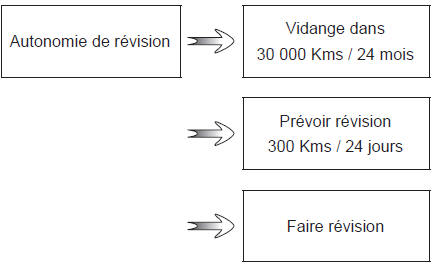 | Oil change range With the ignition on and the engine off, when the message “Service range” is displayed, press button 2 or 3 for about 5 seconds to display the service range, then briefly press button 2 or 3 to display the oil change range. Distance remaining until the next oil change (displayed in kilometres and months). When the range approaches zero, several cases apply:
The vehicle then requires an oil change as soon as possible. |
| Reset: to reset the oil change range, press and hold button 2 or 3 for about 10 seconds until the oil change range is shown steadily. Note: if a service is carried out without an engine oil change, only the service range must be reset. If an engine oil change is carried out, both the service range and the oil change range must be reset. |
|
 .
 .
THE DISPLAY OF THE INFORMATION DESCRIBED BELOW DEPENDS ON VEHICLE EQUIPMENT AND COUNTRY.
| Display selection examples | Interpreting the selected display |
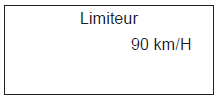 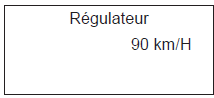 | i) Speed limiter or cruise control set speed. Refer to chapter 2, sections “Speed limiter” and “Cruise control”. |
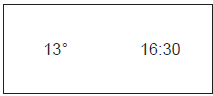 | j) Time and outside temperature. Refer to the section “Time and outside temperature”. |
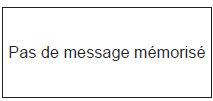 | k) Trip log. Successive display of:
|
They may help you start the vehicle or inform you of a selection or driving status.
Examples of information messages are given below.
| Message examples | Interpreting the selected display |
| “parking brake applied” | Indicates that the parking brake is applied. |
| “remove card” | Reminds you to remove the RENAULT card from the reader when you leave the vehicle. |
| “traction control disabled” | Indicates that you have deactivated the ASR function. |
| “turn steering wheel + start” | Turn the steering wheel slightly while pressing the vehicle start button to unlock the steering column. |
| “steering not locked” | Indicates that the steering column has not been locked. |
They appear with the  warning light and require
a stop at the earliest opportunity, driving carefully. Failure to follow this recommendation may damage the vehicle.
They disappear when the display selection button is pressed or after a few seconds, and are stored in the trip log. The warning light stays on.
Examples of operating fault messages are given below.
| Examples of messages | Interpreting the selected display |
| “diesel filter to bleed” | Indicates water in the diesel filter. Consult a brand representative as soon as possible. |
| “vehicle to be checked” | Indicates a fault with one of the pedal sensors, the battery management system or the oil level sensor. |
| “airbag to be checked” | Indicates a fault in the supplementary restraint systems (airbags) that complement the seat belts. |
They appear with the  warning light and require,
for your safety, an immediate stop compatible with traffic conditions. Stop the engine and do not restart it. Contact a brand representative. Examples of warning messages are given below. Note: messages appear on the display either individually or alternately (when several messages need to be shown). They may be accompanied by a warning light and/or an audible beep.
| Message examples | Interpreting the selected display |
| “engine failure risk” | Indicates an injection fault, engine overheating or a serious engine problem. |
| “braking system fault” | Indicates a braking system fault. |
| “battery charging fault” | Indicates a fault in the vehicle battery charging circuit (alternator, etc.). |
Test yourself
A quick Renault Clio quiz: every answer comes with an explanation and a link to the manual page.