Run-flat tyre PAX
PAX run-flat tyres, tyre inflation
When inflating the tyres, observe the following points:
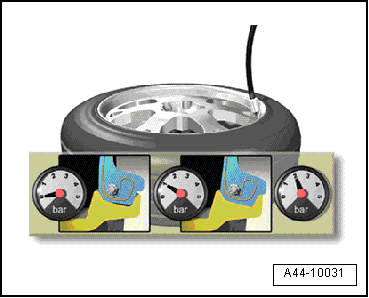
- After fitting the tyres with the valve insert installed, inflate them with air. At 1 bar, check that both beads are seated correctly.
- If one of the beads does not seat correctly, do not let the air out of the tyre. Place the mounting roller on the affected bead and press it lightly while turning. The bead will then seat by itself.
- Then continue inflating until the tyre pressure recommended for the vehicle is reached. As with conventional tyres, tyre inflation gas may also be used.

Note
Briefly exceeding the tyre pressure to 3.5 bar, as is common with conventional tyres, must always be avoided.
PAX run-flat tyres, wheel alignment and chassis adjustment
Chassis adjustment on vehicles with run-flat wheels (PAX) is carried out in the same way as on vehicles fitted with conventional tyres.
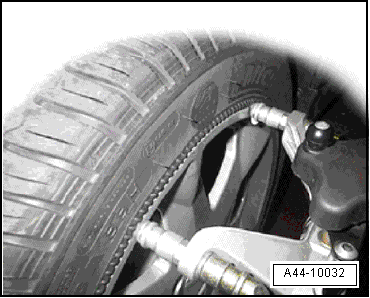
As a rule, the measuring heads and their mountings that are also suitable for conventional tyres with a rim protection ledge can be used for run-flat wheels (PAX). (Contact pads on the inside, clamping in the tread.)
PAX run-flat tyres, tyre repair
General Information
A general replacement of the tyre after a puncture and any further driving on a deflated tyre is not necessary.

Note
The affected tyre must be removed and checked for damage by trained specialist personnel. Assembly work and damage diagnosis on the affected tyre must be carried out by trained specialist personnel.
To inspect the run-flat tyre (PAX) after a puncture, proceed as follows:
- First, remove as much of the remaining gel from the tyre as possible. The smooth side of the spatula is suitable for this.
- Then clean the tyre and the support ring with water and a cloth to remove any remaining gel.
- After separating the tyre and support ring, assess both components (PAX) according to the criteria described below.
Additional notes:
- When refitting, make sure that the support ring used matches the tyre and rim dimensions.
- As with conventional wheel and tyre systems, the rim must also be checked before fitting.
- A damaged rim must be replaced with a new part.
PAX run-flat tyres, inspection
When checking the tire, pay particular attention to the following criteria:
- Surface erosion or marbling of the inner side (air pressure was too low or insufficient for the load)
- detached rubber or loose cord threads
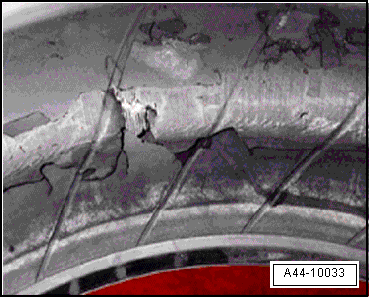
- exposed or deformed bead core
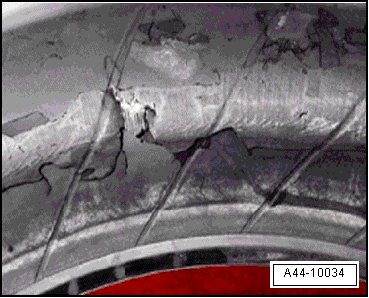
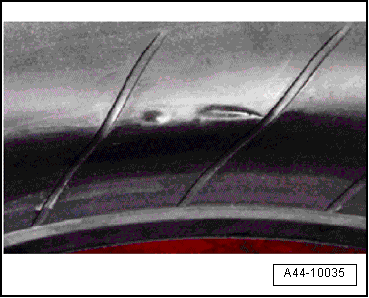
- Damage to the tire bead with visible cords
Tyre storage
Storage area
The tyre storage area must be:
- dark,
- dry,
- cool and
- ventilated
.

WARNING!
During storage, tyres must never come into contact with fuel, oil, grease or chemicals. Otherwise the tyre material will be damaged by chemical processes that are not always visible.
This can lead to a life-threatening situation while driving.
Damage to the tyre only occurs with prolonged exposure to the chemical. If a few drops of petrol get onto the tyre while refuelling, this is harmless.
Storing tyres
Complete wheels
Wheels with fitted tyres can be stored lying flat, stacked on top of each other. Make sure that the wheels are clean and dry. The tyre pressure should be increased to a maximum of 3 bar.
Tyres without wheels
Store tyres without wheels standing upright, preferably. If the tyres are stacked on top of each other for a long period, they will be compressed heavily. This makes fitting more difficult because the tyres do not sit properly against the rim shoulder. For upright storage, it is recommended to rotate the tyres every 14 days to avoid excessive flattening.
Reinforced / Extra Load (XL) tyres
The designation "Reinforced" has for some time been replaced by "Extra Load" by some tyre manufacturers. Outside Europe this designation has been common for a long time. From a technical point of view there is no difference.
Some tyre manufacturers also use the designation "XL" for Extra Load tyres.
Tyres marked "Reinforced" or "Extra Load (XL)" are equivalent.
V-rated winter tyres marked XL have a higher load capacity than V-rated winter tyres without this marking.
XL V-rated winter tyres allow a higher speed, but not every vehicle permits the maximum speed of the V-rated tyre up to 240 km/h.
The same conditions apply to these tyres as to V-rated winter tyres without a special marking.
Winter tyres
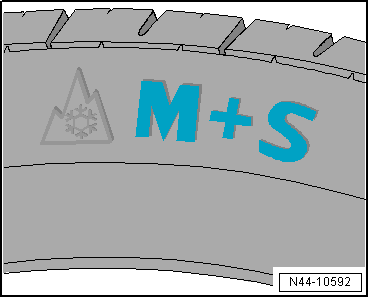
M+S symbol
An "M+S tyre" has a tread pattern, tread compound or construction designed to improve handling in snow compared with a normal tyre, especially when starting off or stabilising vehicle movement.
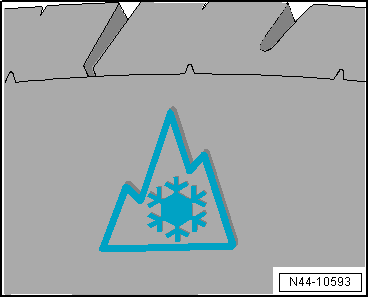
Snowflake symbol
The "snowflake" symbol identifies winter tyres in accordance with the industry standard, which is based on the American definition of winter tyres. These tyres offer exceptional performance in terms of safety and control on snow, icy roads and generally at low temperatures.
M+S marking on 4x4/SUV tyres
Some vehicles are fitted with tyres that carry the "M+S" marking on the outside. This is because this vehicle category was first offered in North America, where all-season tyres marked "M+S" are common. The "M+S" marking is officially defined in an EU directive as follows: "A tyre whose tread pattern and structure are designed to give better performance in snow than normal tyres." The performance of tyres marked "M+S" is therefore neither defined nor measured. In North America, the snow performance of winter tyres is specified by the so-called "Snowflake-on-the-Mountain symbol". Only tyres that meet or exceed these requirements may carry the "Snowflake-on-the-Mountain symbol".
Use of winter tyres
Since 1 May 2006, an amendment to the German Road Traffic Regulations (StVO) has been in effect, which added the following: "Motor vehicles must be equipped to suit weather conditions. This includes in particular suitable tyres and antifreeze in the windscreen washer system."
Please advise customers that, since 1 May 2006, they are legally required to adapt their vehicle's equipment, in particular the tyres, to winter weather conditions.
For winter operation, we recommend equipping the vehicle with the winter tyre sizes recommended in the tables of the Gutachterliche Stellungnahme (expert report).
As a general rule:
All tyre sizes listed in the vehicle documents may also be used as winter tyres!
The use of winter tyres and the resulting possible changes in wheel and tyre dimensions affect the driving characteristics. Therefore, when driving with winter tyres, adjust your speed to the changed driving characteristics and to the respective road conditions.
To obtain the best possible driving characteristics, winter tyres must be fitted to all wheels.
If a vehicle is subsequently fitted with wheels other than the factory-fitted wheels when the winter tyres are mounted, you must observe the following:
- Wheels and wheel bolts are matched to each other!
- Therefore, with every change to different wheels, the corresponding wheel bolts of the correct length and seat shape must be used. The secure fit of the wheels and the function of the brake system depend on this!
- Winter tyres with a tread depth of less than 4...5 mm are only conditionally suitable for winter operation.
- In some countries, a minimum tread depth of 4 mm is required for winter tyres.
- We recommend not using winter tyres for longer than six years. Regardless of mileage, the special "winter properties" of these tyres degrade through the ageing process.
Explanation of wheel bolt seat shapes
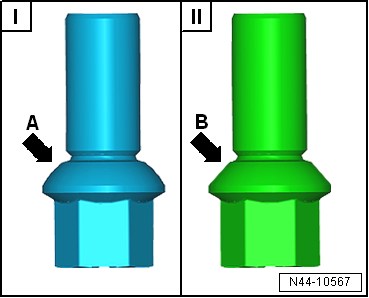
There are basically two seat shapes: the spherical seat and the conical seat.
The spherical seat is the curved surface of a spherical segment –arrow A–. This seat shape is used for original wheels.
The conical seat is the flat surface of a conical segment –arrow B–. This seat shape is partly used for wheels from the aftermarket.
- Wheel bolt with spherical seat
- Wheel bolt with conical seat
Vehicles with tyre pressure monitoring
On vehicles with tyre pressure monitoring, after changing from summer to winter tyres or from winter to summer tyres, the tyre inflation pressure must be re-stored or adjusted → Owner's manual for the respective model.
Approval regulations in the Federal Republic of Germany
Only when winter tyres are fitted is it permissible for the maximum speed attainable by the vehicle to exceed the maximum speed of the winter tyres indicated by the speed symbol.
In this case, a notice plate with the following content must be fitted:
Attention: winter tyres!
Permissible maximum speed ... km/h

Note
This notice plate must be located in the driver's field of view!
Winter tyres with speed symbol V
The tyre industry also supplies winter tyres in V version. However, these tyres can only be used up to the permissible maximum speed vmax = 240 km/h under certain conditions.
Vehicles with V tyres:
Vehicles that require V tyres according to the vehicle documents can run winter tyres in V version without restriction up to a speed "v"max = 240 km/h.
Vehicles with W, Y or ZR tyres:
Vehicles that require W, Y or ZR tyres according to the vehicle documents must not drive at "v"max = 240 km/h with V winter tyres under certain conditions.
Why?
V summer and V winter tyres without special marking only have 100 % of their maximum load capacity, as specified by the load index ("LI"), up to a speed of 210 km/h.
Speeds above 210 km/h are only possible with V winter tyres if the maximum load capacity of the tyres is not exceeded. The load capacity of the tyres decreases further the higher the speed.
The maximum permissible axle loads and the achievable top speed of some vehicles are so high that the load capacity of V tyres is not sufficient for speeds up to 240 km/h.
Example: tyre 205/55 R 16 91V
The load index (LI) 91 gives this tyre a load capacity of 615 kg per tyre up to 210 km/h.
At 240 km/h, this tyre can only carry 560 kg; so the axle load may be at most 1120 kg.
The vehicle has a permissible axle load of 1150 kg and an achievable top speed of 232 km/h. This vehicle may drive with V winter tyres at a maximum of 230 km/h.
This applies to all V winter tyres that have no special marking.
Winter tyres marked Extra Load XL
Approval regulations in the Federal Republic of Germany
Only when winter tyres are fitted is it permissible for the maximum speed attainable by the vehicle to exceed the maximum speed of the winter tyres indicated by the speed symbol.
In this case, a information sign with the following content must be placed in the driver's field of view:
Attention: winter tyres!
Permissible maximum speed ... km/h
Rolling-resistance-optimised tyres
The deformation of the tyre when rolling causes an energy loss, which is noticeable as rolling resistance.
With rolling-resistance-optimised tyres, the deformations are significantly reduced by design measures, and low-loss tread compounds are used.
The tyres approved by the manufacturer are optimised for rolling resistance and, at the same time, meet the current state of the art in all other safety-related and customer-relevant properties.
The corresponding recommended tyre brands are summarised in the following chapter → Guide Wheels, Tyres;
Tyre ageing
- Even tyres that look flawless, are as good as new or have hardly been used, with sufficient tread depth, can suffer significant losses in wet-grip and winter performance from ageing alone if they are older than six years.
- Tyre tests show that a continuous development process, the use of new rubber compounds and modern raw materials, combined with optimisations of tread pattern and tread geometry, constantly produces better tyre products.
- Only tyres at the latest technological level can meet the demands of modern, highly developed vehicles and customers' ever-growing expectation of an economical tyre product that offers the highest degree of safety, driving dynamics and comfort.
- Tyres age through physical and chemical processes, which can impair their function. Tyres that are stored unused for long periods harden and become brittle faster than tyres that are in constant use on the vehicle.
- Older tyres may develop hairline ageing cracks.
- On tyres that are in constant use, the flexing of the tyre activates the plasticisers in the rubber, which prevents hardening and crack formation.
- For this reason, for the spare tyre, stored tyres and tyres that are not in constant use, attention must be paid not only to tread depth but also to the age of the tyres.
- The age can be read from the DOT code on the tyre, which among other things contains the production date of the tyre.
Example of a DOT code up to 31.12.1999

In this example, the production date is week 50 of 1999.
Example of a DOT code from 01.01.2000

In this example, the production date is week 01 of 2000.
Recommendation
- It is recommended that summer and winter tyres older than 6 years are no longer used. Their original properties decrease through the ageing process. Grip properties in particular decline on winter tyres!
- When replacing all four tyres, the spare tyre may be used if it is in flawless condition and no more than 6 years old. The age of a tyre has a major influence on its high-speed durability. Combining a spare tyre that is several years old with new tyres is possible, but it may affect handling.
- Tyres are constantly being further developed, which can lead to small differences in the rubber compound, even when the brand, size and tread pattern are the same.
- All vehicles leave the factory with four identical tyres and wheels.
Vehicles with front-wheel drive:
- For reasons of driving safety, tyres of the same brand and the same tread pattern should always be fitted on one axle.
Vehicles with all-wheel drive:
- On vehicles with all-wheel drive, all 4 wheels must always be fitted with tyres of the same size, construction, tread pattern and brand.
Replacing tyres
The tyres must be replaced in any case if:
- the legal minimum tread depth of 1.6 mm has been reached,
- damage from mechanical injury is visible,
Tyres with rim protector bead
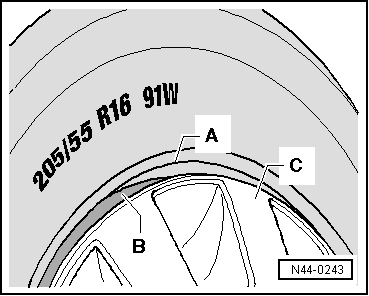
The tyre industry produces tyres with a rim protector bead (kerb guard) for alloy wheels. The rim protector bead is intended to prevent alloy wheels from being damaged by contact with kerbs.
The combination of tyres with a rim protector bead, steel wheels and a full wheel trim can lead to the loss of the full wheel trim while driving. The trim comes loose from its secure seat as a result of the flexing of the tyre.

WARNING!
When fitting tyres to steel wheels, it is essential to ensure that only tyres without a rim protector are mounted on steel wheels.
The illustration shows the impermissible combination of steel wheel, full wheel trim and a tyre with rim protector bead.
- Rim protector bead
- Rim flange of a steel wheel
- Full wheel trim

WARNING!
This combination must NOT be fitted!
Tyre sizes on vehicles with all-wheel drive
On vehicles with all-wheel drive, the following points should be observed:
- Only tyres of the same size, the same brand and the same tread pattern may be fitted on the front and rear axles.
- Different rolling circumferences of the tyres lead to high stress in the drivetrain and increased tyre wear, with possible consequential damage to the drivetrain.
- To a limited extent, this also applies to tyres with different levels of tread wear at the front and rear. In such cases, the tyres with the greater tread depth must be fitted at the front.
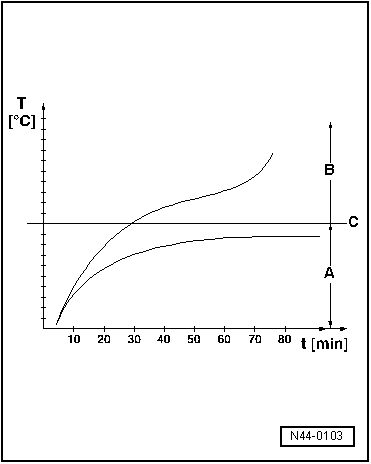
Rising temperature with too low tyre inflation pressure
The diagram shows the temperature behaviour of a tyre at a speed of 180 km/h.
- A - Normal range: if the prescribed tyre pressure is maintained, the temperature remains in equilibrium.
- B - Danger zone: if the prescribed tyre pressure is 0.3 bar below specification, the temperature rises above 120 °C at higher speeds.
- C - Critical temperature limit: tyre failure is initiated.
- T - Temperature in °C
- t - Driving time in minutes