General information
Electronic Stabilization Program improves the vehicle's directional stability.
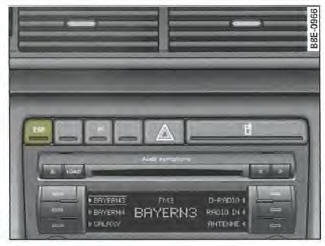
Fig. 198 Centre console with Electronic Stabilization Program control.
ESP helps you keep better control of the vehicle at the limits of stability, for example when accelerating or cornering. It reduces the risk of skidding regardless of road surface conditions, thereby improving vehicle stability. The system operates at all speeds.
Electronic Stabilization Program integrates the anti-lock braking system (ABS), electronic differential lock (EDL) and traction control system (TCS).
Operation
The ESP control unit uses the data from these systems.
It also uses the measured values communicated to it by highly sophisticated sensors.
These sensors record the vehicle's rotation speed around its vertical axis, the lateral acceleration of the vehicle, the brake pressure and the steering angle.
The steering angle and vehicle speed are used to determine the direction intended by the driver and to continuously compare it with the vehicle's actual behaviour. When it detects discrepancies, for example when a skid begins, ESP automatically brakes the appropriate wheel.
The forces acting on the wheels during braking stabilise the vehicle.
When oversteering (the rear of the vehicle slides out), braking is applied mainly to the outside front wheel. When understeering (the vehicle resists turning into the bend), braking is applied to the inside rear wheel. This braking is accompanied by noise.
Electronic Stabilization Control works in conjunction with the ABS. If the ABS is faulty, Electronic Stabilization Control ESP does not function.
Deactivation
When you start the engine, the Electronic Stabilization Control ESP system switches on automatically and performs a self-test.
If necessary, you can switch the system on and off by pressing the button shown => fig. 198. The ESP indicator light illuminates when the system is switched off.
ESP should normally always be switched on. Only in exceptional cases, when wheel slip is desired, can it be advantageous to switch off ESP. Examples:
- when driving with snow chains
- when driving in deep snow or on soft ground
- when rocking the vehicle back and forth to free it from being stuck
Switch ESP back on for all other driving situations.
CAUTION!
Even ESP cannot overcome the laws of physics. The Electronic Stabilization Control ESP does not in any way relieve you of the need to always adapt your driving to road conditions and traffic. Always keep this in mind, especially when roads are slippery or wet. The greatest safety available must not encourage you to take unnecessary risks - risk of accident!
Test yourself
A quick Audi A4 quiz: every answer comes with an explanation and a link to the manual page.