Warning lamps
Overview
The warning lights indicate certain functions or faults.
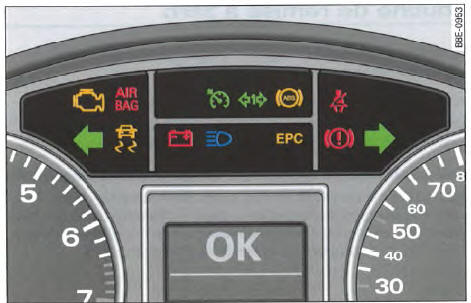
Fig. 8 Instrument cluster with warning lights
Note
The overall control system monitors various functions.
Faults are shown in the instrument cluster display by red symbols (priority 1 – danger) or yellow symbols (priority 2 – caution!).
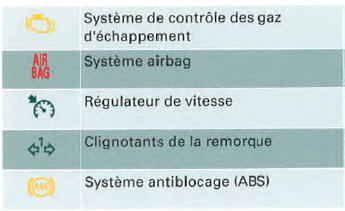
Exhaust emission control system
If the light is on, have the cause of the fault determined and rectified by a specialist workshop as soon as possible.
If the light flashes, drive at low speed and consult a specialist to avoid damaging the catalytic converter.
For more information on the catalytic converter, refer to the
Airbag system
The light monitors the airbag system and the seat belt pretensioners.
The warning light lights up for a few
seconds when you switch on the ignition.
If the does not go out, or it
comes on, flashes or flickers while driving, a system fault must be assumed. The same applies if the light does not come on when you switch on the ignition.
CAUTION!
If a fault has been detected, have the system checked immediately by a specialist workshop. Otherwise the airbag system or seat belt pretensioners may not deploy in an accident.
Applies to vehicles: with cruise control
Cruise control
The warning light lights up in the instrument cluster
when the cruise control is in control mode.
Applies to vehicles: with towing hitch
Towing device
The light flashes at the same rate as the trailer turn signals.
The light flashes when you operate the turn signals, provided the trailer is properly connected to the vehicle.
If a trailer or tow vehicle turn signal fails, the light does not flash.
Anti-lock braking system (ABS)
The warning lamp monitors the ABS system and the electronic differential lock (EDS).
The warning light lights up for a few
seconds when you switch on the ignition and start the engine. The lamp goes out after an automatic self-check process.
You must assume a fault in the ABS system if:
- the lamp does not light up when you switch on the ignition.
- the lamp does not go out after a few seconds.
- the lamp lights up while driving.
The vehicle can then only be braked with the normal braking system, without ABS modulation. Have the vehicle inspected by a specialist workshop as soon as possible. For further information on the ABS system, refer to the.
If the ABS system is faulty, the ESP lamp lights up.
Brake system malfunction
If the ABS lamp lights up
together with the brake system warning lamp G» (with the parking brake released),
you must conclude that not only the ABS system is faulty, but also the brake system
In the event of a brake system malfunction, the symbol appears in the instrument cluster display.
Also observe the information.
Electronic differential lock (EDS) malfunction
The EDS system works together with the ABS system. The ABS lamp lights up when the EDS system is
faulty. Have the vehicle inspected by a specialist workshop as soon as possible. For further information on the EDS system, refer to the.
CAUTION!
- Observe the warnings in «Work in the engine compartment» before opening the hood to check the brake fluid level.
- If the brake system warning lamp
 lights up at the same time as the ABS lamp
 , stop the
vehicle immediately and check the brake fluid level in the reservoir. If the fluid level has dropped below the «MIN» mark, do not continue driving - risk of accident! Consult a specialist. - If the brake fluid level is correct, the fault may be caused by a failure of the ABS control function. The rear wheels may then lock relatively quickly when braking. In some cases this can cause the rear of the vehicle to swerve - risk of skidding! Drive carefully to the nearest specialist workshop and have the fault rectified.
Applies to vehicles: with seat belt reminder
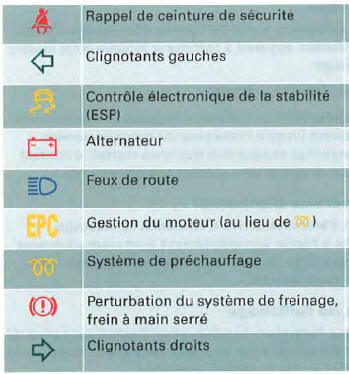
Seat belt reminder
The lamp reminds you to fasten your seat belt.
Lamp A lights up after you switch on the ignition until the driver's seat belt is fastened.
In addition, above a certain speed an audible signal (chime) sounds.
For further information on seat belts, refer to the.
Turn signals
The lamp flashes at the same rate as the turn signals.
Depending on which turn signal is activated, the left lamp or the right lamp
 flashes. When the hazard warning lights
are switched on, both lamps flash simultaneously.
If a turn signal bulb fails, the lamp flashes about twice as fast.
This does not apply when towing a trailer. If a turn signal on the trailer or towing vehicle fails, the lamp does not flash. For further information on turn signals, refer to the.
Electronic Stability Program
The lamp monitors the operation of the Electronic Stability Program (ESP).
The lamp has the following functions:
- It flashes while driving when ESP is active.
- It lights up and stays on for approximately two seconds when you switch on the ignition, for the function check.
- It lights up if the Electronic Stability Program ESP malfunctions.
- It lights up when the battery is disconnected.
- It lights up when the ESP system is switched off.
- As the Electronic Stability Program works in combination with the ABS system, the ESP lamp also lights up if the ABS is faulty.
If the lamp lights up immediately after starting the engine, the system may have been switched off for technical reasons. In this case you can reactivate ESP by switching the ignition off and on again. The lamp goes out when the system is fully operational again.
When you have disconnected or reconnected the battery, the lamp lights up after you switch on the ignition. To make the lamp go out again, simply drive a short distance while steering slightly.
For further details on ESP.
Alternator
The lamp indicates a fault in the alternator or a malfunction in the vehicle's electrical system.
The warning light lights up when you switch on
the ignition. It must go out after the engine starts.
If the lights up while
driving, you can normally continue driving to reach the nearest Audi workshop. However, as the battery is continuously discharging, you should switch off all non-essential electrical consumers.
 Warning!
If the warning lamp  (cooling system malfunction) lights up in the instrument cluster display =:• page 30 while driving, stop the vehicle immediately and switch off the engine. The coolant pump is no longer driven - risk of engine damage!
High beam
The lamp lights up when the high beams are switched on.
The warning light lights up when you switch on
the high beams or flash the headlights.
For further information on high beams, refer to the.
Applies to vehicles: with gasoline engine
Engine management
The lamp monitors the engine management system of the petrol engine.
The warning light (Electronic Power Control)
lights up when the ignition is switched on, to check operation.
Note
If the lamp comes on while driving, a fault has been detected in the engine management system. Have the engine checked by a specialist workshop immediately.
Applies to vehicles: with diesel engine
Glow plug system
The lamp remains on during preheating.
Preheating takes place when the lamp comes on. Start the engine as soon as the
lamp goes out. When the engine is at operating temperature or the outside temperature is above +8 °C, the lamp only stays on for about one second,

- If the glow plug indicator flashes while driving, a fault has been detected in the engine management system. Have the engine checked immediately.
- If the lamp does not come on when you switch on the ignition, there may be a fault in the glow plug system. Have the engine checked.
Braking system
The lamp flashes when the brake fluid level is too low, when the ABS system is faulty or when the parking brake is applied.
If the lamp (' flashes (when the parking brake is released), stop the vehicle and check the brake fluid level
In the event of an ABS fault, the ABS lamp comes on at the same time as the brake system warning lamp
Parking brake applied
The warning light comes on when you apply
the parking brake. The parking brake warning => page 28 also sounds if you drive for more than 3 seconds at a speed above 5 km/h.
CAUTION!
- Observe the warnings in «Work in the engine compartment» before opening the hood to check the brake fluid level.
- If the brake system warning lamp does not go out or comes on while driving, the brake fluid level in the reservoir is too low - risk of accident! Stop and do not continue driving. Contact a specialist.
- If the brake system warning lamp comes on together with the ABS lamp, the ABS control function may be disrupted. The rear wheels may then lock relatively quickly when braking. In some cases this can cause the rear of the vehicle to swerve - risk of skidding! Drive carefully to the nearest specialist workshop and have the fault rectified.
Test yourself
A quick Audi A4 quiz: every answer comes with an explanation and a link to the manual page.