With petrol / diesel engines
Procedure for starting the engine from another battery or for charging a discharged battery.
Accessing the battery
The battery is located under the engine bonnet.
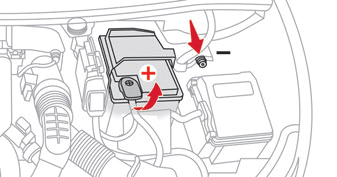
To access the (+) terminal:
► Unlock the bonnet by operating the interior release, then the exterior release.
► Lift the bonnet.
(+) Positive terminal with a quick-release clamp.
(-) Negative terminal.
The negative terminal of the battery is not accessible, so a remote earth point is located near the battery.
Starting from another battery
When the vehicle battery is discharged, the engine can be started using a booster battery (external or from another vehicle) and jump leads, or using a battery booster pack.
Never start the engine with a battery charger connected.
Never use a 24 V or higher battery booster.
Check beforehand that the booster battery has a nominal voltage of 12 V and a capacity at least equal to that of the discharged battery.
The two vehicles must not touch each other.
Switch off all electrical consumers on both vehicles (radio, wipers, lights...).
Make sure the jump leads do not run near moving engine parts (fan, belt...).
Do not disconnect the (+) terminal while the engine is running.
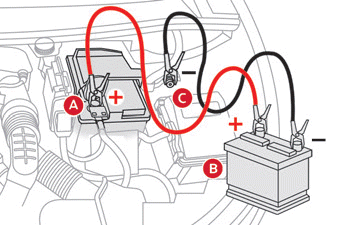
► Lift the plastic cover from the (+) terminal, if the vehicle is fitted with one.
► Connect the red cable to the (+) terminal of the discharged battery A (at the bent metal part), then to the (+) terminal of the booster battery B or the booster.
► Connect one end of the green or black cable to the (-) terminal of the booster battery B or the booster (or to the earth point of the assisting vehicle).
► Connect the other end of the green or black cable to the earth point C.
► Start the engine of the breakdown vehicle and let it run for a few minutes.
► Operate the starter of the vehicle with the flat battery and let the engine run.
If the engine does not start immediately, switch off the ignition and wait a few moments before trying again.
► Wait for the engine to return to idle.
► Disconnect the jump-start cables in the reverse order.
► Refit the plastic cover on the (+) terminal, if fitted.
► Let the engine idle for at least 30 minutes so the battery can reach a sufficient state of charge.
Driving immediately without having reached a sufficient state of charge may impair certain vehicle functions (e.g. Stop & Start).
Charging the battery with a battery charger
To ensure optimum battery service life, it is essential to keep its charge at a sufficient level.
In some cases, it may be necessary to charge the battery:
- Vehicle used mainly for short journeys.
- Before a prolonged period of immobilisation of several weeks.
Consult a CITROËN dealer or a qualified workshop.
To charge the vehicle battery yourself, use only a charger compatible with lead-acid batteries, with a nominal voltage of 12 V.
Follow the operating instructions supplied by the charger manufacturer.
Never reverse the polarities.
It is not necessary to disconnect the battery.
► Switch off the ignition.
► Switch off all electrical consumers (radio, lights, wipers, etc.).
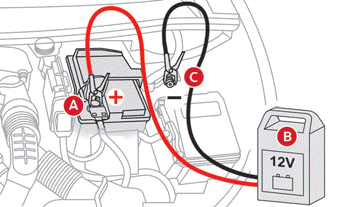
► Switch off charger B before connecting the cables to the battery, to avoid any dangerous spark.
► Check that the charger cables are in good condition.
► If fitted, lift the plastic cover on the (+) terminal.
► Connect the cables of charger B as follows:
- the red positive (+) cable to the (+) terminal of battery A,
- the black negative (-) cable to earth point C on the vehicle.
At the end of the charging operation, switch off charger B before disconnecting the cables from battery A.
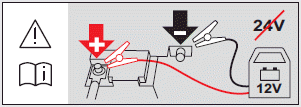
When this label is present, use only a 12 V charger, otherwise electrical equipment may be irreversibly damaged.
Disconnecting / Reconnecting the battery
To maintain a sufficient state of charge to allow the engine to start, it is recommended to disconnect the battery if the vehicle will be immobilised for a very long period.
Before disconnecting the battery:
► Close all openings (doors, boot, windows, roof).
► Switch off all electrical consumers (radio, wipers, lights, etc.).
► Switch off the ignition and observe a waiting time of 4 minutes.
After gaining access to the battery, simply disconnect the (+) terminal.
Quick-release clamp
Disconnecting the (+) terminal
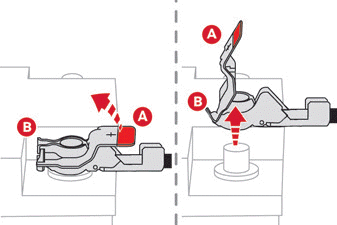
► Depending on equipment, lift the plastic cover on the (+) terminal.
► Raise lever A fully to release clamp B.
► Remove clamp B by lifting it off.
Reconnecting the (+) terminal
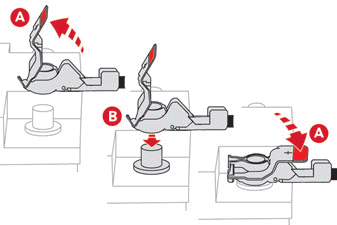
► Raise lever A fully.
► Place the open clamp B onto the (+) terminal.
► Press clamp B down until it stops.
► Lower lever A to lock clamp B.
► Depending on equipment, lower the plastic cover on the (+) terminal.
Do not force the lever by pressing on it, as if the clamp is incorrectly positioned, locking is then impossible.
Repeat the procedure.
On the first journey after the engine is started, Stop & Start may not be operational.
In this case, the function will only become available again after the vehicle has been continuously immobilised, for a period depending on the ambient temperature and the battery state of charge (up to approximately 8 hours).
Test yourself
A quick Citroen C5 Aircross quiz: every answer comes with an explanation and a link to the manual page.