Range Shifting
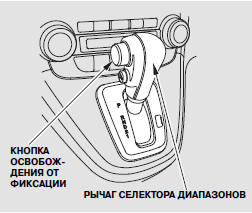
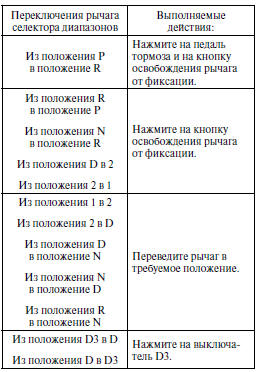
To move the shift lever from P (Park) to any other position, depress the brake pedal and press the release button located on the side of the lever handle. You cannot move the lever out of P (Park) if the ignition key is in the LOCK (0) or ACCESSORY (I) position.
P (Park) position — In this position, the transmission output shaft is mechanically locked. The shift lever must be in P (Park) when starting and stopping the engine. To move the shift lever out of P (Park), depress the brake pedal, then release the accelerator pedal.
Press the release button on the side of the lever handle and move the lever.
If you still cannot move the lever out of P (Park) after performing all of the above actions, release the shift lever in accordance with the instructions on page 385.
To avoid transmission damage, move the lever to P (Park) only after the vehicle has come to a complete stop. To move the shift lever into P (Park), you must also press the release button. To remove the key from the ignition, the shift lever must be in P (Park).
R (Reverse) position: To move the shift lever from P (Park) to R (Reverse), depress the brake pedal and release the lock release button located on the side of the lever knob. Move the shift lever from R (Reverse) to N (Neutral) only after the vehicle has come to a complete stop. Press and release the button before moving the lever from N (Neutral) to R (Reverse).
N (Neutral) position: Use the N (Neutral) position to start the engine when it has stalled and during short stops with the engine running. If you must leave the vehicle for any reason, first move the shift lever to P (Park). Depress the brake pedal when moving the range selector lever from N (Neutral) to another position.
D (Drive) position: In this position, the shift lever must remain in D during normal driving conditions.
The transmission automatically shifts gears (1st through 5th) depending on vehicle speed and the amount of accelerator pedal depression. For example, when the engine is cold, you may notice that upshifts occur at a higher engine speed. This helps the engine warm up faster.
Test yourself
A quick Honda CR-V quiz: every answer comes with an explanation and a link to the manual page.