Tire Pressure Check
Check the tires at least once a month or more often.
Also check the spare tire pressure.
How to Check
Use a quality tire pressure gauge to check tire pressure. You cannot tell if your tires are properly inflated just by looking at them. Radial tires may appear properly inflated even when under-inflated.
Remove the valve cap from the tire valve stem. Press the tire pressure gauge firmly onto the valve to measure the pressure. If the cold tire pressure matches the recommended tire pressure and the load information label, no further adjustment is necessary. If the pressure is low, add air until the recommended pressure is reached.
If you overinflate a tire, release air by pressing the metal pin in the center of the tire valve. Check the tire pressure again with a tire pressure gauge. Be sure to reinstall the valve caps on the valve stems.
Without the valve cap, dirt or moisture can enter the valve core and cause air leakage. If the valve cap is missing, install a new one as soon as possible.
- Check tires regularly for correct inflation, as well as wear and damage. Always use a tire pressure gauge.
- Tires with excessively high or low pressure wear unevenly, which leads to poor handling, loss of vehicle control, and sudden tire failure, resulting in accidents, injuries, and even death. The recommended cold tire pressure for your vehicle can be found in this manual and on the tire information label located on the driver's side center pillar.
- Do not forget to check the spare tire pressure. Kia recommends that you check the spare tire each time you check the pressure of the other tires on your vehicle.
Tire Rotation
To equalize tread wear, it is recommended to rotate the tires every 12,000 km (7,500 miles) or sooner if wear is uneven.
During rotation, check the tire balance.
When rotating tires, check them for uneven wear and damage. Abnormal wear is usually caused by incorrect tire pressure, incorrect wheel alignment, wheel imbalance, hard braking, or sharp cornering. Look for bulges or protrusions on the tread or sidewall of the tires. Replace the tire if you find any of these conditions. Replace the tire if fabric or cord is visible. After rotation, be sure to set the front and rear tire pressures to specification and check the wheel nut tightness.
See "Tires and Wheels" in Chapter 8.
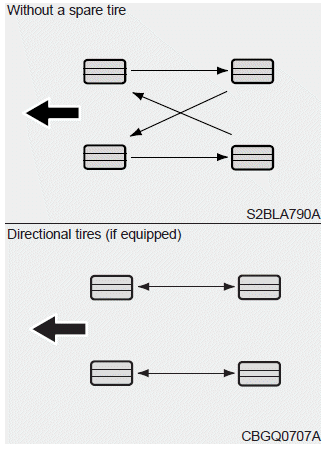
Check disc brake pads for wear every time the tires are rotated.
Rotate radial tires with an asymmetrical tread pattern only front to rear, not side to side.
WARNING - Mixing Tires
- Do not use the compact spare tire (if equipped) for tire rotation.
- Never mix bias-ply and radial tires under any circumstances. This may result in unusual handling characteristics.
Test yourself
A quick Kia Optima DL3 quiz: every answer comes with an explanation and a link to the manual page.