Basic information

In this manual: Basic information
Air bags, seat belts and child restraints — 1Exterior front — 1Exterior rear — 1Passenger compartment — 1Instrument panel — 1Engine compartment check locations — 1Warning and indicator lights — 1Basic Information — 1Basic Information — 1Precautions on Seat Belt Usage — 1Safety - Seats, Seat Belts and Supplemental Restraint System - Child safety — 1Precautions on child restraints — 1Precautions on SRS — 1Instruments and Controls - Instrument Panel — 1Basic Information — 1Warning & Indicator Lights — 1Basic Information — 1Instruments and Controls - Security Systems — 1Instruments and Controls - Wiper and Washer Switch — 1Headlight Control Switch — 1Instruments and Controls - Horn — 1Instruments and Controls - Heated Seat Switches — 1Instruments and Controls - Heated Steering Wheel Switch — 1Instruments and Controls - Vehicle Dynamic Control (VDC) OFF Switch — 1Instruments and Controls - Hill Descent Control Switch — 1Instruments and Controls - Warning systems switch — 1Instruments and Controls - Electronic locking rear differential (E-Lock) system switch — 1Instruments and Controls - Power inverter switch — 1Instruments and Controls - Parking Aids system switch — 1Instruments and Controls - Tow mode switch — 1Instruments and Controls - Emergency Call (SOS) button — 1Instruments and Controls - USB charging ports — 1Instruments and Controls - Wireless charger — 1Instruments and Controls - Rear Door Alert — 1Instruments and Controls - Power outlets — 1Instruments and Controls - Extended storage switch — 1Front-door pockets — 1Instruments and Controls - Windows — 1Instruments and Controls - Moonroof — 1Instruments and Controls - Interior lights — 1Instruments and Controls - HomeLink Universal Transceiver — 1Pre-driving checks and adjustments - Keys — 1Basic information — 1Basic information — 1Basic information — 1Pre-driving checks and adjustments - Hood — 1Pre-driving checks and adjustments - Fuel-filler door — 1Pre-driving checks and adjustments - Steering wheel — 1Pre-driving checks and adjustments - Sun visors — 1Pre-driving checks and adjustments - Mirrors — 1Pre-driving checks and adjustments - Truck box — 1Monitor, climate, audio, phone and voice recognition systems - NissanConnect Owner's Manual — 1Monitor, climate, audio, phone and voice recognition systems - Safety Note — 1Basic Information — 1Basic Information — 1Basic Information — 1Basic Information — 1Basic Information — 1Monitor, climate, audio, phone and voice recognition systems - Servicing air conditioner — 1Monitor, climate, audio, phone and voice recognition systems - Car phone or CB radio — 1Basic Information — 1Basic Information — 1Starting and driving - Starting the engine — 1Engine protection mode — 1Starting and driving - Parking brake — 1Starting and driving - Terrain Mode Selector — 1Starting and driving - Traffic Sign Recognition (TSR) — 1Basic Information — 1Basic Information — 1Basic Information — 1Basic Information — 1Basic Information — 1Basic Information — 1Basic Information — 1Basic Information — 1Starting and driving - Intelligent Driver Alertness (I-DA) — 1Starting and driving - Break-in schedule — 1Starting and driving - Using 4-Wheel Drive (4WD) — 1Starting and driving - Electronic locking rear differential (E-Lock) system — 1Starting and driving - Parking/parking on hills — 1Starting and driving - Brake system — 1Starting and driving - Active Brake Limited Slip (ABLS) system — 1Starting and driving - Vehicle Dynamic Control (VDC) system — 1Starting and driving - Hill descent control system — 1Starting and driving - Hill start assist system — 1Basic Information — 1Basic Information — 1Starting and driving - Cold weather driving — 1In case of emergency - Hazard warning flasher switch — 1In case of emergency - Flat tire — 1In case of emergency - Jump starting — 1In case of emergency - If your vehicle overheats — 1In case of emergency - Towing your vehicle — 1Appearance and care - Cleaning exterior — 1Appearance and care - Cleaning interior — 1Appearance and care - Corrosion protection — 1Do-it-yourself - Maintenance precautions — 1Do-it-yourself - Engine compartment check locations — 1Basic information — 1Checking engine oil level — 1Do-it-yourself - Automatic Transmission Fluid (ATF) — 1Do-it-yourself - Brake fluid — 1Do-it-yourself - Windshield-washer fluid — 1Do-it-yourself - Battery — 1Do-it-yourself - Variable voltage control system — 1Do-it-yourself - Drive belt — 1Do-it-yourself - Spark plugs — 1Do-it-yourself - Air cleaner — 1Do-it-yourself - Windshield wiper blades — 1Do-it-yourself - Brakes — 1Do-it-yourself - Fuses — 1Do-it-yourself - Intelligent Key battery replacement — 1Do-it-yourself - Lights — 1Tire pressure — 1Maintenance and schedules — 5Technical and consumer information — 14
~4min read

Basic information Nissan Frontier SUV

The Nissan Frontier engine cooling system is filled at the factory with a pre-diluted mixture of 50% Genuine NISSAN Long Life Antifreeze/Coolant (blue) and 50% water. This mixture is designed to provide year-round coolant performance, freeze protection, and reliable engine temperature control.

The antifreeze solution also contains rust and corrosion inhibitors that help protect the radiator, engine passages, hoses, and other cooling system components. Additional cooling system additives are not required and should not be used unless specifically recommended.

WARNING

  • Never remove the radiator cap or coolant reservoir cap while the Nissan Frontier engine is hot.

    Allow the engine and radiator to cool completely before opening the system. Hot coolant under pressure can escape suddenly and cause serious burns.

  • The radiator and coolant reservoir are equipped with a pressure-type radiator cap. To help prevent engine damage and maintain proper cooling system pressure, use only a Genuine NISSAN radiator cap.

CAUTION

  • Never use cooling system additives such as radiator sealers. These products may clog passages inside the cooling system and can damage the Nissan Frontier engine, transmission, radiator, heater core, or related components.
  • When adding or replacing coolant, use only Genuine NISSAN Long Life Antifreeze/Coolant (blue) or an equivalent coolant. Genuine NISSAN Long Life Antifreeze/Coolant (blue) is pre-diluted to provide antifreeze protection down to -34ºF (-37ºC). If additional freeze protection is required because of the climate where the Nissan Frontier is operated, add Genuine NISSAN Long Life Antifreeze/Coolant (blue) concentrate according to the directions on the container. If an equivalent coolant other than Genuine NISSAN Long Life Antifreeze/Coolant (blue) is used, follow the coolant manufacturer’s instructions to maintain minimum antifreeze protection down to -34ºF (-37ºC).

    Using coolant other than Genuine NISSAN Long Life Antifreeze/Coolant (blue) or a proper equivalent may damage the engine cooling system.

  • The expected service life of the factory-fill coolant is 105,000 miles (168,000 km) or 7 years. Mixing any other coolant type with Genuine NISSAN Long Life Antifreeze/Coolant (blue), including Genuine NISSAN Long Life Antifreeze/Coolant (green), or using non-distilled water may shorten the service life of the factory-fill coolant. For additional details, refer to the "Maintenance and schedules" section of this manual.

Checking engine coolant level Nissan Frontier SUV
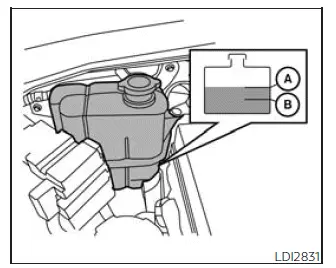
Nissan Frontier engine coolant reservoir MAX and MIN level check

Check the coolant level in the reservoir only when the Nissan Frontier engine is cold. If the coolant level is below the MIN mark B, add coolant until it reaches the MAX mark A. If the reservoir is empty, check the coolant level in the radiator after the engine has cooled completely. If the radiator level is low, fill the radiator with coolant up to the filler opening, then add coolant to the reservoir until it reaches the MAX level A.

This vehicle contains Genuine NISSAN Long Life Antifreeze/Coolant (blue). The factory-fill coolant is designed to last up to 105,000 miles (168,000 km) or 7 years under normal conditions. Mixing other coolant types or using non-distilled water will reduce the expected life of the factory-fill coolant. For more information, see the "Maintenance and schedules" section of this manual.

If the cooling system frequently requires additional coolant, there may be a leak or another system concern. It is recommended that you visit a NISSAN dealer for inspection and service.

Changing engine coolant

A NISSAN dealer can replace the Nissan Frontier engine coolant using the correct service procedure. The proper procedure is described in the NISSAN Service Manual.

Improper coolant replacement or incorrect servicing can reduce heater performance and may cause engine overheating.

WARNING

  • To avoid the risk of scalding, never change the coolant while the engine is hot.
  • Never remove the radiator cap or engine coolant reservoir cap while the Nissan Frontier engine is hot. Pressurized hot coolant can escape from the radiator and cause serious burns.
  • Avoid direct skin contact with used coolant. If coolant contacts your skin, wash the affected area thoroughly with soap or hand cleaner as soon as possible.
  • Keep engine coolant out of the reach of children and pets. Coolant is hazardous and must be handled carefully.

Engine coolant must be disposed of properly and never poured onto the ground, into drains, or into household waste systems.

Check and follow all local regulations for coolant disposal. Proper coolant maintenance helps protect the Nissan Frontier engine from overheating, freezing, corrosion, and long-term cooling system damage.

next pagenext pageEngine compartment check locationsEngine oilnext pagenext page

Nissan Frontier 2022-2026 Owner's Manual

Engine cooling system

More Nissan Vehicles

More Nissan Manuals

More Owner's Manuals

© 2023-2026 - Nissan Frontier technical manuals - www.nifrontier.com/