Instruments and Controls - Windows

In this manual: Instruments and Controls - Windows
Air bags, seat belts and child restraints — 1Exterior front — 1Exterior rear — 1Passenger compartment — 1Instrument panel — 1Engine compartment check locations — 1Warning and indicator lights — 1Basic Information — 1Basic Information — 1Precautions on Seat Belt Usage — 1Safety - Seats, Seat Belts and Supplemental Restraint System - Child safety — 1Precautions on child restraints — 1Precautions on SRS — 1Instruments and Controls - Instrument Panel — 1Basic Information — 1Warning & Indicator Lights — 1Basic Information — 1Instruments and Controls - Security Systems — 1Instruments and Controls - Wiper and Washer Switch — 1Headlight Control Switch — 1Instruments and Controls - Horn — 1Instruments and Controls - Heated Seat Switches — 1Instruments and Controls - Heated Steering Wheel Switch — 1Instruments and Controls - Vehicle Dynamic Control (VDC) OFF Switch — 1Instruments and Controls - Hill Descent Control Switch — 1Instruments and Controls - Warning systems switch — 1Instruments and Controls - Electronic locking rear differential (E-Lock) system switch — 1Instruments and Controls - Power inverter switch — 1Instruments and Controls - Parking Aids system switch — 1Instruments and Controls - Tow mode switch — 1Instruments and Controls - Emergency Call (SOS) button — 1Instruments and Controls - USB charging ports — 1Instruments and Controls - Wireless charger — 1Instruments and Controls - Rear Door Alert — 1Instruments and Controls - Power outlets — 1Instruments and Controls - Extended storage switch — 1Front-door pockets — 1Instruments and Controls - Windows — 1Instruments and Controls - Moonroof — 1Instruments and Controls - Interior lights — 1Instruments and Controls - HomeLink Universal Transceiver — 1Pre-driving checks and adjustments - Keys — 1Basic information — 1Basic information — 1Basic information — 1Pre-driving checks and adjustments - Hood — 1Pre-driving checks and adjustments - Fuel-filler door — 1Pre-driving checks and adjustments - Steering wheel — 1Pre-driving checks and adjustments - Sun visors — 1Pre-driving checks and adjustments - Mirrors — 1Pre-driving checks and adjustments - Truck box — 1Monitor, climate, audio, phone and voice recognition systems - NissanConnect Owner's Manual — 1Monitor, climate, audio, phone and voice recognition systems - Safety Note — 1Basic Information — 1Basic Information — 1Basic Information — 1Basic Information — 1Basic Information — 1Monitor, climate, audio, phone and voice recognition systems - Servicing air conditioner — 1Monitor, climate, audio, phone and voice recognition systems - Car phone or CB radio — 1Basic Information — 1Basic Information — 1Starting and driving - Starting the engine — 1Engine protection mode — 1Starting and driving - Parking brake — 1Starting and driving - Terrain Mode Selector — 1Starting and driving - Traffic Sign Recognition (TSR) — 1Basic Information — 1Basic Information — 1Basic Information — 1Basic Information — 1Basic Information — 1Basic Information — 1Basic Information — 1Basic Information — 1Starting and driving - Intelligent Driver Alertness (I-DA) — 1Starting and driving - Break-in schedule — 1Starting and driving - Using 4-Wheel Drive (4WD) — 1Starting and driving - Electronic locking rear differential (E-Lock) system — 1Starting and driving - Parking/parking on hills — 1Starting and driving - Brake system — 1Starting and driving - Active Brake Limited Slip (ABLS) system — 1Starting and driving - Vehicle Dynamic Control (VDC) system — 1Starting and driving - Hill descent control system — 1Starting and driving - Hill start assist system — 1Basic Information — 1Basic Information — 1Starting and driving - Cold weather driving — 1In case of emergency - Hazard warning flasher switch — 1In case of emergency - Flat tire — 1In case of emergency - Jump starting — 1In case of emergency - If your vehicle overheats — 1In case of emergency - Towing your vehicle — 1Appearance and care - Cleaning exterior — 1Appearance and care - Cleaning interior — 1Appearance and care - Corrosion protection — 1Do-it-yourself - Maintenance precautions — 1Do-it-yourself - Engine compartment check locations — 1Basic information — 1Checking engine oil level — 1Do-it-yourself - Automatic Transmission Fluid (ATF) — 1Do-it-yourself - Brake fluid — 1Do-it-yourself - Windshield-washer fluid — 1Do-it-yourself - Battery — 1Do-it-yourself - Variable voltage control system — 1Do-it-yourself - Drive belt — 1Do-it-yourself - Spark plugs — 1Do-it-yourself - Air cleaner — 1Do-it-yourself - Windshield wiper blades — 1Do-it-yourself - Brakes — 1Do-it-yourself - Fuses — 1Do-it-yourself - Intelligent Key battery replacement — 1Do-it-yourself - Lights — 1Tire pressure — 1Maintenance and schedules — 5Technical and consumer information — 14
6steps
~36min
2/5difficulty
Done 0 of 6

Power windows

Basic Information

WARNING

  • Ensure that all passengers keep their hands, arms, and other body parts inside the Nissan Frontier while the vehicle is moving and before closing any window. Use the window lock switch whenever necessary to prevent unintended operation.
  • To help prevent injury or death resulting from unintended vehicle operation, window entrapment, or accidental door lock activation, never leave children, pets, or individuals requiring assistance unattended inside the vehicle. Temperatures inside a closed Nissan Frontier can rise rapidly and become life-threatening.

The power windows operate when the ignition switch is in the ON position and for a limited period after the ignition switch is moved to the ACC or OFF position. If either the driver's door or front passenger's door is opened during this retained-power period, power window operation is canceled.
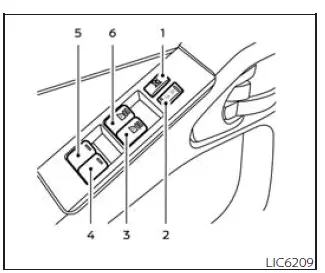
Nissan Frontier driver side power window control panel

Driver's side power window switch

  1. Window lock button
  2. Power door lock switch
  3. Front passenger side automatic window switch
  4. Right rear passenger window switch (Crew Cab models only)
  5. Left rear passenger window switch (Crew Cab models only)
  6. Front driver's side automatic window switch

The Nissan Frontier driver's control panel provides centralized control of all available power windows. Using these switches, the driver can conveniently operate both front and rear windows from a single location.

To open a window, press and hold the appropriate switch downward. To close a window, pull the switch upward and hold it. Releasing the switch immediately stops window movement.
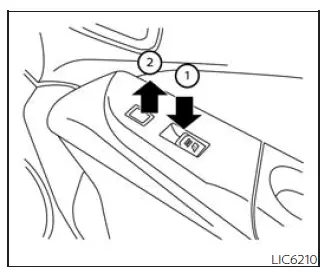
Nissan Frontier front passenger power window switch

Front passenger's power window switch

The passenger-side switch controls only the corresponding front passenger window.

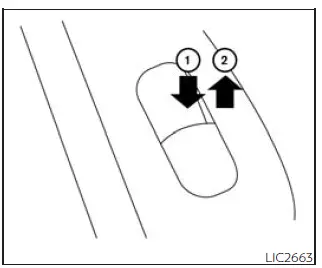
To lower the window, press and hold the switch downward 1. To raise the window, pull the switch upward 2.
Nissan Frontier rear power window switch Crew Cab

Rear power window switch (Crew Cab models only)

The rear passenger window switches control only their respective windows. Press and hold the switch downward 1 to open the window. Pull the switch upward 2 to close the window.

Locking passengers' windows

When the window lock switch is activated, only the driver's window remains operational. This feature helps prevent accidental window operation by rear passengers and children. Press the switch again to restore normal operation.
Nissan Frontier automatic window operation switch

Automatic operation

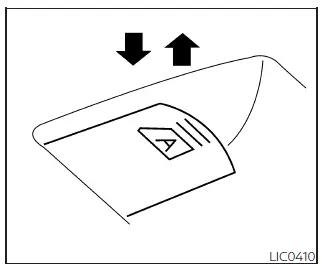
To fully lower a window equipped with automatic operation, press the window switch past the second detent and release it. The window will automatically travel to the fully open position without requiring the switch to be held.

To stop the window before it reaches the fully open position, pull the switch upward while the window is moving.

Rear sliding window
Nissan Frontier rear sliding window operation

WARNING

  • Before operating the rear sliding window, make certain that all passengers, pets, and objects are clear of the window opening and moving components.

    Failure to observe this precaution may result in personal injury or damage to the rear window mechanism.

  • The rear sliding window is not designed to support or transport long objects through the opening.
  • Do not place cargo, equipment, lumber, pipes, or other items through the open rear window. Do not use the rear sliding window as a cargo pass-through.

    Improper use may damage the Nissan Frontier rear window system or result in injury.

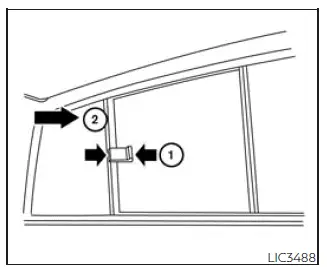
To open the rear sliding window, squeeze the handles of lever 1 and slide the glass panel in the direction indicated by arrow 2.

The rear sliding window helps improve cabin ventilation and airflow while enhancing comfort for Nissan Frontier occupants during warm-weather driving conditions.

next pagenext pageStorageMoonroofnext pagenext page

Nissan Frontier 2022-2026 Owner's Manual

More Nissan Vehicles

More Nissan Manuals

More Owner's Manuals

© 2023-2026 - Nissan Frontier technical manuals - www.nifrontier.com/