Starting and driving - Parking/parking on hills
In this manual: Starting and driving - Parking/parking on hills
Air bags, seat belts and child restraints — 1Exterior front — 1Exterior rear — 1Passenger compartment — 1Instrument panel — 1Engine compartment check locations — 1Warning and indicator lights — 1Basic Information — 1Basic Information — 1Precautions on Seat Belt Usage — 1Safety - Seats, Seat Belts and Supplemental Restraint System - Child safety — 1Precautions on child restraints — 1Precautions on SRS — 1Instruments and Controls - Instrument Panel — 1Basic Information — 1Warning & Indicator Lights — 1Basic Information — 1Instruments and Controls - Security Systems — 1Instruments and Controls - Wiper and Washer Switch — 1Headlight Control Switch — 1Instruments and Controls - Horn — 1Instruments and Controls - Heated Seat Switches — 1Instruments and Controls - Heated Steering Wheel Switch — 1Instruments and Controls - Vehicle Dynamic Control (VDC) OFF Switch — 1Instruments and Controls - Hill Descent Control Switch — 1Instruments and Controls - Warning systems switch — 1Instruments and Controls - Electronic locking rear differential (E-Lock) system switch — 1Instruments and Controls - Power inverter switch — 1Instruments and Controls - Parking Aids system switch — 1Instruments and Controls - Tow mode switch — 1Instruments and Controls - Emergency Call (SOS) button — 1Instruments and Controls - USB charging ports — 1Instruments and Controls - Wireless charger — 1Instruments and Controls - Rear Door Alert — 1Instruments and Controls - Power outlets — 1Instruments and Controls - Extended storage switch — 1Front-door pockets — 1Instruments and Controls - Windows — 1Instruments and Controls - Moonroof — 1Instruments and Controls - Interior lights — 1Instruments and Controls - HomeLink Universal Transceiver — 1Pre-driving checks and adjustments - Keys — 1Basic information — 1Basic information — 1Basic information — 1Pre-driving checks and adjustments - Hood — 1Pre-driving checks and adjustments - Fuel-filler door — 1Pre-driving checks and adjustments - Steering wheel — 1Pre-driving checks and adjustments - Sun visors — 1Pre-driving checks and adjustments - Mirrors — 1Pre-driving checks and adjustments - Truck box — 1Monitor, climate, audio, phone and voice recognition systems - NissanConnect Owner's Manual — 1Monitor, climate, audio, phone and voice recognition systems - Safety Note — 1Basic Information — 1Basic Information — 1Basic Information — 1Basic Information — 1Basic Information — 1Monitor, climate, audio, phone and voice recognition systems - Servicing air conditioner — 1Monitor, climate, audio, phone and voice recognition systems - Car phone or CB radio — 1Basic Information — 1Basic Information — 1Starting and driving - Starting the engine — 1Engine protection mode — 1Starting and driving - Parking brake — 1Starting and driving - Terrain Mode Selector — 1Starting and driving - Traffic Sign Recognition (TSR) — 1Basic Information — 1Basic Information — 1Basic Information — 1Basic Information — 1Basic Information — 1Basic Information — 1Basic Information — 1Basic Information — 1Starting and driving - Intelligent Driver Alertness (I-DA) — 1Starting and driving - Break-in schedule — 1Starting and driving - Using 4-Wheel Drive (4WD) — 1Starting and driving - Electronic locking rear differential (E-Lock) system — 1Starting and driving - Parking/parking on hills — 1Starting and driving - Brake system — 1Starting and driving - Active Brake Limited Slip (ABLS) system — 1Starting and driving - Vehicle Dynamic Control (VDC) system — 1Starting and driving - Hill descent control system — 1Starting and driving - Hill start assist system — 1Basic Information — 1Basic Information — 1Starting and driving - Cold weather driving — 1In case of emergency - Hazard warning flasher switch — 1In case of emergency - Flat tire — 1In case of emergency - Jump starting — 1In case of emergency - If your vehicle overheats — 1In case of emergency - Towing your vehicle — 1Appearance and care - Cleaning exterior — 1Appearance and care - Cleaning interior — 1Appearance and care - Corrosion protection — 1Do-it-yourself - Maintenance precautions — 1Do-it-yourself - Engine compartment check locations — 1Basic information — 1Checking engine oil level — 1Do-it-yourself - Automatic Transmission Fluid (ATF) — 1Do-it-yourself - Brake fluid — 1Do-it-yourself - Windshield-washer fluid — 1Do-it-yourself - Battery — 1Do-it-yourself - Variable voltage control system — 1Do-it-yourself - Drive belt — 1Do-it-yourself - Spark plugs — 1Do-it-yourself - Air cleaner — 1Do-it-yourself - Windshield wiper blades — 1Do-it-yourself - Brakes — 1Do-it-yourself - Fuses — 1Do-it-yourself - Intelligent Key battery replacement — 1Do-it-yourself - Lights — 1Tire pressure — 1Maintenance and schedules — 5Technical and consumer information — 14
~3min read
Nissan Frontier proper parking and wheel positioning on hills

WARNING

  • Never stop or park your Nissan Frontier over flammable materials such as dry grass, leaves, paper, cardboard, or cloth. Hot exhaust system components may ignite these materials and create a fire hazard.
  • Safe parking practices require both the parking brake to be firmly applied and the transmission to be placed in the P (Park) position.

    Failure to follow these procedures may allow the Nissan Frontier to move unexpectedly or roll away, increasing the risk of an accident, property damage, or personal injury. Always verify that the shift lever is fully engaged in P (Park) and cannot be moved without depressing the brake pedal.

  • Never leave the engine running when the Nissan Frontier is unattended. An unattended running vehicle may present safety and security risks.
  • Do not leave children unattended inside the vehicle. They may accidentally operate switches, controls, or the transmission and cause unintended vehicle movement or other dangerous situations.
  • To reduce the risk of serious injury or death caused by unintended vehicle operation, never leave children, individuals requiring assistance, or pets unattended inside your Nissan Frontier. Interior temperatures can rise rapidly, even on moderately warm days, creating life-threatening conditions within a short period of time.

1. Firmly apply the parking brake to help secure the Nissan Frontier before leaving the vehicle.

2. Move the shift lever completely into the P (Park) position.

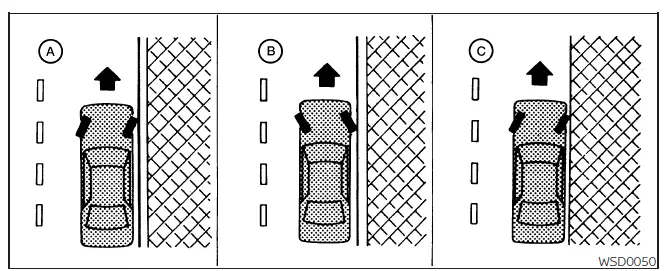
3. When parking on an incline, take additional precautions to help prevent the vehicle from rolling into traffic. Turning the wheels as illustrated is considered a good safety practice.

  • HEADED DOWNHILL WITH CURB A : Turn the front wheels toward the curb and slowly move the Nissan Frontier forward until the curb-side tire lightly contacts the curb.
  • HEADED UPHILL WITH CURB B : Turn the front wheels away from the curb and carefully allow the vehicle to roll backward until the curb-side tire gently touches the curb.
  • HEADED UPHILL OR DOWNHILL, NO CURB C : Turn the wheels toward the edge of the roadway. If the vehicle moves unexpectedly, it will roll away from the center of traffic rather than into it.

4. Place the ignition switch in the LOCK position before exiting the Nissan Frontier.

NOTE:

The Idling Stop System can help reduce fuel consumption and emissions when the Nissan Frontier is temporarily stopped, such as at traffic lights or in slow-moving traffic. However, when parking for an extended period, always turn the engine off using the ignition switch rather than relying on the Idling Stop System.

Power steering

The Nissan Frontier power-assisted steering system uses a hydraulic pump driven by the engine to reduce steering effort and improve maneuverability during everyday driving.

If the engine stops running or the drive belt becomes damaged or breaks, you will still be able to maintain directional control of the Nissan Frontier.

However, significantly greater steering effort will be required, particularly during low-speed maneuvers, parking operations, and sharp turns. Steering response may feel noticeably heavier than normal.

Under normal operating conditions, the power steering system helps provide smooth and responsive handling, contributing to overall driving comfort and control.

WARNING

If the engine is not running or shuts off while the Nissan Frontier is being driven, power steering assistance will no longer be available. As a result, steering effort will increase substantially and the steering wheel may become much harder to turn, especially at lower speeds. Always maintain firm control of the vehicle and steer carefully if this situation occurs.


next pagenext pageElectronic locking rear differential (E-Lock) systemBrake systemnext pagenext page

Nissan Frontier 2022-2026 Owner's Manual

More Nissan Vehicles

More Nissan Manuals

More Owner's Manuals

© 2023-2026 - Nissan Frontier technical manuals - www.nifrontier.com/