Do-it-yourself - Battery replacement
Basic information
WARNING
- Ingestion hazard: Death or serious injury can occur if ingested.
- A swallowed button cell or coin battery can cause internal chemical burns in as little as 2 hours.
- Keep new and used batteries out of reach of children.
- Be careful not to allow children or pets to swallow removed parts.
- Seek immediate medical attention if a battery is suspected to be swallowed or inserted inside any part of the body.
- For treatment information call the National battery ingestion hotline @ 1-800-498-8666.
- There is a danger of explosion if the battery is incorrectly replaced. Replace only with the same or equivalent type of battery. Incorrectly replacing the battery can lead to injury or death.
- Do not crush or cut the battery.
- Do not subject the battery to extremely low air pressure at high altitude.
- Do not expose the battery to excessive heat such as sunshine, fire or similar heat sources.
CAUTION
- An improperly disposed battery can harm the environment. Always confirm local regulations for battery disposal.
- When changing batteries, do not let dust or oil get on the components.
NISSAN Intelligent Key
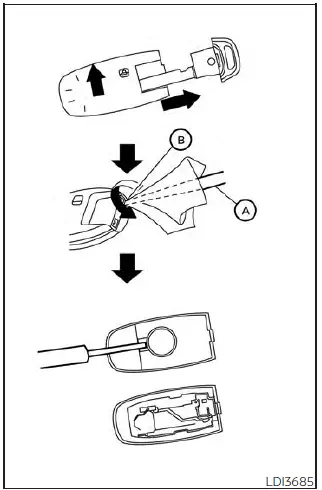
Replace the battery in the Intelligent Key as follows:
1. Remove the mechanical key from the Intelligent Key.
2. Insert a small flathead screwdriver A into the slit B of the corner and twist it to separate the upper part from the lower part. Place a cloth over the screwdriver to protect the casing.
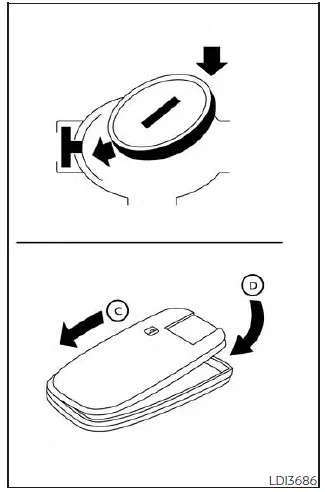
3. Replace the battery with a new one.
Recommended battery: CR2032 or equivalent.
- Do not touch the internal circuit and electric terminals as doing so could cause a malfunction.
- Hold the battery by the edges. Holding the battery across the contact points will seriously deplete the storage capacity.
- Make sure that the + side faces the bottom of the lower part.
4. Close the lid securely as illustrated with C and D .
5. Operate the buttons to check the operation.
If you need assistance with replacement, it is recommended that you visit a NISSAN dealer for this service.
FCC Notice:
For USA:
his device complies with Part 15 of the FCC Rules. Operation is subject to the following two conditions: (1) This device may not cause harmful interference, and (2) this device must accept any interference received, including interference that may cause undesired operation.
Note:
Changes or modifications not expressly approved by the party responsible for compliance could void the user's authority to operate the equipment.
For Canada:
This device contains licence-exempt transmitter(s)/receiver(s) that comply with Innovation, Science and Economic Development Canada's licence-exempt RSS(s). Operation is subject to the following two conditions: (1) This device may not cause interference. (2) This device must accept any interference, including interference that may cause undesired operation of the device.