Starting and driving - Front and Rear Sonar System
- Basic information
- System operation
Basic information Nissan Pathfinder SUV
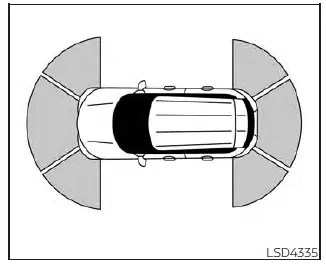
The sonar system sounds a tone to inform the driver of obstacles around the vehicle using the sonar sensors located in the front and rear bumpers..
When the sonar system is turned on, the sonar view will automatically appear in the vehicle information display.
WARNING
- The sonar system is a convenience but it is not a substitute for proper parking.
- The driver is always responsible for safety during parking and other maneuvers.
Always look around and check that it is safe to do so before parking.
- Read and understand the limitations of the sonar system as contained in this section. The colors of the corner sonar indicator indicates different distances to the object.
- Inclement weather or ultrasonic sources such as an automatic car wash, a truck's compressed-air brakes or a pneumatic drill may affect the function of the system; this may include reduced performance or a false activation.
- The sonar system is designed as an aid to the driver in detecting large stationary objects to help avoid damaging the vehicle.
- The sonar system is not designed to prevent contact with small or moving objects. Always move slowly. The system will not detect small objects below the bumper, and may not detect objects close to the bumper or on the ground.
- The sonar system may not detect the following objects: fluffy objects such as snow, cloth, cotton, glass-wool, etc.; thin objects such as rope, wire and chain, etc.; or wedge-shaped objects.
- The front and rear sonar detect the distance between the vehicle and the obstacle by detecting the sound wave reflected from the surface of an obstacle. When there is a sound such a horn, or an ultrasonic source (such as sonar of other vehicles) around the vehicle, the sonar may not detect objects properly.
If your vehicle sustains damage to the bumper fascia, leaving it misaligned or bent, the sensing zone may be altered causing inaccurate measurement of obstacles or false alarms.
CAUTION
- Excessive noise (such as audio system volume or an open vehicle window) will interfere with the tone and it may not be heard.
- Keep the sonar sensors (located on the bumper fascias) free from snow, ice and large accumulations of dirt.
Do not clean the sensors with sharp objects. If the sensors are covered, the accuracy of the sonar function will be diminished.
System operation Nissan Pathfinder 2022
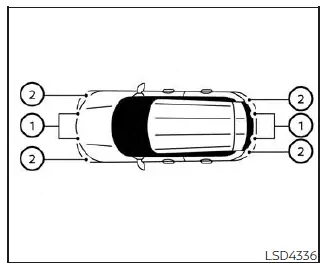
- Center sonar sensors
- Corner sonar sensors
The system informs with a visual and audible alert of:
- front obstacles when the shift lever is in the D (Drive) position
- front and rear obstacles when the shift lever is in the R (Reverse) position
How the system alerts of obstacles:
The system is deactivated at speeds above 10 km/h. It is reactivated at lower speeds.
The intermittent tone will stop after several seconds when the obstacle is identified only with the center sensor. The tone will stop when the obstacle gets away from the vehicle.
When the object is detected, the indicator (green) appears and blinks and the tone sounds intermittently. When the vehicle moves closer to the object, the color of the indicator turns yellow and the rate of the blinking increases. When the vehicle is very close to the object, the indicator stops blinking and turns red, and the tone sounds continuously.
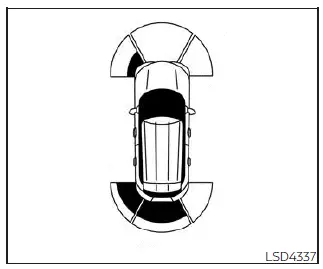
When the vehicle moves closer to an obstacle, the sonar indicator (detected area) appears in the vehicle information display.
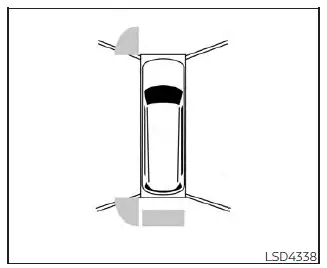
The sonar indicator also appears on the camera view of the center display.
How to enable/disable the front and rear sonar system
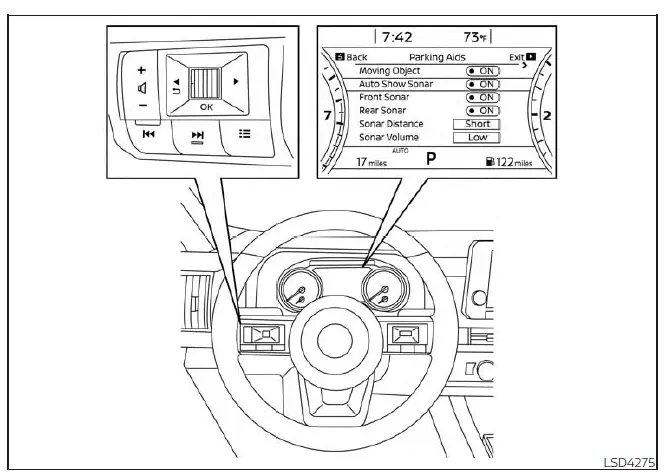
For vehicles with the 7 inch (18 cm) display
The system is automatically activated when the push button ignition switch is placed in the ON position and the shift lever is in the R (Reverse) position.
Perform the following steps to enable or disable the sonar system:
1. Press the  button until "Settings" appears in the vehicle information display and then press OK. Use the scroll dial to select "Driver Assistance." Then press the OK button.
2. Select "Parking Aids" and press the OK button.
- Select "Auto Show Sonar" and press the OK button to turn on or off the option to automatically display the sonar when activated.
- Select "Front Sonar" (if so equipped) and press the OK button to turn the front sonar sensors only on or off.
- Select "Rear Sonar" and press the OK button to turn the rear sonar sensors only on or off.
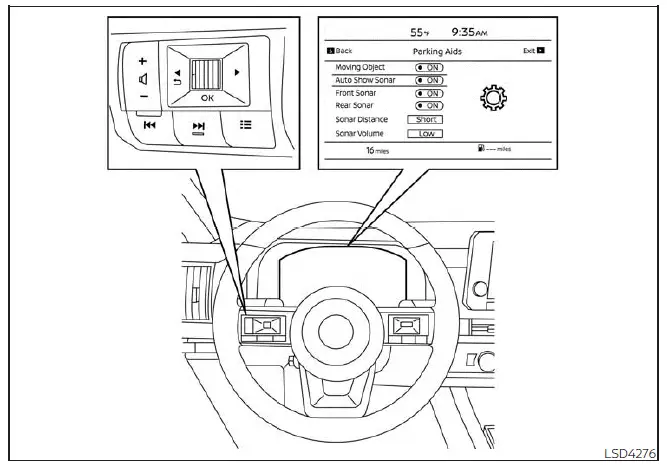
For vehicles with the 12.3 inch (31.2 cm) display
- Select "Sonar Distance" to change the sonar system distance to "Long," Medium" or "Short."
- Select "Sonar Volume" to change the sonar system volume to "High," "Medium" or "Low."
NOTE: The settings will be retained even if the engine is restarted.
Sonar limitations
WARNING Listed below are the system limitations for the sonar system. Failure to operate the vehicle in accordance with these system limitations could result in serious injury or death.
- Read and understand the limitations of the sonar system as contained in this section. Inclement weather may affect the function of the sonar system; this may include reduced performance or a false activation.
- The sonar system is deactivated at speeds above 10 km/h. It is reactivated at lower speeds.
- Inclement weather or ultrasonic sources such as an automatic car wash, a truck's compressed-air brakes or a pneumatic drill may affect the function of the system; this may include reduced performance or a false activation.
- The sonar system is not designed to prevent contact with small or moving objects. Always move slowly. The system will not detect small objects below the bumper or on the ground.
- The sonar system may not detect the following objects: fluffy objects such as snow, cloth, cotton, glass-wool, etc.; thin objects such as rope, wire and chain, etc.; or wedge-shaped objects; complex-shaped objects or multiple objects in close.
- The sonar system may not detect objects at speeds above 5 km/h and may not detect certain angular or moving objects.
- The sonar system may not operate in the following conditions:
- When rain, snow, ice, dirt, etc. adheres to the sonar.
- When a loud sound is heard in the area around the vehicle.
- When the surface of the obstacle is diagonal to the front or rear of the vehicle.
- When a sonar or the area around the sensor is extremely hot or cold.
- The sonar system may unintentionally operate in the following conditions:
- When there is overgrown grass in the area around the vehicle.
- When there are bumps, protrusions or manhole covers on the road surface.
- When the vehicle drives through a draped flag or a curtain.
- When there is an accumulation of snow or ice behind the vehicle.
- When driving on a steep hill.
System temporarily unavailable
When sonar blockage is detected, the system will be deactivated automatically.
The system is not available until the conditions no longer exist.
The sonar sensors may be blocked by temporary ambient conditions such as splashing water, mist or fog. The blocked condition may also be caused by objects such as ice, frost or dirt obstructing the sonar sensors.
Action to take:
When the above conditions no longer exist, the system will resume automatically.
System maintenance
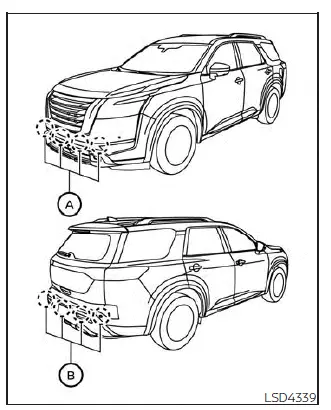
The sonar sensors A and B are located on the front and rear bumpers.
- Always keep the area near the sonar sensors clean.
- If the sonar sensors are dirty, wipe them off with a soft cloth while being careful to not damage them.
- The sonar sensors may be blocked by temporary ambient conditions such as splashing water, mist or fog. The blocked condition may also be caused by objects such as ice, frost or dirt obstructing the sonar sensors. Check for and remove objects obstructing the area around the sonar sensors.
- Do not subject the area around the sonar sensors to strong impact. Also, do not remove or disassemble the sonar sensors.
If the sonar sensors and peripheral areas are deformed in an accident, etc., have the sonar sensors checked by a NISSAN dealer.
- Do not attach stickers (including transparent material), install accessories or apply additional paint on the sonar sensors and their surrounding areas. This may cause a malfunction or improper operation.
- When washing the vehicle using a high-pressure washer, do not apply direct washer pressure on the sonar sensors.
This may cause a malfunction of the sonar sensors.