Instruments and controls - Storage
- Front-door pockets
- Overhead sunglasses storage
- Roof rack (Type A)
Front-door pockets Nissan Pathfinder Fifth generation
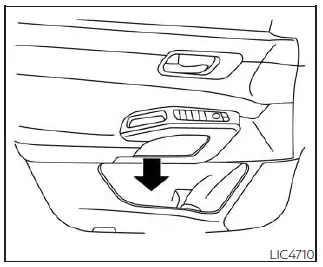
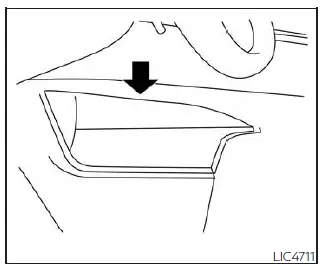
Lower console storage tray
Seatback pockets
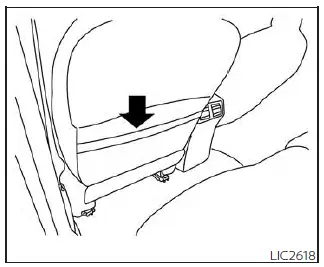
There is one seatback pocket located on the back of the driver and passenger seats.
The pockets can be used to store maps.
WARNING
To ensure proper operation of the driver's and/or front passenger's NISSAN Advanced Air Bag System (if so equipped), please observe the following items:
- Do not allow a passenger in the rear seat or 2nd row to push or pull on the seatback pocket or head restraint/ headrest.
- Do not place heavy loads heavier than 9.1 lbs. (4 kg) on the seatback, head restraint/headrest or in the seatback pocket.
Storage trays
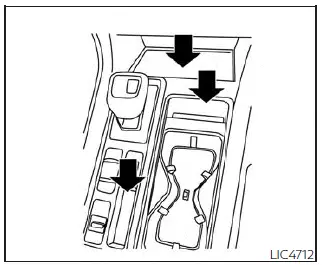
Front console
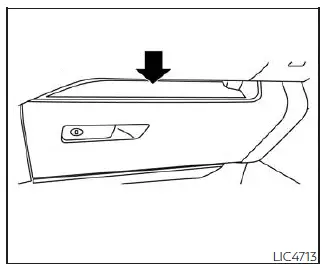
Passenger side
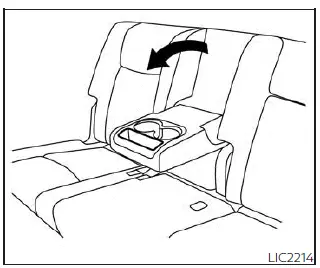
Rear armrest (if so equipped)
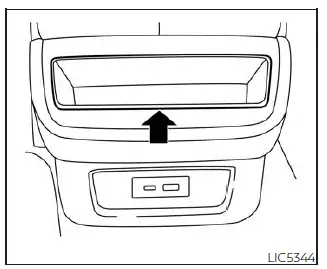
2nd row (if so equipped)
WARNING Do not place sharp objects in the trays to help prevent injury in an accident or sudden stop.
Glove box
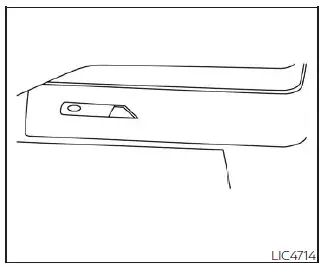
Open the glove box by pulling the handle.
Use the mechanical key when locking or unlocking the glove box.
WARNING Keep the glove box lid closed while driving to help prevent injury in an accident or a sudden stop.
Console box
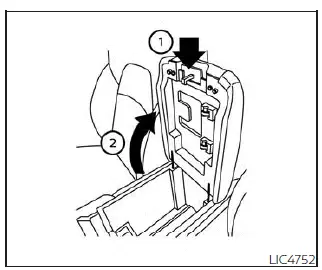
To open the console box, pull the lever up 1 and raise the lid 2.
To close, push the lid down until the lock latches.
2nd row console
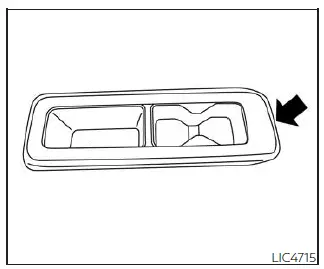
The 2nd row console is removable. In order to remove, locate the front panel opening at the front of the center console.
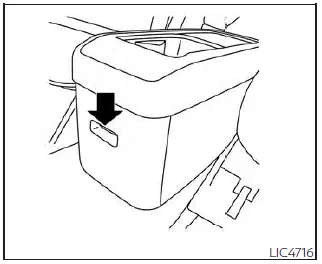
Remove the front panel of the center console.
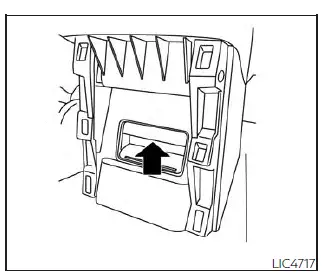
Pull up on the lever and lift up to remove center console.
Overhead sunglasses storage Nissan Pathfinder
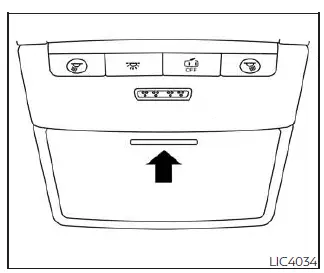
To open the sunglasses holder, push and release.
Only store one pair of sunglasses in the holder.
WARNING Keep the sunglasses holder closed while driving to avoid obstructing the driver's view and to help prevent an accident.
CAUTION
- Do not use for anything other than sunglasses.
- Do not leave sunglasses in the sunglasses holder while parking in direct sunlight. The heat may damage the sunglasses.
Cup holders
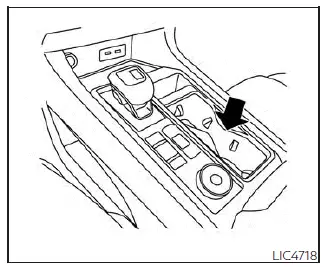
Front console
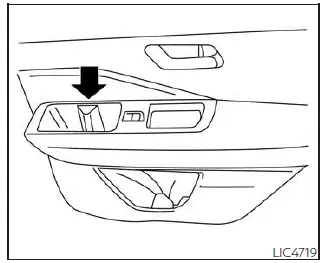
Rear door
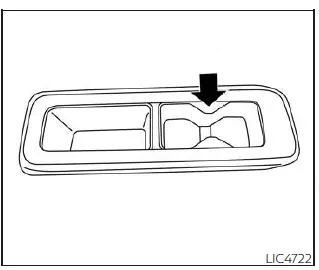
2nd row (if so equipped)
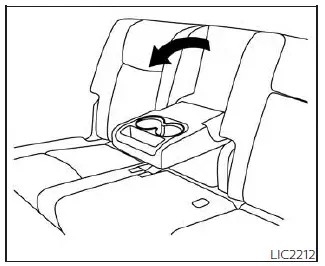
2nd row (if so equipped)
CAUTION Do not recline the rear seatback when you use the cup holders on the rear armrest. Doing so may cause the beverages to spill over, and if they are hot, they may scald the passengers.
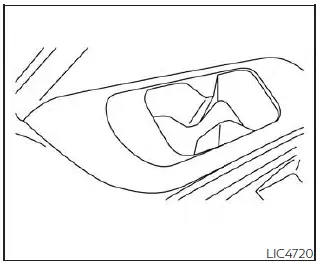
3rd row
CAUTION Avoid abrupt starting and braking when the cup holder is being used to prevent spilling the drink. If the liquid is hot, it can scald you or your passenger.
CAUTION Use only soft cups in the cup holder.
Hard objects can injure you in an accident.
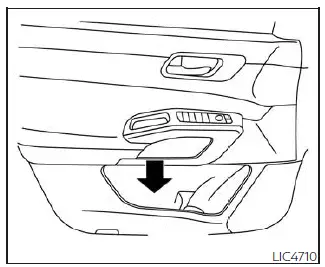
Bottle holder - front
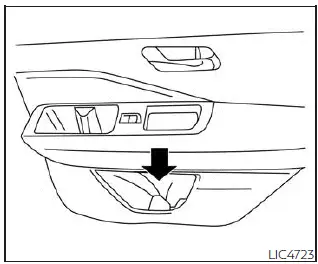
Bottle holder - rear
CAUTION
- Do not use the bottle holder for any other objects that could be thrown about in the vehicle and possibly injure people during sudden braking or an accident.
- Do not use the bottle holder for open liquid containers.
Cargo area storage bin


To access the floor storage area pull up on the strap to lift the luggage board.
Luggage hooks
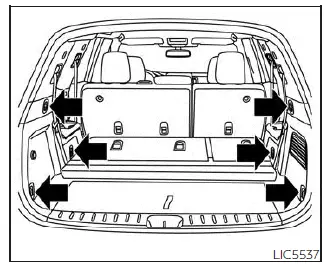
When securing items using luggage hooks located on the upper side finisher do not apply a load over more than 6.5 lbs. (29 N) to a single hook.
The cargo hooks that are located closer to the floor should have loads less than 110 lbs. (490 N) to a single hook.
The cargo hooks can be used to secure cargo with ropes or other types of straps.
WARNING
- Properly secure all cargo with ropes or straps to help prevent it from sliding or shifting. Do not place cargo higher than the seatbacks. In a sudden stop or collision, unsecured cargo could cause personal injury.
- Use suitable ropes and hooks to secure cargo.
- Never allow anyone to ride in the luggage area. It is extremely dangerous to ride in a cargo area inside of a vehicle.
In a collision, people riding in these areas are more likely to be seriously injured or killed.
- Do not allow people to ride in any area of your vehicle that is not equipped with seats and seat belts.
- The child restraint top tether strap may be damaged by contact with items in the cargo area. Secure any items in the cargo area. Your child could be seriously injured or killed in a collision if the top tether strap is damaged.
- Be sure everyone in your vehicle is in a seat and using a seat belt properly.
Roof rack (Type A) Nissan Pathfinder R53
Basic Information
WARNING
- Always install the crossbars onto the roof side rails before loading cargo of any kind. Loading cargo directly onto the roof side rails or the vehicle's roof may cause vehicle damage.
- Roof rack cross bars should be evenly distributed.
- Do not exceed maximum roof rack crossbars load capacity and always distribute the load uniformly.
- Heavy loading of the crossbars has the potential to affect the vehicle stability and handling during sudden or unusual handling maneuvers.
- Properly secure all cargo with ropes or straps to help prevent it from sliding or shifting. In a sudden stop or collision, unsecured cargo could cause personal injury.
- Drive extra carefully when the vehicle is loaded at or near the cargo carrying capacity, especially if the significant portion of that load is carried on the crossbars.
CAUTION
- Use care when placing or removing items from the roof rack. If you cannot comfortably lift the items onto the roof rack from the ground, use a ladder or a stool.
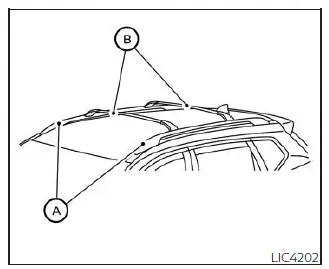
Do not apply any load directly to the roof side rails A . Crossbars B must be installed before applying load/cargo/luggage to the roof of the vehicle.
Genuine NISSAN accessory crossbars may be available through a NISSAN dealer. It is recommended that you visit a NISSAN dealer for additional information.
The service load capacity for the roof side rails is 220 lbs. (100 kg.), however do not exceed the crossbars load capacity.
Be careful that your vehicle does not exceed the Gross Vehicle Weight Rating (GVWR) or its Gross Axle Weight Rating (GAWR front and rear).
For additional information regarding GVWR and GAWR, refer to:
- F.M.V.S.S. or C.V.M.S.S. certification label (located on the driver's door pillar).
Installing Crossbars (if so equipped)
WARNING
- It is recommended that you have the roof rack crossbars installed by a NISSAN dealer.
- Make sure the moonroof (if so equipped) is in the closed position during the installation process.
CAUTION Protect the painted area on the vehicle roof under the crossbars by placing a piece of cloth under the cross bars to prevent scratch damage.
Roof rack (Type B)
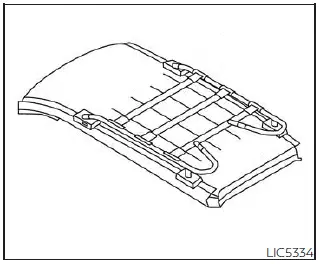
Roof rack (for Rock Creek)
WARNING
- Always install the crossbars onto the roof side rails before loading cargo of any kind. Loading cargo directly onto the roof rack or the vehicle's roof may cause vehicle damage.
- Do not remove load label on both sides of the front stanchions.
- Do not exceed maximum roof rack load capacity and always distribute the load uniformly. Heavy loading of the roof rack has the potential to affect the vehicle stability and handling during sudden or unusual handling maneuvers.
- Properly secure all cargo with ropes or straps to help prevent it from sliding or shifting. In a sudden stop or collision, unsecured cargo could cause personal injury.
- Drive extra carefully when the vehicle is loaded at or near the cargo carrying capacity, especially if the significant portion of that load is carried on the roof rack.
CAUTION
- Use care when placing or removing items from the roof rack. If you cannot comfortably lift the items onto the roof rack from the ground, use a ladder or a stool.
- Do not put load directly on the roof rack. To avoid damage to paint, the rubber seal and plastic supports, use soft padding or soft cloth on the crossbar before putting rough surface load like plywood, lumber, etc.
Genuine NISSAN accessory roof rack attachments may be available through a NISSAN dealer. It is recommended that you visit a NISSAN dealer for additional information.
The service load capacity for the roof side rails is 220 lbs. (100 kg.).
Be careful that your vehicle does not exceed the Gross Vehicle Weight Rating (GVWR) or its Gross Axle Weight Rating (GAWR front and rear).
For additional information regarding GVWR and GAWR, refer to:
- F.M.V.S.S. or C.V.M.S.S. certification label (located on the driver's door pillar).