Seat belts
For your safety, wear your seat belt on every journey. You must also comply with the local legislation of the country in which you are travelling.
For the rear seat belts to work effectively, make sure the rear seat is properly locked.
Refer to the 'Rear seat: features' section in chapter 3.
! Incorrectly adjusted or twisted seat belts may cause injury in an accident. Use one seat belt per person, child or adult. Even pregnant women must wear their seat belt. In this case, make sure the lap belt does not press too hard on the abdomen without creating additional slack.Before starting, first adjust your driving position, then, for all occupants, adjust the seat belt for the best protection.
Adjusting the driving position
- Sit fully back in your seat (after removing your coat, jacket, etc.). This is essential for correct back positioning;
- adjust the seat forward or back according to the pedals. Your seat should be moved back as far as possible while still allowing the clutch pedal to be fully depressed. The backrest should be adjusted so that your arms remain slightly bent;
- adjust your head restraint. For maximum safety, the distance between your head and the head restraint should be minimal;
- adjust the seat height. This adjustment optimises your view of the road;
- adjust the steering wheel position.
Seat belt fitting
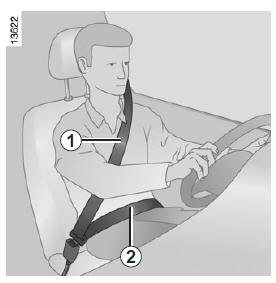
Seat belt adjustment
Sit firmly back against the backrest.
The shoulder belt 1 must be positioned as close as possible to the base of the neck, without resting on it.
The lap belt 2 must lie flat across the thighs and against the pelvis.
The belt must lie as directly as possible on the body. E.g.: avoid thick clothing, objects between the belt and the body...
Latching
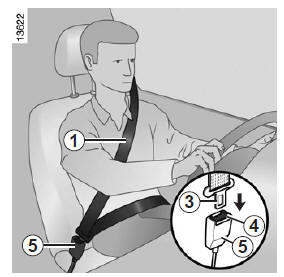
Locking
Pull the webbing out slowly and smoothly and make sure latch plate 3 clicks into buckle 5 (check the locking by pulling on latch plate 3).
If the belt locks, pull back firmly and then unroll it again.
If your seat belt is completely locked, pull the webbing firmly but slowly to extract about 3 cm.
Let it retract on its own, then unroll it again.
If the problem persists, consult a brand representative.
 Front seat belt not fastened warning light
It stays on when starting if your seat belt is not fastened. A warning chime sounds at low volume for 30 seconds, then at high volume for 90 seconds.
Unlatching
Press button 4; the belt is retracted by the reel. Guide it back. Note: an object placed on the front passenger seat may in some cases trigger the warning light.
Front seat belt height adjustment
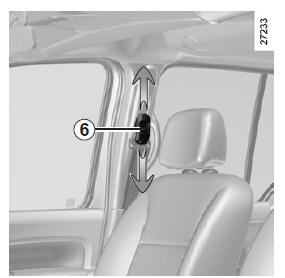
Front seat belt height adjustment
Use button 6 to adjust the belt height so that the shoulder strap 1 runs as described above:
- to lower the belt, press button 6 and lower the belt at the same time;
- to raise the belt, press button 6 then lift it to the desired height.
Once adjusted, make sure it is securely locked.
Rear centre seat belt
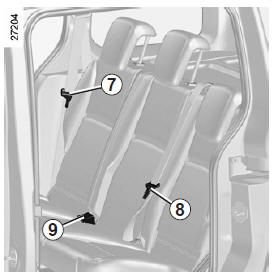
Rear centre seat belt
Slowly pull out the webbing until latch plate 8 clicks into buckle 9.
For the rear seat belts to work effectively, make sure the rear seat is properly locked.
Refer to the 'Rear seat: features' section in chapter 3.
Rear outer seat belts 7
Locking, unlocking and adjustment are carried out in the same way as for the front seat belts.
!- No modifications must be made to original restraint system components: belts, seats and their mountings. For special cases (e.g. fitting a child seat), consult a brand representative.
- Do not use devices that introduce slack into the webbing (examples: clothes peg, clip...): a seat belt worn loosely may cause injury in an accident.
- Never route the shoulder strap under your arm or behind your back.
- Do not use the same belt for more than one person and never secure a baby or child on your lap with your belt.
- The belt must not be twisted.
- After an accident, have the belts checked and replaced if necessary. Likewise, have your belt replaced if it shows signs of deterioration.
- Make sure the latch plate is inserted into the correct buckle.
- When refitting the rear seat, make sure the seat belt is repositioned so that it can be used correctly.
- Make sure no object is placed in the area of the belt buckle that could interfere with its correct operation.
- Make sure the buckle is correctly positioned (it must not be hidden, crushed, pressed... by people or objects).
Test yourself
A quick Renault Kangoo quiz: every answer comes with an explanation and a link to the manual page.