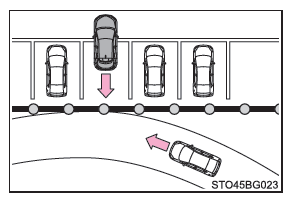
RCTA Function
RCTA is active when your vehicle is in reverse. The system can detect other vehicles approaching from the right or left behind your vehicle. It uses radar sensors to alert the driver to the presence of other vehicles by flashing the indicators built into the outside rear view mirrors and sounding a buzzer.
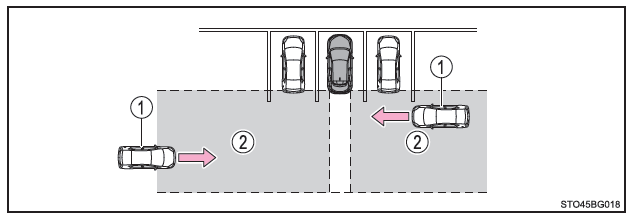
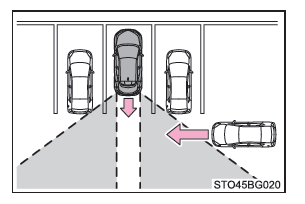
- Approaching vehicles
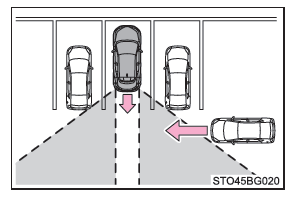
- Detection zones
■ Warnings regarding use of the function The driver is solely responsible for safe driving. Always drive carefully and keep watch on your surroundings.
The RCTA function is only an auxiliary function that alerts the driver that a vehicle is approaching from the right or left behind the vehicle.
Under certain conditions the RCTA function may not operate properly, so the driver must visually confirm safety themselves. Placing too much trust in this function may result in a serious or fatal accident.
RCTA function detection zones
The zones in which vehicles can be detected are shown below.
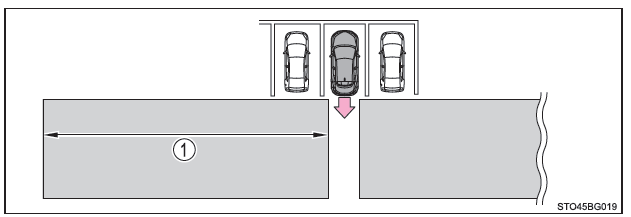
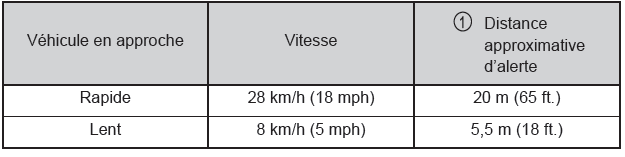
To give the driver more time to react, the buzzer may alert from farther away for vehicles traveling at higher speeds.
Example:
■ Conditions for RCTA function operation
The RCTA function operates when all of the following conditions are met:
- The BSM system is on.
- The shift position is in R.
- The vehicle is traveling at less than approximately 8 km/h.
- The speed of the approaching vehicle is approximately between 8 km/h and 28 km/h.
■ Conditions in which the RCTA function does not detect vehicles The RCTA function is not designed to detect the following types of vehicles and/or obstacles:
- Vehicles approaching directly from behind
- Vehicles backing into a parking space next to yours
- Vehicles that the sensors cannot detect because they are blocked by obstructions
- Guardrails, walls, road signs, parked vehicles and other stationary obstacles*
- Small motorcycles, bicycles, pedestrians, etc.*
- Vehicles moving away from your vehicle
- Vehicles approaching from parking spaces next to yours*
*: Depending on conditions, a vehicle and/or an obstacle may be detected.
■ Conditions in which the RCTA function may not operate properly
- The RCTA function may not detect vehicles properly in the following situations:
- When the sensor is misaligned after it or the area around it has been subjected to a strong impact
- When the sensor or the rear bumper area around it is covered with mud, snow, frost, an adhesive, etc.
- When driving on a road surface made wet by standing water in bad weather (e.g., heavy rain, snow or fog)
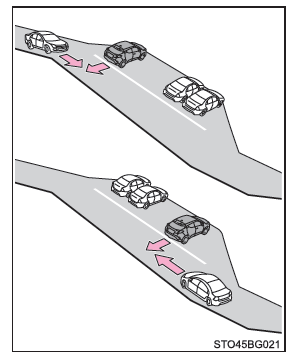
- When several vehicles are approaching while following closely behind each other
- When a vehicle approaches at high speed
- When backing up on a slope with a sudden change in elevation
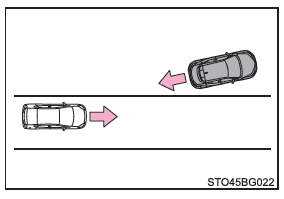
- Cases in which the RCTA function incorrectly detects a vehicle and/or an obstacle may increase in the following situations:
- When a vehicle passes by the side of your vehicle
- When the parking space faces a street and vehicles are traveling on it